

Table of Contents
- Why 15 lb Dumbbells Are Enough for Toned Arms
- Your 15 Minute 15 lb Dumbbell Arm Workout Routine
- How Many Reps for Muscle Toning With 15 lbs?
- Progressive Overload With Fixed Weights: The 4 Methods
- Form First: Common Mistakes That Sabotage Results
- Conclusion: Build Your At-Home Arm Routine Today
- Frequently Asked Questions
Last Updated: September 7, 2026
Why 15 lb Dumbbells Are Enough for Toned Arms
A dumbbell arm workout for muscle toning doesn't require heavy iron. For most women and many men, 15 lb dumbbells hit the sweet spot between challenging muscles and maintaining strict control. Toning is less about absolute weight and more about muscular endurance, time under tension, and total training volume.
Most people abandon home fitness because they think they need to "level up" equipment constantly. That instinct is wrong. Muscle definition comes from fatiguing the muscle through sufficient volume, not from lifting the heaviest weight possible for a few sloppy reps. With 15 lbs, you can perform the 15 to 20 repetition range that builds lean muscle and improves endurance without adding bulk.
This guide covers a complete 15 minute routine, ideal rep schemes for toning, and four proven methods to keep progressing with fixed weights.
Your 15 Minute 15 lb Dumbbell Arm Workout Routine
This routine uses a circuit format combining compound and isolation exercises to hit every major muscle group in the arms and shoulders. Complete the circuit twice, keeping rest periods to 45 seconds or less to maintain fatigue and elevate heart rate.
Warm-Up: Prepare Your Shoulders and Elbows
Before any dumbbell arm workout, spend 3 minutes warming up to avoid joint strain. Perform arm circles forward and backward for 30 seconds each, then do 10 slow push-ups on your knees to activate the chest and triceps.
Follow with band pull-aparts or doorway stretches to open the chest, then finish with 10 lightweight shoulder rolls. Your upper body should feel warm and mobile before picking up the 15 lb dumbbells.
The Main Circuit: Curls, Extensions, and Presses
Perform each exercise for 45 seconds, resting 15 seconds between moves. Complete the full circuit twice.
-
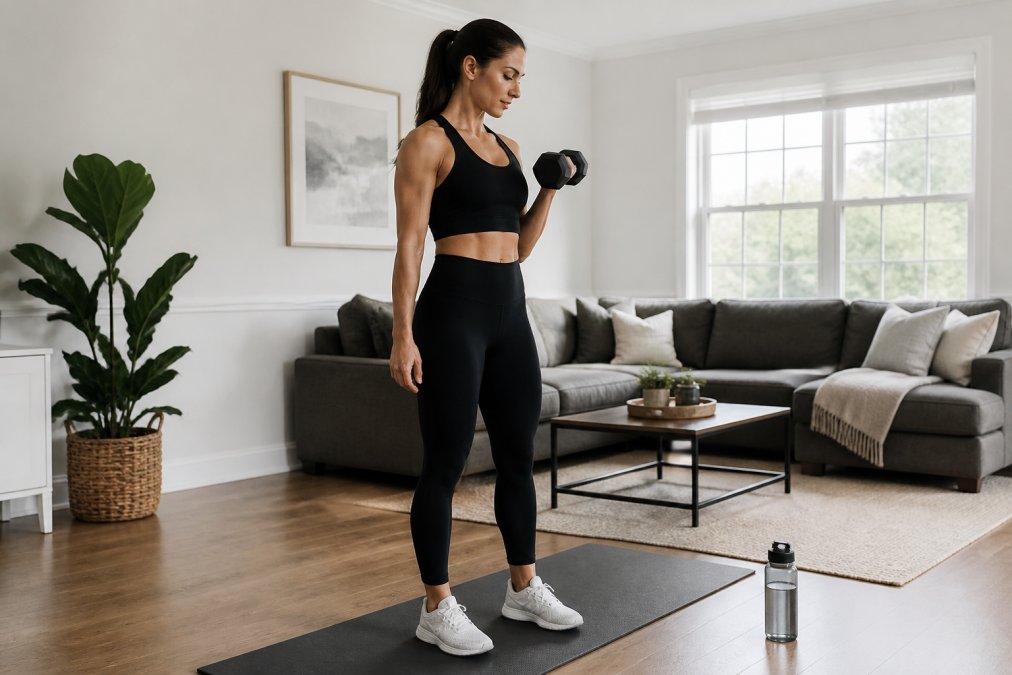
Bicep Curls: Stand tall with dumbbells at your sides, palms facing forward. Curl the weights up, squeezing the biceps at the top. Lower for a full 3-second eccentric phase. This is the foundation of any dumbbell arm workout for muscle toning.
-
Tricep Extensions: Hold one dumbbell with both hands overhead. Lower it behind your head by bending at the elbows, then press back up. Keep elbows pointed forward and close to your head to protect the shoulder joints.
-
Alternating Hammer Curls: Curl one arm at a time with a neutral grip (palms facing each other). This targets the brachialis muscle, adding thickness to the upper arm.
-
Overhead Press: Press both dumbbells from shoulder height to full arm extension overhead. This compound movement recruits the deltoids, triceps, and upper chest.
-
Lateral Raises: With a slight bend in the elbows, raise the dumbbells out to your sides until they reach shoulder height. Lower with control. This isolates the side deltoids, creating the appearance of broader, more defined shoulders.
-
Skull Crushers: Lie on a mat with a dumbbell in each hand, arms extended toward the ceiling. Bend at the elbows to lower the weights toward your ears, then extend back up.
How Many Reps for Muscle Toning With 15 lbs?
The term "toning" is a misnomer in exercise physiology. You cannot "tone" a muscle; you can only make it larger, stronger, or more enduring. When most people say they want toned arms, they mean muscles that appear defined and firm without looking bulky. With a fixed 15 lb weight, your pathway to that look is primarily through muscular endurance and time under tension.
The Science of the 12-20 Rep Range
Muscle fibers are recruited based on force required. With a 15 lb dumbbell, you are not generating enough force to recruit the largest, most growth-prone Type II fibers exclusively. Instead, you heavily engage Type I (slow-twitch) fibers, which respond to high-repetition work by becoming more efficient at utilizing oxygen and clearing metabolic byproducts. This adaptation increases muscle firmness at rest without a significant increase in size.
A 2021 NSCA position stand confirms that loads of 40-60% of your one-rep max, where a 15 lb dumbbell typically falls for most women and untrained men, are effective for muscular endurance when performed for 15-20 reps. The key is that the set must be taken to near-failure; stopping at 15 reps because you've counted does nothing.
Why 20 Reps Feels Different Than 8 Reps
At 8 reps with a heavier weight, the limiting factor is mechanical tension. At 20 reps with 15 lbs, it is metabolic stress, the buildup of lactate, hydrogen ions, and inorganic phosphate. This triggers the "burn" and post-workout pump, and signals the body to increase blood flow, improving the appearance of muscle definition over time.
The Tempo Protocol for Toning
If you simply rattle off 20 quick reps, you are doing cardio, not muscle work. Use a 3-1-1-1 cadence: 3 seconds lowering, 1-second pause at the bottom stretch, 1 second lifting, 1-second squeeze at the top. This puts each rep at 6 seconds, meaning 120 seconds of continuous tension per set, the stimulus that creates visible definition.
How to Know You Are in the Toning Zone
A practical test: if you can hold a conversation while performing the set, you are not working hard enough. If you cannot speak at all, you have drifted into a pure strength zone. The target is in between, able to say a few words but not full sentences, correlating with a perceived exertion of 7-8 on a 10-point scale.
The Role of Rest Intervals in Toning
Rest between sets is a training variable. For muscular endurance and definition, rest periods should be short, 30 to 45 seconds. This keeps blood pooled in the working muscles, maintaining the metabolic stress that drives adaptation. Resting 2 minutes clears out the metabolites and loses the signaling that promotes endurance-based changes.
A Note on "High Reps = Burn Fat"
A persistent myth is that high-rep work with light weights "burns fat" locally. Spot reduction is physiologically impossible; fat loss occurs systemically through a caloric deficit. The reason 15 lb dumbbell work helps with arm appearance is twofold: it builds the underlying muscle so it holds its shape, and the circuit-style format elevates heart rate. But you cannot out-tone a poor diet, the definition you see in the mirror is muscle development plus a low enough body fat percentage to reveal it.
Progressive Overload With Fixed Weights: The 4 Methods
Progressive overload with fixed weights is the biggest gap in most at-home arm workout routine guides. You cannot increase the load, so you must increase the difficulty of the movement itself. Here are the four methods that work.
1. Tempo Manipulation: Slow down the eccentric phase to 5 seconds per rep. This dramatically increases time under tension without changing the weight.
2. Reduced Rest Periods: Cut your rest between sets from 60 seconds down to 30, then 15. This keeps the muscle under continuous tension and spikes muscular endurance.
3. Increased Training Volume: Add one extra set per exercise each week. Going from 3 sets to 4 sets of bicep curls increases total training volume, which signals the muscle to adapt and grow more defined.
4. Isometric Holds: Pause at the hardest point of the movement for 3 to 5 seconds. Hold the curl at the top, or pause halfway through the overhead press. This builds strength at the sticking point and improves joint stability.
| Method | How to Apply | Best For |
|---|---|---|
| Tempo Manipulation | Lower weight over 5 seconds | Increasing time under tension |
| Reduced Rest Periods | Cut rest from 60s to 15s | Boosting muscular endurance |
| Increased Volume | Add 1 set per exercise weekly | Building lean muscle definition |
| Isometric Holds | Pause 3-5s at peak contraction | Improving joint stability |
Form First: Common Mistakes That Sabotage Results
Most form guides tell you to "keep your elbows tucked" and "don't swing." That advice is correct but incomplete. With a fixed 15 lb weight at high repetitions, you are not fighting a heavy load that could tear a muscle; you are fighting cumulative fatigue that degrades joint position over time. The specific mistakes below cause nagging wrist, elbow, and shoulder pain after weeks of consistent 15 lb training.
Mistake 1: Wrist Extension During Curls
Watch most people perform a bicep curl. As they fatigue, the wrist begins to extend backward (dorsiflexion), turning the movement into a partial wrist curl. This shifts tension away from the biceps and onto the forearm flexors, which are not designed to handle that load at high volume. Over weeks, this leads to medial epicondylitis (golfer's elbow).
The Fix: Maintain a neutral wrist position, imagine you are holding a can of soda and do not want to crush it. The knuckles should stay in line with the forearm throughout the entire range of motion. If you feel your wrist bending back on the final reps of a set, stop the set, those last three sloppy reps are doing more harm than good.
Mistake 2: Elbow Flare in Overhead Presses and Extensions
When performing overhead presses or tricep extensions, the elbows naturally want to drift outward as the deltoids fatigue. This places the shoulder joint in a position of impingement, the acromion process pinches the supraspinatus tendon and the subacromial bursa. High-repetition work in this compromised position is a direct pathway to shoulder impingement syndrome.
The Fix: For overhead press, the elbows should track at approximately 45 degrees from your torso, not 90 degrees. For tricep extensions, keep the elbows pointing forward and close to your head. A useful cue: "elbows to ears" for extensions, and "elbows in your peripheral vision" for presses. If you cannot maintain this position, reduce the range of motion rather than letting the elbows flare.
Mistake 3: The Half-Rep Trap at the Bottom of Skull Crushers
Skull crushers are the most technically demanding exercise in this routine. The danger zone is the bottom of the movement when the dumbbells are near your ears. As fatigue sets in, lifters tend to cut the range short at the top and rush through the bottom, so the long head of the triceps is never fully stretched and the elbow joint absorbs the load instead of the muscle.
The Fix: Lower the dumbbells to a position where your elbows are bent to at least 90 degrees. If you cannot safely control the weight that deep, use a single dumbbell held with both hands for more stability. At the top, do not lock out the elbows, stop just short of full extension to keep constant tension on the triceps and protect the elbow joint.
Mistake 4: Ignoring Scapular Position During Lateral Raises
Lateral raises are the exercise most likely to cause shoulder pain with a 15 lb weight. The reason is not the weight itself; it is the position of the scapula. When the shoulder blade is not properly set (depressed and slightly retracted), the humerus rubs against the acromion during the raise, causing impingement.
The Fix: Before each rep, perform a subtle "pack" of the shoulder, pull the shoulder blade down and back as if putting it in your back pocket. Maintain this position throughout the raise. You will find you cannot raise the dumbbells as high without the shoulder blade moving. That is fine, stop at the point where the scapula begins to wing, typically around 60-70 degrees of abduction, not the full 90 degrees.
Mistake 5: Breathing That Creates Intra-Abdominal Pressure Spikes
Holding your breath during heavy lifts is a valid technique (the Valsalva maneuver) for spinal stability. But with 15 lb dumbbells at 20 reps, breath-holding does not help, it spikes blood pressure and reduces oxygen delivery, causing premature fatigue and dizziness.
The Fix: Exhale on the concentric (lifting) phase, inhale on the eccentric (lowering) phase. For a 3-second lowering phase, that means a slow, controlled inhale. For the 1-second lift, a sharp exhale. This rhythmic breathing keeps your core lightly braced without the pressure spikes.
Conclusion: Build Your At-Home Arm Routine Today
Consistency beats intensity every time. A 15 minute routine performed three times per week will produce better results than a 60 minute session you skip because it feels like a chore. Start with the circuit above, focus on the 12 to 20 repetition range, and apply one progressive overload method each week.
The right equipment makes the difference between a workout you maintain and one you abandon. Bodyhackfitness offers a curated selection of premium training gear, including the Adjustable 15lbs Rubber Hex Dumbbell Set that protects your floors and fits comfortably in any living space. For those who want room to grow, the Premium Adjustable Dumbbell Set with 44lbs of cast iron plates lets you progress beyond 15 lbs when you're ready.


As the National Academy of Sports Medicine resources notes, consistency and proper form are the cornerstones of any effective strength program. Your arms will respond to the work you put in. Shop now and start building the toned, defined arms you want, right from your living room.
Frequently Asked Questions
Can you build muscle with 15 lb dumbbells?
Yes. Muscle growth depends on taking the muscle close to fatigue, not just on the absolute weight. With 15 lbs, you can build muscle by using higher rep ranges (12 to 20), slowing down the tempo, and shortening rest periods to keep the muscle under tension longer. Over time, progressive overload with fixed weights, such as adding more reps or sets, will continue to stimulate growth and definition.
How many reps should I do with a 15 pound dumbbell for toning?
For muscle toning, which really means building muscle definition while reducing body fat, aim for 12 to 15 reps per set. This repetition range builds muscular endurance and hypertrophy. If 15 reps feels easy on your last set, it's time to apply a progressive overload method, such as slowing down the eccentric phase or adding a fourth set, to keep challenging your muscles.
Is 15 lbs too heavy for arm toning exercises?
15 lbs is not too heavy if you can complete each rep with strict form. For beginners, it may be challenging, so start with a lighter weight like 8 lbs if needed. For most people, 15 lbs is an effective weight to stimulate muscle growth in the biceps, triceps, and shoulders. The key is to feel fatigue in the target muscle by the final reps of each set.
How often should I do this 15 lb dumbbell arm workout?
Train your arms two to three times per week with at least one rest day between sessions. This frequency allows adequate recovery time, which is essential for muscle repair and growth. Since this is a 15-minute high-efficiency routine, you can pair it with other lower-body or cardio workouts on alternate days. Listen to your body and add an extra rest day if you experience joint pain.