

Table of Contents
- Why 15 lb Dumbbells Work for HIIT
- The Science: Muscle Growth and Fat Loss Benefits
- Structuring a Dumbbell HIIT Workout Routine
- Optimal HIIT Workout Duration for Fat Loss
- How to Increase Intensity with Light Weights
- Progressive Overload and Recovery Protocols
- Conclusion: Start Your HIIT Journey Today
- Frequently Asked Questions
Last Updated: September 5, 2026
Why 15 lb Dumbbells Work for HIIT
The benefits of using 15 lb dumbbells for high intensity interval training extend far beyond simple muscle toning; this weight range is a versatile tool for elevating your heart rate and building functional strength simultaneously. At Bodyhackfitness, we see fixed-weight training as a cornerstone of efficient home workouts, and 15 lb dumbbells sit in a sweet spot. They are light enough to keep moving through high-rep circuits that spike your cardiovascular capacity, yet heavy enough to create meaningful time under tension for your upper body and core.

Most people assume heavier is always better for strength, but that misses the point of metabolic conditioning. The goal of HIIT is sustained intensity and heart rate elevation, not maximal load. With 15 lb dumbbells, you can perform compound movements like thrusters, renegade rows, and clean-and-presses without sacrificing form, maintaining a demanding work-to-rest ratio that drives caloric expenditure and post-exercise oxygen consumption.
According to guidance from the American Council on Exercise on metabolic training, metabolic conditioning circuits with moderate loads are an effective method for improving both aerobic and anaerobic capacity in a single session. The real benefits of using 15 lb dumbbells for high intensity interval training emerge when you focus on workout volume and intensity modulation rather than chasing a heavier plate.
The Science: Muscle Growth and Fat Loss Benefits
The physiological response to light-weight, high-repetition HIIT differs from traditional strength training, but the outcomes are complementary. While heavy lifting primarily targets hypertrophy, or an increase in muscle fiber size, using 15 lb dumbbells for high intensity interval training emphasizes muscular endurance and lean muscle mass. You build the ability to sustain repeated efforts, which translates directly to functional strength used in daily life.
For fat loss, the mechanism is twofold. First, the intense intervals elevate your metabolic rate during the session. Second, the recovery phase demands energy, contributing to post-exercise oxygen consumption, sometimes called the afterburn effect. This means your body continues burning calories while you rest, which is a distinct advantage of HIIT over steady-state cardio. Research compiled by the American College of Sports Medicine on high-intensity interval training highlights that interval training can lead to significant improvements in cardiorespiratory fitness in a shorter time commitment compared to moderate-intensity continuous exercise.
Where 15 lb Loads Deliver vs. Where They Fall Short
A 15 lb dumbbell is not a one-size-fits-all tool. It excels for some movements and underdelivers for others, and knowing the difference separates an effective session from a wasted one.
Best targets for 15 lb loads:
- Deltoids (shoulders): Lateral raises, front raises, and overhead presses at 15 lbs create significant tension for the relatively small deltoid muscles. High-rep pressing with controlled tempo can fatigue these muscles effectively.
- Triceps: Overhead extensions and kickbacks at this weight allow for full range of motion with constant tension. The triceps are smaller muscles that respond well to moderate loads with high repetition.
- Core stabilizers: Renegade rows, plank rows, and Turkish get-up progressions force your core to resist rotation and maintain spinal alignment. The instability created by holding a weight in one hand while stabilizing with the other is a unique stimulus that heavier loads cannot replicate safely at high speed.
- Upper back and rear deltoids: Bent-over rows and reverse flyes at 15 lbs are effective for building postural endurance, especially when performed with a slow eccentric phase.
Where 15 lb loads underdeliver:
- Quadriceps and glutes: Goblet squats and lunges with 15 lbs will spike your heart rate, but they will not stimulate significant strength gains in your lower body. Your legs are accustomed to supporting your full body weight plus more. For lower-body strength, you need heavier resistance or single-leg variations that increase the relative load.
- Latissimus dorsi: Pulling movements like dumbbell rows at 15 lbs are too light to create meaningful tension for this large back muscle. You will build endurance but not size or strength here.
This anatomical awareness lets you pair 15 lb-appropriate movements (shoulder presses, rows, core work) with bodyweight lower-body exercises (squats, lunges, step-ups) to create a balanced, demanding session that challenges your entire body without pretending a light dumbbell replaces a barbell.
The key to unlocking these benefits with a fixed weight is fatigue management. You must push your muscles to near-failure on the final repetitions of each set to stimulate adaptation. If the movement becomes too easy, you increase the speed of the concentric phase or shorten rest periods to maintain the intensity.
Structuring a Dumbbell HIIT Workout Routine
A successful dumbbell HIIT routine hinges on exercise selection and pacing, not dumbbell weight. The structure should force your muscles to work continuously while your cardiovascular system fights to keep up. A full-body circuit pairing upper-body pushes with lower-body squats and core stabilization is the most efficient use of your time.
A common mistake is resting too long between exercises. For a metabolic effect, keep rest periods to 15-30 seconds between movements to maintain intensity and prevent your anaerobic threshold from dropping.
Sample 20-Minute Full-Body Circuit
Perform each exercise for 40 seconds of work followed by 20 seconds of rest. Complete the circuit four times through for a total of 20 minutes. This format prioritizes a high work-to-rest ratio and keeps total workout volume manageable.
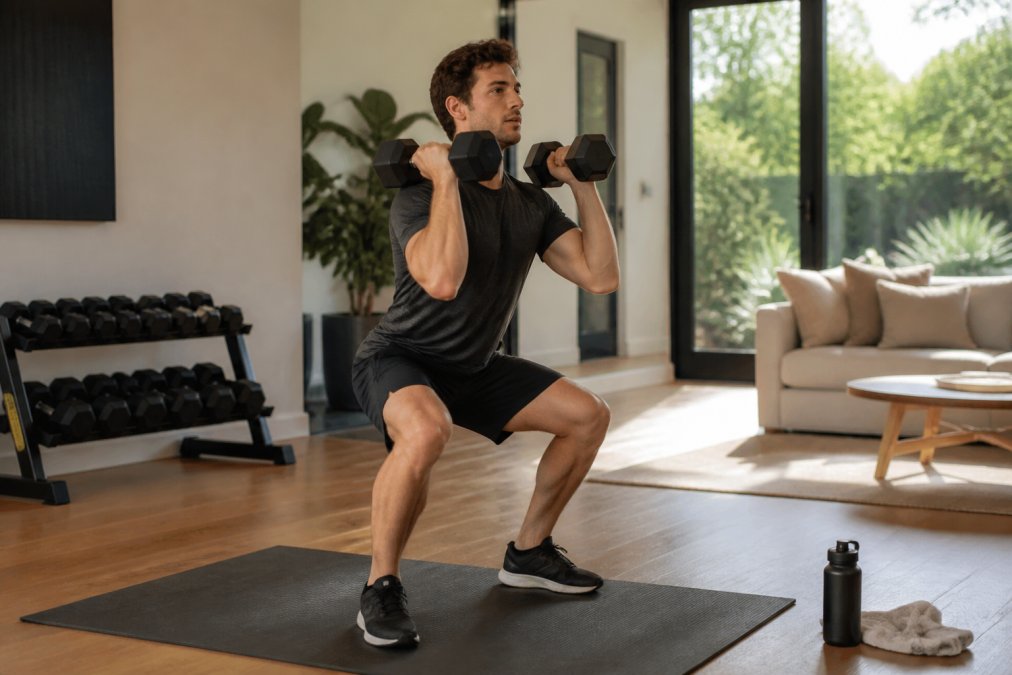
- Dumbbell Thrusters: Hold the dumbbells at your shoulders. Squat down, then drive up through your heels to press the weights overhead.
- Renegade Rows: In a high plank position with a dumbbell in each hand, row one weight toward your hip while stabilizing your core.
- Goblet Squats: Hold one dumbbell vertically against your chest and perform a deep squat, keeping your chest proud and elbows inside your knees.
- Dumbbell Snatches: With one dumbbell on the floor, explosively drive your hips to lift it overhead in one motion. This builds power and functional strength.
- Plank with Row: Similar to the renegade row, but hold a static plank for the entire 40 seconds while performing rapid, short-range rows.
This circuit hits all major muscle groups and forces your body to adapt to changing demands. If you are new to this, start with just two rounds and focus on mastering the range of motion before increasing your workout volume.
Optimal HIIT Workout Duration for Fat Loss
When it comes to HIIT duration for fat loss, more is not better. The intensity dictates keeping total time between 15 and 25 minutes. Beyond this window, form degrades and injury risk rises without proportional gains in caloric expenditure.
A 20-minute session is the gold standard for fat loss with light weights. This duration is long enough to accumulate significant work and spike your metabolic rate, but short enough to maintain high power output throughout. If you are training at the correct intensity, you should be unable to hold a conversation by the end of your work intervals. This is a practical indicator that you have crossed your anaerobic threshold.
For a home workout routine, this short time commitment eliminates the barrier of needing an hour or more to train. You can fit an effective session into a lunch break or before work, and consistency more than any single workout drives body composition changes.
How to Increase Intensity with Light Weights
Progressive overload is the principle of gradually increasing demands on your body. With fixed-weight dumbbells, you cannot add more plates, so you must manipulate other variables to continue progressing. This is where many trainees hit a plateau, but it is avoidable with a few strategic adjustments.
One effective method is to increase time under tension. Slow down the eccentric, or lowering, phase of each rep to a three-second count. This makes the muscle work harder without changing the weight. Another strategy is to reduce the rest time between exercises, effectively increasing the density of the workout. This shifts the focus toward cardiovascular capacity and metabolic conditioning.
You can also add more repetitions or sets to your circuit. If you completed four rounds last week, aim for five this week. Finally, consider pausing at the hardest point of the movement. A two-second pause at the bottom of a goblet squat eliminates momentum and forces your muscles to work purely. These methods ensure that your 15 lb dumbbells remain challenging for months. If you are looking to expand your setup, a premium [adjustable dumbbell set(https://bodyhackfitness1.store/products/premium-adjustable-dumbbell-set-44lbs-cast-iron-barbell-kit-for-home-gym-office-workouts) | bodyhackfitness1.store] allows you to transition to heavier loads when you are ready to shift focus toward pure hypertrophy.

Progressive Overload and Recovery Protocols
The benefits of using 15 lb dumbbells for high intensity interval training are only realized if you recover properly. HIIT is demanding on your central nervous system. Training at high intensity daily without adequate rest leads to burnout and diminished performance, not gains.
Why HIIT Recovery Differs from Steady-State Recovery
HIIT places unique physiological stress on your body that requires a different recovery approach than steady-state cardio or moderate weightlifting. During HIIT, you repeatedly push your anaerobic energy systems to their limit, depleting phosphocreatine stores, accumulating metabolic byproducts, and creating microtrauma in muscle fibers faster than lower-intensity work.
This means your recovery protocol must address three distinct areas:
1. Central nervous system fatigue. HIIT sessions tax your nervous system's ability to recruit fast-twitch muscle fibers rapidly. This is why you may feel "flat" or sluggish 24-48 hours after a hard session even if your muscles are not sore. Most practitioners find that 48 hours between intense HIIT sessions is the minimum for nervous system recovery, and 72 hours is often better for those over 40 or new to this training style.
2. Glycogen replenishment. Interval training depletes muscle glycogen faster than steady-state work because of the explosive nature of the efforts. Your post-workout window matters. Consuming 30-50 grams of carbohydrates with 20-30 grams of protein within 60 minutes of finishing helps restore glycogen and initiates muscle repair. This is not optional if you train HIIT more than three times per week.
3. Connective tissue stress. Explosive movements like snatches and thrusters place rapid loading on tendons and ligaments. Unlike muscle tissue, which can adapt within weeks, connective tissue requires months to strengthen. This is why gradual progression matters more with HIIT than with steady-state cardio.
Practical Recovery Protocol for HIIT Trainees
Schedule at least one full rest day between intense HIIT sessions. On active recovery days, focus on light mobility work or a brisk walk. Your muscles rebuild during the recovery phase, not during the workout itself. Ignoring this leads to a plateau and can increase the risk of overuse injuries.
Immediate post-session (0-30 minutes):
- Walk for 5 minutes to gradually lower your heart rate rather than stopping abruptly
- Hydrate with 16-24 ounces of water with electrolytes if you sweat heavily
- Consume a carbohydrate-protein snack within the 60-minute window
Same-day recovery (2-6 hours later):
- Perform 10 minutes of gentle stretching focusing on the hips, shoulders, and thoracic spine
- Avoid prolonged sitting; light movement promotes blood flow and reduces stiffness
Next-day recovery:
- If you are sore, perform 15-20 minutes of low-intensity work like walking or cycling at a conversational pace
- Foam rolling for 5-10 minutes on the quadriceps, glutes, and upper back can reduce perceived soreness
- Prioritize protein intake at each meal (roughly 25-30 grams per meal for most adults)
Nutrition and sleep are the pillars of recovery. Ensure you are consuming enough protein to support lean muscle mass repair. Aim for seven to nine hours of sleep to allow your hormonal systems to reset. When you return to the gym, you should feel refreshed and ready to attack the circuit with the intensity required to drive adaptation.
Conclusion: Start Your HIIT Journey Today
Starting a new fitness routine is challenging, but the equipment required does not have to be complicated or expensive. A single pair of quality dumbbells opens the door to endless workout variations that improve cardiovascular health and build strength simultaneously.
At Bodyhackfitness, we focus on providing the tools and guidance to support your consistent progress. Our Adjustable 15lbs Rubber Hex Dumbbell Set is designed for durability and floor protection, making it a smart addition to any home gym. We also offer digital fitness programs that emphasize proper exercise form and structured progression, helping you stay consistent and see real results.
Frequently Asked Questions
Can you build muscle with 15 lb dumbbells?
Yes, 15 lb dumbbells can build muscle, especially for beginners or when training for muscular endurance. The key is manipulating time under tension, slowing down your reps, and using high-volume sets. For example, performing 15-20 slow reps of bicep curls or overhead presses creates enough stimulus for growth in smaller muscle groups when combined with a consistent HIIT schedule.
Is HIIT with dumbbells effective for fat loss?
HIIT with 15 lb dumbbells is highly effective for fat loss because it combines cardiovascular stress with resistance training. This method elevates your heart rate rapidly while forcing muscles to work, leading to a high caloric expenditure during the session and a prolonged post-exercise oxygen consumption effect. This means your metabolic rate stays elevated for hours after you finish training.
How many reps should I do with 15 lb dumbbells for HIIT?
For HIIT, aim for higher rep ranges of 15-20 reps per exercise. The goal is not maximum strength but metabolic conditioning. You should select a rep count that allows you to maintain good exercise form while pushing your heart rate up. If you can easily exceed 20 reps, try slowing down the tempo or reducing rest time to increase the challenge.
How do I increase intensity with light weights?
To increase intensity with 15 lb dumbbells, focus on reducing rest periods between sets, combining exercises into supersets, or adding explosive movements like jump squats. You can also increase the time under tension by pausing at the top of a movement or lowering the weight slowly over a 4-second count. These methods increase cardiovascular demand without needing heavier weights.
Getting started with the benefits of using 15 lb dumbbells for high intensity interval training is simple: commit to a 20-minute session, focus on your form, and trust the process. Consistency with a solid routine will always outperform sporadic heavy lifting. Get started with Bodyhackfitness and build a training environment that supports your goals today.
This article was written using GrandRanker