

Table of Contents
- Why Adding 15 lb Dumbbells to Yoga Changes Everything
- Weighted Yoga Benefits: Strength, Stability, and Joint Health
- Best Yoga Poses for Dumbbells: A Practical Guide
- Weighted Yoga Safety Tips: Protecting Joints and Preventing Injury
- Choosing the Right Weight: Why 15 lb Dumbbells Work for Most People
- Equipment That Makes Weighted Yoga Safer and More Comfortable
- Frequently Asked Questions
Last Updated: September 11, 2026
Why Adding 15 lb Dumbbells to Yoga Changes Everything
Adding 15 lb dumbbells to a yoga routine turns a flexibility practice into a genuine strength workout. People who plateau with bodyweight flows often progress once they add real resistance. But 15 lb is roughly three times a standard 5 lb yoga weight, so your joints, alignment, and tempo all need to change.
Weighted yoga means performing traditional asana while holding or pressing external resistance to build functional strength alongside mobility, prioritizing time under tension, joint stability, and controlled eccentric movement over sheer range of motion.
That distinction matters because most guides treat 15 lb like a slightly heavier version of a 5 lb weight. It is not. The American Council on Exercise resistance training guidelines treat this load as intermediate resistance, not a prop. Below, we break down exactly how to build the routine, which poses hold up under load, and how to protect your joints while you do it.
Weighted Yoga Benefits: Strength, Stability, and Joint Health
Weighted yoga trains the muscles yoga usually leaves alone. A bodyweight flow builds endurance and range of motion but rarely creates enough mechanical tension to drive hypertrophy. Adding 15 lb dumbbells fills that gap.
Here is what changes when you load the practice:
- Stabilizing muscles engage harder. Holding weight overhead in Warrior II forces your rotator cuff and scapular stabilizers to work continuously.
- Joint stability improves through controlled isometric contraction at end-range positions.
- Bone density responds to load. According to the National Institute of Arthritis and Musculoskeletal and Skin Diseases, weight-bearing and resistance exercise both support bone health.
- Strength-to-weight ratio climbs, which translates directly to better balance and lower injury risk in daily life.
The trade-off is recovery: loaded asana creates more fatigue than a bodyweight flow, so most people do well with three weighted sessions and two lighter flows per week.
Best Yoga Poses for Dumbbells: A Practical Guide
The best yoga poses for dumbbells are held, grounded postures where you control the load without rushing. At 15 lb, any posture that puts the load far from your center of mass or bends your wrist under tension becomes a liability. These four carry most of the value, each with a setup change that makes the heavier load workable.
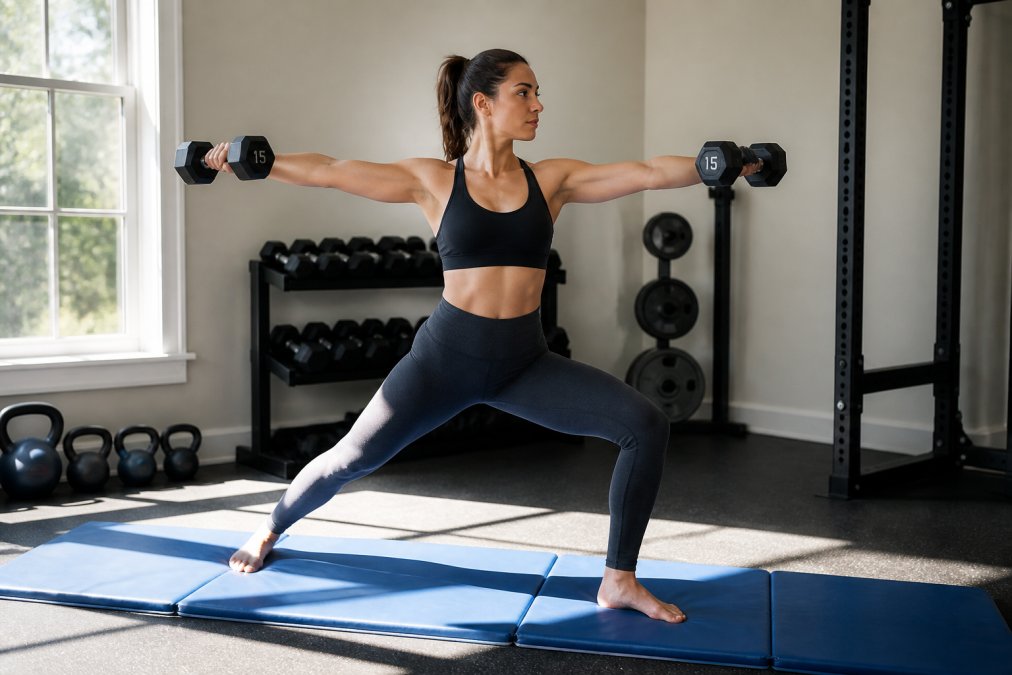
Warrior II with Overhead Press
Warrior II with an overhead press builds shoulder strength and lower body power together. Set your stance wide, front knee over the ankle, then press both dumbbells overhead as you exhale and lower to shoulder height as you inhale. Keep your core engaged so your ribcage does not flare.
At 15 lb, the press is the hard part, not the hold. Use a neutral grip (palms facing each other) at the bottom, letting the dumbbells turn slightly outward only as they pass your forehead, this keeps the shoulder safer under heavy load. Shorten the press range if your shoulders round forward at the top; stopping just short of full lockout keeps tension on the deltoids and rotator cuff instead of the joint capsule.
Start with 8 to 10 presses per side, then hold the final overhead position for 20 seconds. If your arms start shaking before rep eight, the load is ahead of your stabilizers, not your strength.
Chair Pose with Bicep Curls
Chair pose with bicep curls is the best lower body burner in a weighted practice. Sink into Chair, weight in your heels, then curl both dumbbells to your shoulders with elbows pinned to your ribs. The isometric quad hold plus the curl compounds fatigue. Ten to twelve reps is plenty at 15 lb.
Grip is where most people lose this pose. A 15 lb hex dumbbell has a thicker handle than a 5 lb yoga weight, and a wrist collapsing backward on the curl loads the wrist extensors instead of the biceps. Keep the wrist stacked over the forearm and let the dumbbell head rest lightly against your shoulder at the top. If grip fatigues before biceps, add wrist curls at a lighter weight rather than pushing through.
High Lunge with Single-Arm Row
High lunge with a single-arm row trains the posterior chain and anti-rotation core together, a combination a bodyweight flow cannot replicate. Step into a high lunge with the back knee lifted, hinge slightly forward over the front thigh, and row one dumbbell toward your hip with the elbow close to your ribs. The other arm stays free for balance.
This is where 15 lb feels most different from 5 lb. A single-arm row at 15 lb creates a rotational pull, and if your core does not resist it, your low back takes the load. Brace as if about to be poked in the stomach and keep the hips square to the mat. Eight reps per side is a good start.
Bridge Pose with Chest Press
Bridge pose with a chest press puts the load directly over the ribcage, the safest position for heavy dumbbells while supine. Lie on your back, press up into Bridge, then press both dumbbells straight up from the chest, lower to a hover just above the ribs, and repeat. The glute hold is isometric and the press dynamic, so one setup gives two training effects.
Keep the wrists neutral and the elbows at roughly 45 degrees from your ribs at the bottom of the press. Flaring the elbows to 90 degrees is the most common form error here and shifts stress onto the front of the shoulder. Ten reps is a solid set at 15 lb.
Poses to Skip at 15 lb
Some traditional poses do not survive a 15 lb load. Skip side plank with a dumbbell raised overhead, twisted chair or twisted lunge variations with weight in hand, and reverse tabletop with a press. Each puts the load at the end of a long lever or adds rotation to a loaded spine, and risk climbs faster than benefit at this weight.
Weighted Yoga Safety Tips: Protecting Joints and Preventing Injury
Weighted yoga safety tips come down to load management and alignment, not caution for its own sake. The American Academy of Orthopaedic Surgeons injury prevention guidance stresses gradual progression and controlled technique for any resistance work, and 15 lb dumbbells qualify as real resistance. What most guides skip is that the joints at risk change when the load triples. At 5 lb, the wrist and shoulder tolerate a lot of sloppiness. At 15 lb, they do not.
Wrist Loading: The First Joint to Complain
The wrist is the smallest joint in the chain and the first to feel a 15 lb load. Two habits protect it. Keep the wrist stacked directly over the forearm in every press and curl, a wrist bending backward under 15 lb is loaded in its least stable position. And switch to a neutral grip (palms facing each other) whenever the dumbbell is overhead or in front of the body; it keeps the radius and ulna parallel and takes strain off the wrist extensors.
If your wrists ache after a session, the fix is usually grip, not weight. A thicker-handled dumbbell makes the grip harder to hold, which is one reason a rubber hex dumbbell with a knurled handle is easier on the wrist than a smooth chrome one at the same weight.
Shoulder Safety: End-Range Is Where Injuries Live
The shoulder is the joint most likely to be injured in weighted yoga, almost always from end-range loading. Pressing a 15 lb dumbbell to full lockout with the shoulder shrugged toward the ear loads the joint capsule and acromioclavicular joint rather than the deltoid. Two rules prevent this: keep the shoulder blade pulled down and back before every press, and stop just short of lockout if you feel the shoulder shrug.
Overhead work also requires adequate shoulder flexion. Test it: stand with your back against a wall, arms at your sides, and raise both arms overhead without letting your low back arch off the wall. If you cannot, start with the Bridge chest press and single-arm row instead of overhead 15 lb presses.
Spine Loading: No Rotation Under Load
The spine is designed to rotate, but not while holding 15 lb at the end of a lever. Skip forward folds and twists with dumbbells in hand, and skip any pose that combines a twist with a side bend. The rule is simple: if the load is in your hands, your spine stays neutral. If you want to train rotation, do it unloaded.
Tempo and Hold Time
Rushed reps with heavy load are where tweaks happen. At 15 lb, a controlled three-second lowering phase is not optional; it is what makes the load safe. Shorten holds to 20 to 30 seconds per loaded pose, a two-minute grind degrades alignment long before it builds strength.
Warm-Up and Progression
Warm up unloaded first: five minutes of dynamic stretching and sun salutations raises tissue temperature and primes the stabilizers that will hold the load. Then progress the load, not the volume. Add reps at 15 lb until you can complete 12 clean reps in every pose, then consider 20 lb. Adding a fourth set before you own three clean sets is the most common progression mistake.
Injury prevention here is about tempo and joint position, not avoiding weight. Loaded asana done with control is safer than bodyweight flows done with momentum, because the load forces you to slow down.
Choosing the Right Weight: Why 15 lb Dumbbells Work for Most People
Fifteen pounds is the sweet spot for most intermediate practitioners: heavy enough to drive adaptation, light enough to control through a full range of motion. Lighter weights stop challenging you once bodyweight strength improves; heavier loads make held poses unstable and push you out of alignment.
A simple progression keeps the load honest:
| Level | Weight | Reps per Pose | Sessions per Week |
|---|---|---|---|
| Beginner | 5-8 lb | 8 | 2 |
| Intermediate | 10-15 lb | 10-12 | 3 |
| Advanced | 15-20 lb | 12-15 | 3-4 |
If you can complete every rep with clean form and no shaking, move up. If your last two reps look different from your first two, stay put.
The Bodyhackfitness Adjustable 15lbs Rubber Hex Dumbbell Set is built for exactly this kind of work, with a rubber-wrapped head that protects your floors and a set of two so both sides load evenly.
Equipment That Makes Weighted Yoga Safer and More Comfortable
The right equipment removes most of the friction from a weighted practice. A [thick folding fitness yoga mat(https://bodyhackfitness1.store/products/thick-folding-fitness-yoga-mat-for-home-gym) | bodyhackfitness1.store] gives you the joint and spine support that a thin standard mat cannot when you are holding load in a lunge or Chair. Its density keeps your knees and wrists cushioned through longer holds.

Two smaller additions help more than people expect. A yoga knee pad takes pressure off the kneecap in any kneeling posture, and an adjustable yoga strap lets you open tight shoulders before you press weight overhead. Warm, mobile shoulders are the difference between a clean overhead press and a strained one.
None of this is optional gear for beginners. It is what lets you train consistently without the nagging joint discomfort that ends most home routines early.
Frequently Asked Questions
Can you build muscle with 15 lb dumbbells?
Yes, 15 lb dumbbells can build muscle when used with progressive overload and enough volume. For upper body movements like bicep curls, shoulder presses, and rows, 15 lb provides meaningful resistance for many beginners and intermediate lifters. The key is gradually increasing reps, sets, or time under tension. For lower body exercises, 15 lb may be too light to drive hypertrophy, so combine dumbbells with bodyweight movements like squats and lunges.
Are 15 lb dumbbells too heavy for yoga?
For most healthy adults with some strength training experience, 15 lb dumbbells are manageable for yoga-inspired movements. However, if you are new to resistance training or have shoulder, wrist, or lower back concerns, start with 5 to 8 lb and progress. The goal is controlled movement, not maximum load. If you cannot complete a pose with proper alignment and core engagement, the weight is too heavy for that pose.
How do you modify yoga poses for weighted training?
Modify poses by shortening your range of motion, widening your stance for stability, and keeping dumbbells close to your center of mass. For example, in Chair Pose, hold dumbbells at your sides rather than overhead to reduce shoulder strain. In Warrior II, keep the front knee bent and avoid locking it. Always warm up with dynamic stretching first, and use a yoga strap or knee pad to support joints during transitions.
What are the benefits of adding weights to a yoga routine?
Adding weights to yoga increases muscle endurance, bone density, and functional strength while preserving flexibility. Weighted yoga benefits include improved joint stability, better posture, and higher calorie burn compared to bodyweight-only flows. Research shows that combining resistance training with yoga can enhance strength-to-weight ratio and reduce injury risk in daily activities. It also keeps workouts challenging as your body adapts to bodyweight training.
Building a weighted practice takes patience, and the biggest obstacle is consistency, not knowledge. Bodyhackfitness exists to make that easier, with curated dumbbells, supportive mats, and recovery gear that let you train at home without compromising on quality. Start with the Bodyhackfitness Adjustable 15lbs Rubber Hex Dumbbell Set, pair it with a thick folding mat, and add one loaded pose at a time. Shop now and build a routine you will actually keep.