

Table of Contents
- The Short Answer: What 15 lb Dumbbells Can and Cannot Do
- Progressive Overload with Light Dumbbells: The 3 Variables That Matter
- Time Under Tension Techniques: Slow Down to Speed Up Growth
- The Best Dumbbell Muscle Building Routine with 15 lb Weights
- The Plateau Threshold: When 15 lbs Stops Being Enough
- Common Mistakes That Stall Muscle Growth with Light Weights
- Final Verdict: Should You Start with 15 lb Dumbbells?
- Frequently Asked Questions
Last Updated: September 9, 2026
The Short Answer: What 15 lb Dumbbells Can and Cannot Do
Yes, 15 lb dumbbells are enough to build muscle at home, but only if you train with the right variables. The question "are 15 lb dumbbells enough for building muscle at home" has a more nuanced answer than a simple yes or no. For upper body movements like curls, lateral raises, and overhead presses, a pair of 15 lb dumbbells can stimulate significant growth, especially for beginners. For compound lower-body exercises like squats and Romanian deadlifts, the weight will feel light quickly, and you will need to rely on tempo, volume, and technique to keep making progress.
The science of muscle growth, or hypertrophy, hinges on mechanical tension, metabolic stress, and muscle damage. A light weight creates all three when you push the working muscle close to fatigue. The key distinction is that muscle fibers do not know how heavy a weight is; they only know how much tension they are under and for how long. Muscle fibers do not know how heavy a weight is; they only know how much tension they are under and for how long.
What these weights cannot do is build maximal strength in your largest muscle groups once you pass the beginner phase. Your legs and back will adapt to 15 lbs per hand within a few months. The solution is not necessarily buying heavier equipment, but rather manipulating how you perform each rep.
Progressive Overload with Light Dumbbells: The 3 Variables That Matter
Progressive overload is the gradual increase of stress placed on the body during training. With heavy weights, you simply add more pounds each week. With fixed 15 lb dumbbells, you must manipulate three other variables to create that same stress: volume, tempo, and rest. American Council on Exercise's guide to progressive overload confirms that increasing repetitions, slowing down movement speed, and shortening rest periods are all legitimate ways to apply progressive overload without changing the load.
Volume refers to the total number of hard sets and reps. A common approach is to push each set close to technical failure, where you cannot complete another clean rep. This ensures that the muscle fibers are being recruited at a high threshold, which is what signals growth.
Repetition Range: Higher Reps, Shorter Rest
Forget the old rule that only 6-12 reps build muscle. With light dumbbells, you should target 15-30 reps per set. This higher repetition range creates significant metabolic stress, the burning sensation that drives muscle adaptation. Keep rest periods short, around 45-60 seconds, to maintain tension on the muscle throughout the entire session.
Micro-Loading and Accessory Equipment
Micro-loading is the practice of adding small increments of weight, often as little as one pound at a time. Since you cannot change 15 lb dumbbells into 16 lb ones easily, you can use accessory equipment to increase difficulty. A weighted vest adds resistance to bodyweight exercises like push-ups and lunges. Resistance bands clipped to the dumbbell can add variable tension at the top of a movement. These tools extend the lifespan of your 15 lb set by several months.
Time Under Tension Techniques: Slow Down to Speed Up Growth
Time under tension is the total amount of time a muscle is actively contracting during a set. Slowing down your reps dramatically increases this metric, which is a powerful stimulus for muscle fiber recruitment. A controlled rep with a 15 lb dumbbell is far more effective than a rushed rep with a heavier one.
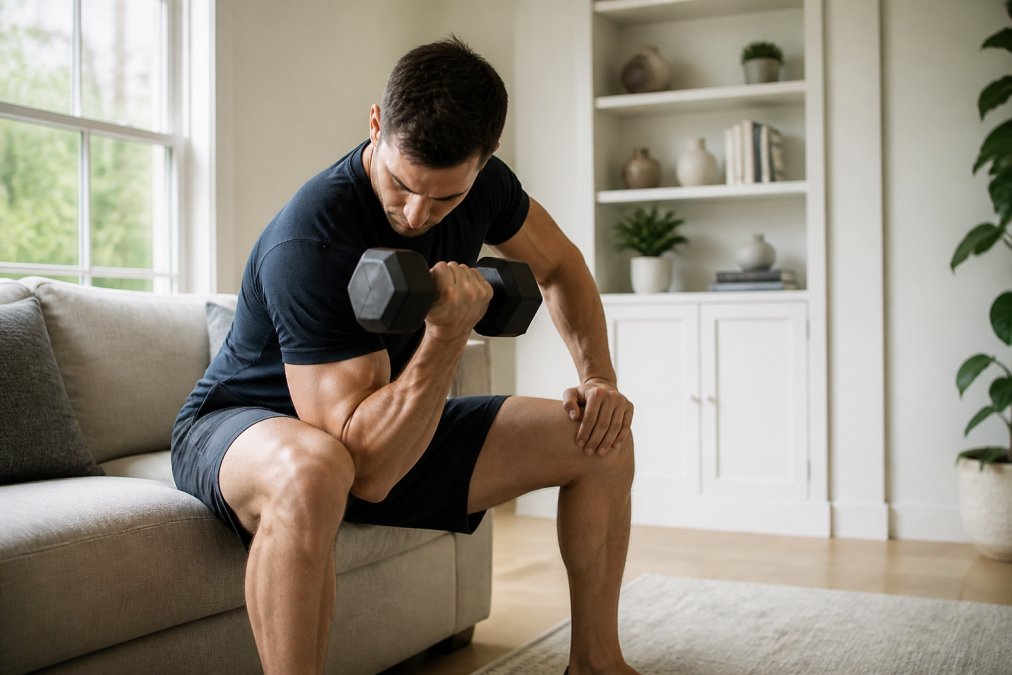
The most effective tempo for light weights is a 3-1-3 cadence. This means taking three seconds to lower the weight (the eccentric phase), a one-second pause at the bottom, and three seconds to lift it (the concentric phase). This single change can make a 15 lb curl feel as challenging as a 25 lb one done sloppily. The eccentric phase, in particular, is where most muscle damage occurs, so resist the urge to let gravity do the work.
The Best Dumbbell Muscle Building Routine with 15 lb Weights
A structured dumbbell muscle building routine with 15 lb weights focuses on full-body circuits performed three times per week. This training frequency allows for adequate recovery time while hitting every major muscle group consistently. Below are two circuits that alternate between push/pull emphasis and legs/core emphasis.
Full-Body Circuit A: Push and Pull Focus
Perform each exercise for 15-20 reps, moving from one to the next with minimal rest. Complete 3-4 rounds total.
- Floor Press: Lie on your back, press the dumbbells from your chest to full arm extension.
- Bent-Over Rows: Hinge at the hips, pull the dumbbells toward your lower ribs.
- Overhead Press: Press the dumbbells from shoulder height to full lockout.
- Upright Rows: Pull the dumbbells up along your torso to chest level.
- Plank Rows: In a plank position on the dumbbells, row one weight at a time.
Full-Body Circuit B: Legs and Core Focus
Rest 60 seconds between rounds and aim for 3-4 rounds.
- Goblet Squats: Hold one dumbbell vertically at your chest and squat deep.
- Romanian Deadlifts: Hold both dumbbells in front of your thighs, hinge back with a flat back.
- Reverse Lunges: Hold dumbbells at your sides, step backward into a lunge.
- Weighted Sit-Ups: Hold one dumbbell across your chest during a sit-up.
- Standing Calf Raises: Hold dumbbells at your sides and rise onto your toes.
The Plateau Threshold: When 15 lbs Stops Being Enough
The plateau threshold is the point where you can no longer create enough tension with a given weight, regardless of tempo or volume. For most people using 15 lb dumbbells, this threshold arrives for upper body pushing movements after 8-12 weeks of consistent training. You will know you have hit it when you can perform 30 clean reps of a movement with perfect form and a full range of motion, and the muscle does not feel fatigued by the end of the set.
When you reach this point, it is a signal to upgrade. The jump from 15 lbs to 20 lbs is significant but manageable. For legs, you may need to graduate to heavier weights or unilateral movements sooner, as the glutes and quadriceps are powerful muscles that adapt quickly. If you are not ready to buy a new set, focus on single-leg variations like Bulgarian split squats, which effectively double the load on one leg.
Common Mistakes That Stall Muscle Growth with Light Weights
Several errors undermine progress when training with lighter dumbbells. The most common is using momentum to swing the weight up, which removes tension from the target muscle and transfers it to joints and connective tissue. Another frequent issue is a limited range of motion; half-reps on curls or presses will never fully stimulate the muscle. You need to stretch the muscle fully at the bottom of the movement and squeeze hard at the top.
A third mistake is inconsistent training frequency. Building muscle requires consistent stimulus. Training once a week with 15 lb dumbbells will not produce noticeable results, while three focused sessions per week will. Finally, do not neglect your nutrition. Muscle growth requires a calorie surplus and adequate protein intake; the best workout routine cannot out-train a poor diet.
Final Verdict: Should You Start with 15 lb Dumbbells?
For a complete beginner training at home, starting with 15 lb dumbbells is a smart, cost-effective decision. They are heavy enough to challenge your arms, shoulders, and chest, and light enough to allow you to master proper form without injury risk. As you progress, you will learn to manipulate tempo, volume, and rest, which are skills that transfer to any future training style. Mayo Clinic's guide to strength training basics emphasizes that proper form and gradual progression are the foundations of any effective resistance training program.
The main limitation is longevity. You will eventually outgrow them for lower-body and heavy back movements. This is not a failure of the equipment, but a sign of your progress. When that day comes, you can step up to a heavier set, like the National Strength and Conditioning Association's position on resistance training suggests, to continue challenging your muscles.
Your home gym journey does not require a room full of iron. It requires a plan, consistency, and the willingness to make a light weight feel heavy through effort and control. A pair of quality dumbbells, like the Adjustable 15lbs Rubber Hex Dumbbell Set from our store, provides the foundation you need to start building muscle today. The rubber coating protects your floors, and the hexagon shape prevents annoying rolling between sets.

Building muscle at home with 15 lb dumbbells is absolutely possible, but it demands more intention than simply lifting a heavier barbell. You must be disciplined about your rep tempo, rest periods, and pushing each set to near failure. If you commit to the techniques outlined here, you will see measurable changes in your strength and physique within a few months. When you are ready to progress, explore our range of Premium Adjustable Dumbbell Sets and 20 lb options to keep the gains coming. Get started with Bodyhackfitness and turn your living room into a results-driven training space.


Frequently Asked Questions
How many reps should I do with 15 lb dumbbells to build muscle?
Aim for 12 to 20 reps per set. With lighter fixed weights, the goal is to reach muscle fatigue within that range. The last 2 to 3 reps should feel very challenging. If you can easily complete 20 reps without your form breaking down, increase the time under tension by slowing the tempo, or move up to a heavier set.
Is 15 lbs enough for bicep curls and shoulder presses?
For many beginners, yes. A 15 lb dumbbell is a solid starting point for bicep curls and shoulder presses, especially for women and newer lifters. The key is to use strict form, slow the eccentric phase, and avoid swinging. You will need to progress to heavier weights as you get stronger.
How do you achieve progressive overload with fixed-weight dumbbells?
Since you cannot add more plates, you must increase the difficulty of the exercise itself. Use slower tempos, like a 3-second lowering phase. Shorten rest periods between sets. Increase total volume by adding sets. Or, try unilateral movements, which force each arm to work harder with the same weight.
What are the limitations of training with only 15 lb weights?
The main limitation is your lower body and large back muscles. Exercises like goblet squats and rows will eventually become too easy, and you will hit a plateau. At that point, you need heavier dumbbells, like a 20 lb or 44 lb adjustable set, to continue building muscle mass in these larger muscle groups.