

Table of Contents
- How We Selected These Digital Fitness Programs
-
Best Digital Fitness Programs for Home Workouts
- Bodyhackfitness: Premium Equipment and Structured Programs
- Alo Moves: Best for Yoga and Flexibility
- Jillian Michaels Fitness App: Best for Personalized Plans
- Future: Best for 1-on-1 Coaching and Accountability
- Apple Fitness+: Best for HIIT and Cardio
- Tonal: Best for Strength Training
- The Mirror: Best for Interactive Live Classes
- Openfit: Best Holistic Wellness Platform
- Quick Comparison Table
- Online Workout Programs for Beginners
- Home Workout Routine Duration and Frequency
- Fitness Program Calorie Tracking Features
- What to Look for in a Digital Fitness Program
- Long-Term Adherence: Staying Consistent Beyond the First Month
Last Updated: August 14, 2026
How We Selected These Digital Fitness Programs
At Bodyhackfitness, we evaluated platforms based on workout variety, personalization, user experience, equipment compatibility, and long-term sustainability. We tested each program's interface, class quality, tracking features, and support across different fitness levels and goals. The programs below represent the current digital fitness landscape, each with distinct strengths for different users and training styles.
Best Digital Fitness Programs for Home Workouts
Bodyhackfitness: Premium Equipment and Structured Programs
Bodyhackfitness stands out by combining curated premium gym products with structured digital fitness programs designed to support consistent progress. The platform integrates training and recovery equipment, offering a complete ecosystem rather than just workout videos. For beginners setting up their first home gym or experienced lifters optimizing their setup, Bodyhackfitness provides vetted equipment that complements your training style.
Pros:
- Carefully curated premium gym products reduce decision fatigue
- Integration of training and recovery equipment creates a complete system
- Programs align with the specific equipment you own
- Supports consistent progress across every training stage
Cons:
- Premium positioning means higher upfront investment
- Requires commitment to building a complete setup
Alo Moves: Best for Yoga and Flexibility
Alo Moves delivers studio-quality yoga, Pilates, barre, and mindfulness content without expensive class memberships. The extensive class library filters by style, difficulty, length, and instructor, ranging from 5-minute flows to 90-minute deep dives. Programs and series guide you through structured learning rather than random selection. The 14-day free trial lets you test fit before committing.
Pros:
- Extensive, well-organized class library across multiple disciplines
- Programs provide structure for progressive learning
- High-quality instruction and production value
- Generous free trial
Cons:
- Limited emphasis on heavy strength training or HIIT
- Fewer interactive features compared to live-streaming competitors
Jillian Michaels Fitness App: Best for Personalized Plans
The Jillian Michaels app creates daily workout and meal plans based on your goals, schedule, and fitness level. The library includes over 1,000 videos covering HIIT, strength training, targeted routines, and audio-only workouts. Meal planning integration aligns nutrition with workout intensity, providing recipes, shopping lists, and macronutrient tracking. The lifetime access option eliminates recurring fees.
Pros:
- Custom daily workout and meal plans adapt to your goals
- Includes pre- and postnatal programs
- Over 1,000 workout videos across multiple styles
- Lifetime access option available
Cons:
- Limited community features
- Does not sync with other fitness apps or smartwatches
- Personalization depends on initial input accuracy
Future: Best for 1-on-1 Coaching and Accountability
Future delivers dedicated certified personal coaches who create customized weekly plans and check in daily via messaging. Your coach adjusts programming based on progress, injuries, or schedule changes. Smartwatch integration provides data-driven adjustments in real time. This approach solves the accountability problem that causes most people to fade after a few weeks.
Pros:
- True 1-on-1 personal training with certified coaches
- High accountability through daily check-ins
- Workouts adapt to injuries and schedule changes
- Smartwatch integration for real-time data
Cons:
- Significantly higher price point
- Requires genuine commitment and active engagement
- Coach quality may vary
Apple Fitness+: Best for HIIT and Cardio
Apple Fitness+ offers diverse workouts with exceptional production quality and deep Apple ecosystem integration. Real-time metrics appear on-screen during workouts, showing heart rate, calories burned, and activity rings. New content drops weekly, and you can share activity with up to five family members. The catch: you need an Apple Watch for the full experience.
Pros:
- Wide variety of workout types prevents monotony
- Deep Apple ecosystem integration with on-screen metrics
- High production quality and motivating instructors
- Shareable with up to five family members
Cons:
- Requires an Apple Watch for full experience
- Only available on Apple devices
- Limited interactive features or live coaching
Tonal: Best for Strength Training
Tonal is a wall-mounted smart gym that replaces a full weight rack with digital resistance up to 200 pounds. Dynamic resistance adjusts automatically based on your performance, making each rep optimally challenging. The platform tracks reps, sets, range of motion, and power output, providing detailed insights that inform programming. Setup takes about an hour, and the wall-mounted design is space-efficient.
Pros:
- Replaces a full gym with a compact, wall-mounted system
- AI-powered dynamic weight adjusts automatically for optimal training
- Detailed performance tracking guides long-term progression
- Space-efficient for full-featured strength training
Cons:
- Very high initial hardware cost
- Requires monthly subscription for full functionality
- Primarily focused on strength training
The Mirror: Best for Interactive Live Classes
The Mirror combines a sleek full-length mirror with an interactive display streaming live and on-demand fitness classes. The design looks like a mirror until activated, so it doesn't dominate your space. Live classes create real-time community and motivation, while on-demand options provide flexibility. Real-time instructors provide on-screen feedback. Optional 1-on-1 personal training adds personalized guidance.
Pros:
- Combines stylish mirror design with interactive fitness
- Wide range of workout types and difficulty levels
- Live classes create real-time community and accountability
- Real-time instructor feedback on form and performance
Cons:
- High initial hardware cost
- Requires separate monthly membership
- Takes up wall space despite mirror design
Openfit: Best Holistic Wellness Platform
Openfit combines fitness, nutrition, and coaching into one platform. The workout library includes live and on-demand classes across HIIT, strength, barre, and Pilates. Personalized meal plans and nutrition tracking ensure training and eating work together. Access to certified trainers and nutritionists provides expert guidance. Community support and challenges create accountability. Annual billing offers favorable pricing compared to monthly options.
Pros:
- Combines fitness and nutrition for integrated wellness
- Offers both live and on-demand workout content
- Access to expert trainers and nutritionists
- Community support and challenges build accountability
Cons:
- Annual billing requires larger upfront commitment
- May feel like overkill for fitness-only users
- Nutrition tracking adds complexity
Quick Comparison Table
| Program | Best For | Equipment Needed | Community Features | Personalization Level |
|---|---|---|---|---|
| Bodyhackfitness | Complete home gym builders | Varies by program | Integrated with equipment | High |
| Alo Moves | Yoga and flexibility focus | Minimal (mat optional) | Moderate | Medium |
| Jillian Michaels | Personalized plans and meal prep | Minimal to moderate | Limited | High |
| Future | 1-on-1 coaching and accountability | Flexible | Direct coach messaging | Very High |
| Apple Fitness+ | HIIT and cardio enthusiasts | Apple Watch required | Family sharing | Medium |
| Tonal | Serious strength trainers | Wall-mounted system | Moderate | High |
| The Mirror | Interactive live classes | Mirror display | Live class community | Medium |
| Openfit | Holistic fitness and nutrition | Minimal to moderate | Active challenges | High |
Online Workout Programs for Beginners
Starting a digital fitness program as a beginner feels overwhelming. The best programs remove guesswork by offering clearly labeled beginner content and difficulty filters. Alo Moves and Jillian Michaels excel here, while Bodyhackfitness supports beginners with curated equipment recommendations alongside beginner-appropriate programming.
Start with bodyweight or minimal equipment. Most effective beginner programs use just your body weight, a mat, and possibly dumbbells. For beginners, consistency over intensity matters most. A 20-minute workout three times per week produces better results than sporadic intense sessions.
Home Workout Routine Duration and Frequency
Most people see results with 3-4 training sessions per week. Aim for 30-45 minutes for most training styles, long enough to create meaningful stimulus without excessive time commitment. HIIT workouts can be shorter at 20-30 minutes, while strength training typically requires 45-60 minutes to cover multiple muscle groups.
The most important variable is consistency. A 20-minute workout you actually do three times per week beats a 60-minute workout you skip. Recovery days matter too; most people benefit from 2-3 dedicated recovery days per week, including light mobility work or active recovery.
Fitness Program Calorie Tracking Features
Calorie tracking quality varies significantly across platforms. Jillian Michaels and Openfit excel by creating personalized meal plans aligned with training intensity, removing guesswork about nutrition. Apple Fitness+ and Tonal focus primarily on workout tracking with less detailed nutrition features.
Calorie tracking is useful for awareness but imperfect; most people underestimate actual intake when self-reporting. Digital programs providing meal plans and recipes reduce this error. Consider whether calorie tracking serves your goals, for strength or endurance training, obsessing over exact counts often backfires, while weight management benefits from calorie awareness combined with structured meal plans.
What to Look for in a Digital Fitness Program
Workout Variety and Specificity: Does the platform offer training styles you actually want? Look for variety within your preferred styles, multiple instructors, difficulty levels, and class lengths to prevent boredom.
Personalization Capability: Can the program adapt to your goals, fitness level, and schedule? Platforms offering personalization through AI or coaching tend to produce better long-term adherence.
User Interface and Mobile Experience: Can you navigate quickly? Do workouts start without endless loading? Poor UX kills consistency.
Equipment Requirements: Be honest about what equipment you own or will buy. Don't choose a strength-focused platform if you have no dumbbells and don't plan to buy any.
Community and Accountability: Evaluate whether social features motivate or overwhelm you.
Instructor Quality: Watch sample classes. Do they provide clear cueing and modifications? Are they motivating?
Tracking and Feedback: Does the platform track progress meaningfully? Can you see improvements over time?
Pricing Model: Calculate total annual cost, including hardware and subscriptions.
Long-Term Adherence: Staying Consistent Beyond the First Month
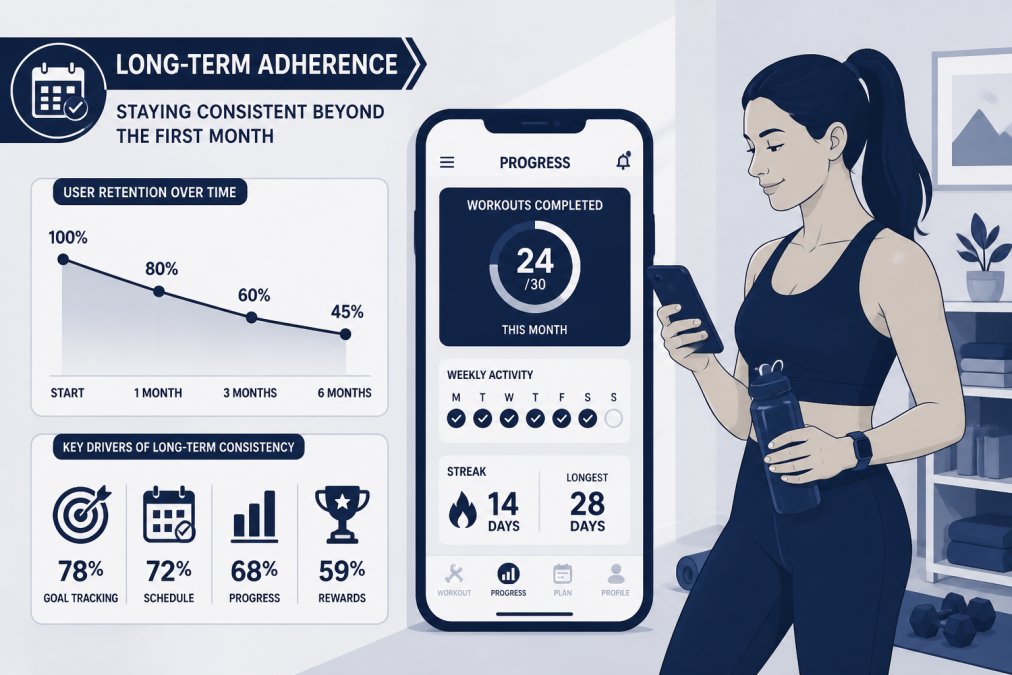
The first month feels exciting, but real challenge begins in month two when novelty wears off and progress slows. Long-term adherence requires shifting from motivation to systems.
Build Habit Stacking: Attach your workout to an existing habit. If you always drink coffee in the morning, work out immediately after. This removes the decision of "when should I work out?"
Track Progress Visibly: Digital programs tracking metrics, reps, heart rate recovery, or workout streaks provide feedback that keeps motivation alive when physical changes are slow.
Vary Your Training: Diverse class libraries let you change things up while maintaining consistency, preventing boredom and plateaus.
Set Specific Goals: "Get fit" is too vague. "Complete 5 workouts per week for 12 weeks" gives you something concrete to chase.
Schedule Recovery Strategically: Programs including recovery content, mobility work, or meditation help you stay healthy and mentally fresh. Recovery is essential for consistency.
Evaluate and Adjust: Every 4-6 weeks, assess what's working. Are you enjoying workouts? Getting results? Adjust your approach accordingly.
The programs listed above support long-term adherence differently. Future uses coaching and accountability. Bodyhackfitness integrates recovery equipment with programming. Openfit combines fitness with nutrition. The common thread: sustained progress requires more than just workout videos.
Frequently Asked Questions
What are the best digital fitness programs for home workouts?
The best digital fitness programs depend on your goals. Alo Moves excels for yoga and flexibility, Apple Fitness+ offers diverse HIIT and cardio classes, Jillian Michaels provides personalized workout plans, and Tonal specializes in strength training. Future delivers 1-on-1 coaching for maximum accountability. Consider your fitness level, preferred workout types, and whether you want community support or personalized guidance when choosing a program.
Are online workout programs for beginners effective?
Yes, online workout programs for beginners are highly effective when they offer progressive difficulty levels and clear form instruction. Programs like Jillian Michaels and Alo Moves allow you to start at your level and advance gradually. The key is choosing a program with beginner-specific classes, video demonstrations of proper form, and the flexibility to modify exercises. Consistency matters more than intensity when starting out.
How long should a home workout routine duration be?
Most effective home workout routines range from 20 to 60 minutes, depending on intensity and goals. HIIT workouts deliver results in 20-30 minutes, while strength training and yoga typically require 45-60 minutes. Many digital fitness programs offer class options in multiple lengths so you can choose based on your schedule. Starting with 20-30 minute sessions helps build the habit without overwhelming your routine.
Do digital fitness programs track calories, and how accurate are they?
Many digital fitness programs include calorie tracking features. Jillian Michaels and Openfit offer nutrition tracking alongside workouts, while some programs like Apple Fitness+ sync with wearables for heart rate-based calorie estimates. Fitness program calorie tracking features vary in accuracy; wearable integration generally provides better estimates than manual entry. For precise tracking, pair your program with a dedicated fitness tracker or smartwatch.
How do I stay consistent with a digital fitness program after the first month?
Long-term adherence requires accountability and variety. Programs like Future offer daily check-ins with a coach, while others provide workout challenges and community support. Schedule workouts like appointments, choose programs with diverse class options to prevent boredom, and track progress visually. Start with realistic goals, celebrate small wins, and consider rotating between program types (strength, cardio, flexibility) to maintain engagement beyond the initial motivation phase.
Staying consistent with digital fitness programs comes down to removing friction and building systems that work with your life, not against it. Bodyhackfitness supports this by curating both the equipment and programming needed for sustainable progress. When your training environment is complete and your programs are structured, showing up becomes the default rather than the exception. Shop now to build your complete home training setup.
This article was written using GrandRanker