


Table of Contents
- Why Concrete Floors Need Home Gym Flooring
- Rubber Gym Flooring for Concrete: The Heavy-Duty Standard
- Gym Flooring Rolls vs Tiles: Which Fits Your Space?
- Home Gym Flooring Thickness: Matching Density to Your Workouts
- Foam, Vinyl, and Mats: Lighter Options for Concrete Subfloors
- How to Install Gym Flooring on Concrete: Step-by-Step
- Moisture, Vapor Barriers, and Concrete Slab Preparation
- Conclusion
- Frequently Asked Questions
Last Updated: October 17, 2026
Why Concrete Floors Need Home Gym Flooring
Concrete is unforgiving. It offers no shock absorption, drains heat from your body, and will crack under a dropped dumbbell before your grip gives out, which is why the best flooring for home gym on concrete matters so much. That is why the best flooring for home gym on concrete is not a cosmetic upgrade, it is equipment protection and injury prevention in one purchase.
At Bodyhackfitness, we see the same pattern in customer questions: people build the rack first, then realize the slab underneath is the weak link. Bare concrete also holds moisture and dust, both of which shorten the life of rubber and foam. The Occupational Safety and Health Administration guidance on walking-working surfaces treats slip-resistant, well-maintained flooring as a basic safety control, and a home gym is no exception.
Below, we break down rubber, foam, vinyl, and mats by workout type, thickness, and installation method, so you buy once instead of twice.
Rubber Gym Flooring for Concrete: The Heavy-Duty Standard
Rubber gym flooring for concrete is the default choice for anyone lifting heavy, because dense rubber absorbs impact, grips shoes, and resists oil and chemical spills. It comes as rolls, interlocking tiles, or stall mats, and it holds up under racks, dumbbells, and dropped weights.
What most guides miss is density. A soft rubber mat feels great underfoot and compresses under a loaded barbell, which puts the shock straight into your slab. Look for dense, low-compression rubber under lifting zones and reserve softer rubber for walkways.
Gym Flooring Rolls vs Tiles: Which Fits Your Space?
Rolls win for large, uninterrupted lifting areas; tiles win for odd-shaped rooms and easy replacement. This is the gym flooring rolls vs tiles decision most people get backwards, buying tiles for a big open basement and fighting seams for years.
| Option | Best For | Installation | Repair |
|---|---|---|---|
| Rubber rolls | Large lifting zones, racks | Adhesive or loose lay | Cut and patch a section |
| Interlocking tiles | Irregular rooms, rental spaces | Snap together, no glue | Swap one tile |
| Foam tiles | Yoga, floor work, kids | Snap together | Swap one tile |
| Vinyl rolls | Cardio, light weights | Adhesive | Replace full sheet |
Rolls need a flat subfloor and a helper to position them. Tiles need nothing but a utility knife and patience.
Home Gym Flooring Thickness: Matching Density to Your Workouts
Home gym flooring thickness should match the load above it, not the room's aesthetics. A 0.4-inch foam tile protects joints during yoga but does nothing for a dropped 45-pound plate. Competitors stop at a generic thickness chart; the more useful approach is to plan by workout and equipment load, because a power rack, a treadmill, and a yoga mat have almost nothing in common at the slab.

Thickness and density by workout
- Yoga, stretching, Pilates, floor work: 0.4 inch EVA foam or a folding mat in the 0.25 to 0.4 inch range. You want cushion and grip, not impact absorption.
- Cardio machines (treadmill, rower, bike): 0.25 to 0.4 inch dense rubber, ideally in rolls so the machine's feet do not sit on seams. Dense rubber resists creeping under vibration and protects the slab from repeated point loads.
- Dumbbells under 50 pounds, kettlebells, bodyweight circuits: 0.25 to 0.4 inch dense rubber tiles or rolls. This is the mixed-use sweet spot.
- Squat racks, benches, Olympic lifts: 0.75 inch or thicker dense rubber, and preferably a plywood platform under the rack so the load spreads across the slab instead of concentrating at four feet.
- Dropped weights (Olympic lifts, deadlifts, dumbbell drops): 0.75 inch dense rubber at minimum, with a crumb-rubber or layered platform in the drop zone. Thin mats compress and transfer the shock straight into concrete.
Why density matters more than thickness
A soft rubber mat feels great underfoot and compresses under a loaded barbell, which puts the shock straight into your slab. Two mats can both be 0.75 inch thick and behave completely differently: a low-compression, high-density rubber stays firm under a rack, while a soft, high-void rubber squashes and bottoms out. Look for dense, low-compression rubber under lifting zones and reserve softer rubber for walkways and stretching areas.
Zone planning for a mixed-use garage or basement
Most home gyms are not one activity. A practical layout splits the room into zones:
- Lifting zone: 0.75 inch or thicker dense rubber, or a platform, under the rack and deadlift area.
- Cardio zone: 0.25 to 0.4 inch dense rubber rolls under machines.
- Floor-work zone: 0.4 inch foam or a folding mat where you stretch and do core work.
- Walkways: the same dense rubber as the lifting zone, or a thinner rubber runner, so you are not stepping from foam onto bare concrete.
Thinner is not cheaper if it fails. A compressed mat transfers impact to the slab, and concrete cracks are expensive to fix. Buy the density your heaviest lift requires, then use cheaper foam only where the load is your body, not a barbell.
Foam, Vinyl, and Mats: Lighter Options for Concrete Subfloors
Foam, vinyl, and portable mats suit lighter training and tighter budgets, but they will not survive heavy iron. Foam cushions joints and deadens noise; vinyl handles sweat and cleaning; folding mats store in a closet.
Our EVA Interlocking Foam Fitness Mat is a solid pick for yoga, Pilates, and general exercise, with 16 tiles per order at 0.4 inch thick, a textured non-slip surface, and a waterproof finish that wipes clean. It protects the slab from scratches and reduces noise, which matters in a basement under a living room. For stretching and core work, our Thick Folding Fitness Yoga Mat folds into a compact square, and the Tri-Fold Fitness Mat adds a leather surface with resilient foam for joint support.

How to Install Gym Flooring on Concrete: Step-by-Step
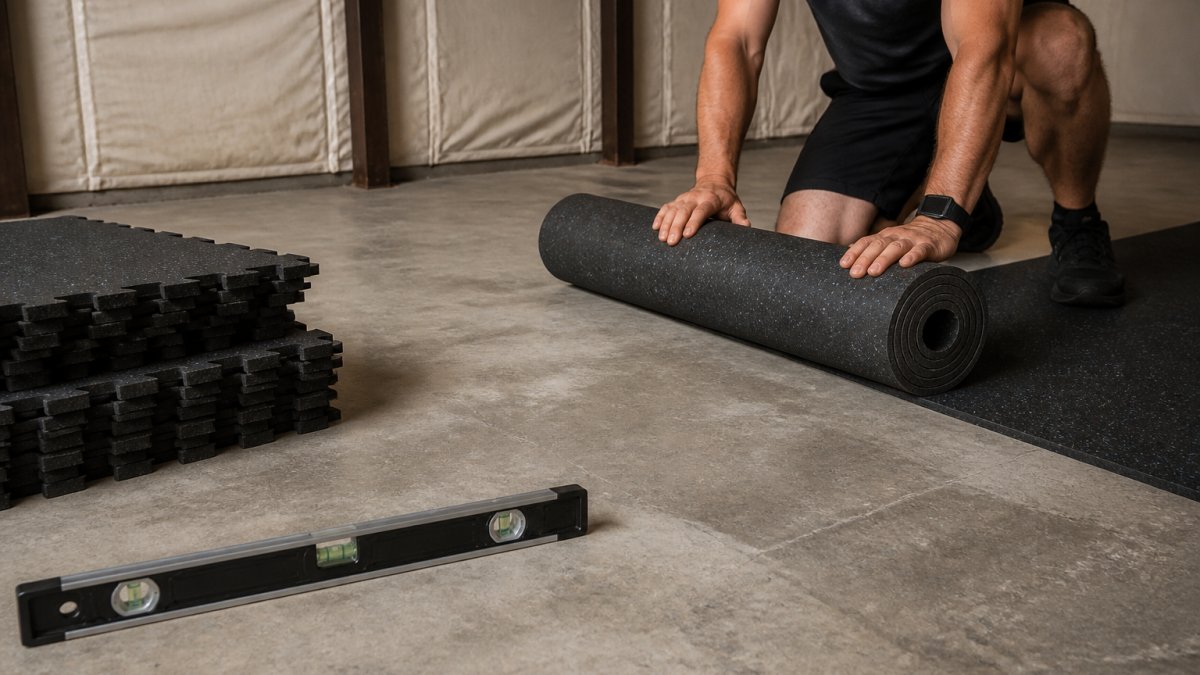
Installing gym flooring on concrete takes an afternoon for most home setups, provided the slab is clean, flat, and dry. Skip the prep and even premium flooring will lift, slide, or trap moisture. Most guides stop at "clean the floor and roll it out." The concrete-specific details below are where installs actually succeed or fail.
The basic sequence
- Clear and clean the slab. Sweep, then vacuum. Oil stains prevent adhesive from bonding.
- Check flatness. A straightedge should show no gaps greater than roughly 3/16 inch over 10 feet. Grind high spots, fill low ones.
- Test for moisture. Tape a plastic sheet to the slab for 24 hours. Condensation underneath means you need a vapor barrier first.
- Acclimate the flooring. Let rolls and tiles sit in the room for a day so they relax and match room temperature.
- Lay out dry first. Position rolls or tiles before gluing so seams land away from high-traffic paths.
- Install. Snap tiles together or roll out and trim rolls with a straightedge and utility knife.
- Seal edges. Use transition strips at doorways to stop tripping and edge curl.
Concrete-specific details that decide the install
Expansion joints. Concrete slabs have control and expansion joints, and flooring laid tight across them will buckle or tear as the slab moves. Do not glue or bridge a joint. Leave a gap in the flooring over the joint, or cut the flooring along the joint line and cover it with a transition strip.
EVA Interlocking Foam Fitness Mat →
Cracks. Hairline cracks are normal in concrete and usually fine to cover. Wider or moving cracks should be filled and allowed to cure before flooring goes down, and the flooring should not be glued across an active crack.
Floor drains. A garage or basement slab often has a drain. Cut the flooring around the drain rather than covering it, and finish the cut edge with a trim ring or transition so water can still reach the drain and the edge does not curl.
Door clearance. Measure the gap under the door before you buy. A 0.75-inch mat plus a transition strip can be enough to stop a door from swinging. If clearance is tight, use a thinner tile at the threshold or trim the door bottom rather than compressing the flooring.
Edge transitions. At doorways and where flooring meets bare concrete, use a transition strip or ramp edge. It stops tripping, prevents edge curl, and keeps tiles from sliding. This matters most in a garage where the flooring meets a sloped apron.
Rolls versus tiles around obstacles. Rolls give a cleaner, seam-free surface in open areas but are harder to fit around posts, drains, and joints. Tiles are easier to cut and replace around obstacles and are the better choice for odd-shaped rooms, rental spaces, and slabs with several joints.
Expected result: a flat, quiet surface with no rocking underfoot, no gaps at the walls, and no flooring bridging a joint or covering a drain.
Moisture, Vapor Barriers, and Concrete Slab Preparation
Moisture is the failure point competitors gloss over. Concrete wicks water vapor from below, and trapped vapor destroys adhesives, curls vinyl, and breeds odor in foam. A vapor barrier is cheap insurance.
Also plan for indoor air quality. New rubber has a smell that fades with ventilation, so air the room for a few days before training. For quantity planning, measure the room and add 10 percent for cuts and mistakes, then price per square foot against your total area rather than per box.
Conclusion
The hard part is not choosing between rubber and foam, it is matching thickness and density to the weight you actually move. Get the slab dry and flat, put dense rubber under the rack, and keep lighter foam where you stretch.
Bodyhackfitness stocks the mats that make that plan work, including the EVA Interlocking Foam Fitness Mat for floor work and folding mats for portable sessions. Shop now and build the training space your concrete floor deserves.

Frequently Asked Questions
Can I put gym flooring directly on concrete?
Yes, most home gym flooring goes directly on concrete, but the slab needs to be clean, flat, and dry first. Sweep away dust, fill cracks, and check for moisture with a plastic sheet test. Rubber rolls and interlocking tiles sit well on bare concrete. A vapor barrier is a smart addition in basements or damp climates. Skipping prep is the most common reason flooring shifts, curls, or traps moisture underneath.
How thick should home gym flooring be for weightlifting?
For free weights, racks, and dropped dumbbells, aim for at least 0.4 inch (10 mm) of dense rubber, and 0.75 inch or more for heavy deadlifts. Home gym flooring thickness matters more for density than raw millimeters: a dense 0.4-inch rubber tile absorbs impact better than a thick soft foam. Foam at 0.4 inch suits yoga, stretching, and bodyweight work, but it compresses under barbells and heavy racks.
Do I need a moisture barrier under gym flooring on concrete?
It depends on the slab. Concrete wicks moisture from below, and that vapor can warp rolls, grow mildew under mats, and damage the floor. Test with a 2x2-foot plastic sheet taped down for 24 hours: condensation means you need a vapor barrier. Basements and ground-level slabs are the highest risk. A 6-mil polyethylene sheet under rubber gym flooring for concrete is a cheap safeguard.
How do I keep gym mats from sliding on concrete?
Interlocking edges do most of the work: tiles lock together and stay put as one unit. For loose mats, add a rubber or anti-slip underlay between the mat and the slab, which grips both surfaces. Rubber rolls are heavy enough to stay flat once unrolled and settled. Avoid smooth-backed foam directly on polished concrete, since it slides easily. Clean the slab first so dust does not act like ball bearings.
Is rubber flooring good for a home gym on concrete?
Rubber is the top pick for concrete subfloors. It handles dropped weights, protects the slab from cracks and scuffs, reduces noise, and offers reliable traction even when you sweat. Dense rubber also resists oil and chemical spills. The trade-offs are cost and weight: rubber runs higher per square foot than foam, and rolls are heavy to move alone. For strength training on concrete, it is hard to beat.