

Table of Contents
- Why 15 lb Dumbbells Are Enough to Build Real Muscle
- The Best Full Body Exercises With 15 lb Dumbbells
- A 15 Minute Dumbbell Workout Routine You Can Repeat Weekly
- How to Progress With Fixed Weight Dumbbells
- Full Body Dumbbell Circuit for Beginners
- Common Mistakes That Limit Results With Light Weights
- What to Ignore: Bad Advice About Light Dumbbells
- Frequently Asked Questions
Last Updated: September 13, 2026
Why 15 lb Dumbbells Are Enough to Build Real Muscle
The 15 lb dumbbells sitting in the corner of your garage are not a compromise. They are a complete training tool, and the research on muscle growth backs that up. A landmark meta-analysis published in the Journal of Strength and Conditioning Research found that low-load training produces hypertrophy comparable to heavy-load training when sets are taken close to failure (Journal of Strength and Conditioning Research). The catch is that most people never get close to failure with light weights, so they assume the weights are the problem. They are not.
This guide from Bodyhackfitness covers the best full body exercises with 15 lb dumbbells, plus methods that make them feel far heavier than the number on the handle suggests.
The fix is not heavier equipment, it is manipulating tempo, range of motion, and rest intervals so 15 lb dumbbells create genuine mechanical tension and metabolic stress.
The Best Full Body Exercises With 15 lb Dumbbells
The best full body exercises with 15 lb dumbbells are compound movements that recruit multiple muscle groups at once. Because your strongest muscles help carry the load, you can push a lighter weight closer to failure than isolation moves allow.
Upper Body: Press, Row, and Raise Variations
Press and pull patterns cover the chest, back, and shoulders. Control the lowering phase for three full seconds on each.
- Floor press - Lie on your back, elbows at 45 degrees, press both dumbbells up and lower until your triceps touch the floor.
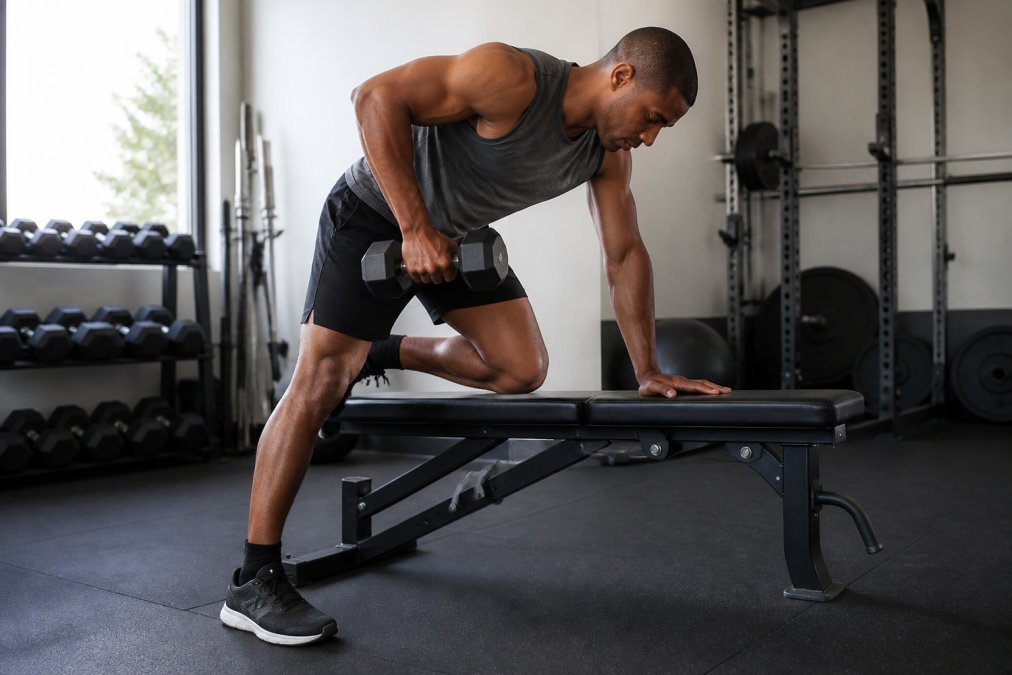
- Single-arm bent-over row - Brace one hand on a bench, pull the dumbbell to your hip, and squeeze the shoulder blade at the top.
- Arnold press - Rotate the dumbbells from a palms-in start to a palms-out finish to hit all three shoulder heads.
- Lateral raise with a pause - Raise to shoulder height, hold for two seconds, then lower slowly.
Lower Body: Squat, Lunge, and Hinge Patterns
Squat, lunge, and hinge patterns load your largest muscles, driving the biggest hormonal response.
- Goblet squat - Hold one dumbbell vertically at your chest and squat until your thighs break parallel.
- Reverse lunge - Step back, drop the back knee toward the floor, and drive through the front heel.
- Romanian deadlift - Hinge at the hips with a slight knee bend, feeling the stretch in your hamstrings.
- Bulgarian split squat - Elevate your rear foot on a bench for a brutal single-leg variation.
Core and Carry: Stability Under Load
Core work with light dumbbells is about resisting movement, not creating it. These two patterns train the deep stabilizers that protect your spine.
- Suitcase carry - Walk 30 to 40 steps holding one dumbbell at your side without leaning.
- Renegade row - From a plank position with hands on the dumbbells, row one arm at a time without rotating your hips.
A 15 Minute Dumbbell Workout Routine You Can Repeat Weekly
A 15 minute dumbbell workout routine works best as a circuit: three rounds of five exercises, 45 seconds of work and 15 seconds of rest per movement. This keeps your heart rate elevated while delivering enough time under tension to trigger hypertrophy. The 45/15 split yields roughly 8 to 12 controlled reps per station at a 4-2-1-1 tempo, squarely in the hypertrophy range for 15 lb dumbbells.
| Block | Exercises | Time | Rest |
|---|---|---|---|
| Warm-up | Arm circles, bodyweight squats, hip hinges | 2 min | None |
| Round 1 | Goblet squat, floor press, bent-over row, reverse lunge, plank row | 5 min | 60 sec after round |
| Round 2 | Same five movements | 5 min | 60 sec after round |
| Round 3 | Same five movements | 5 min | None |
| Cool-down | Chest stretch, hip flexor stretch, hamstring stretch | 2 min | None |
How to run each station
- Goblet squat (45 sec): Hold one dumbbell vertically at your chest, elbows tucked. Lower 4 seconds, pause 2 at the bottom, drive up in 1. If your heels lift, widen your stance.
- Floor press (45 sec): Lie on your back, elbows at 45 degrees. Lower until your triceps touch the floor, pause, press. The floor is a depth gauge, so you cannot cheat the range.
- Bent-over row (45 sec): Hinge to roughly 45 degrees, brace your core, and pull the dumbbell to your hip. Squeeze the shoulder blade for a full second at the top.
- Reverse lunge (45 sec): Step back, drop the rear knee toward the floor, drive through the front heel. Alternate legs each rep for equal work.
- Plank row (45 sec): From a plank with hands on the dumbbells, row one arm at a time without letting your hips rotate. This is the core and back finisher.
Three intensity levers to rotate week to week
Running the same circuit at the same tempo for months causes plateaus. Rotate one lever per week:
- Tempo week: Keep 45/15 but shift every rep to 4-2-1-1. Expect to lose 2 to 3 reps per station, that is the point.
- Density week: Keep the tempo standard but cut rest to 30 seconds between stations. Same work, less recovery.
- Volume week: Add a fourth round, or a burnout set of lateral raises and curls after Round 3 using the 21s protocol (7 bottom-half, 7 top-half, 7 full reps).
Progression rules
- If you complete all three rounds with clean form and hit the top of the rep range on every station, move to the next lever.
- If your form breaks before 45 seconds, drop to two rounds and rebuild.
- Repeat this circuit three times per week on non-consecutive days. Two days maintains; three is the minimum for steady progress.
If you want a heavier option for the same patterns, the Premium Adjustable Dumbbell Set lets you scale the load as your strength builds, and the connecting rod converts it into a barbell for squats and presses.
How to Progress With Fixed Weight Dumbbells
Learning how to progress with fixed weight dumbbells comes down to one principle: progressive overload does not require more weight, just more demand from the same weight. When the load is locked at 15 lbs, you manipulate the other variables, and the order matters, because some levers add tension without joint stress while others just add fatigue.
Here is the hierarchy most practitioners use, from most productive to least.
1. Tempo manipulation (the highest-yield lever)
Tempo is written as four numbers: eccentric, bottom pause, concentric, top pause. A standard rep is roughly 2-0-1-0. To make 15 lbs feel like 25, shift to 4-2-1-1.
- Eccentric (lowering): 4 seconds. Mechanical tension peaks here, and most muscle damage from light loads is generated here.
- Bottom pause: 2 seconds. Kills the stretch reflex so you cannot bounce out of the hole. On a goblet squat or floor press, this is the hardest change you can make.
- Concentric (lifting): 1 second. Do not grind it out slowly, drive.
- Top pause: 1 second. Removes momentum and forces a fresh start each rep.
Run three weeks at 4-2-1-1, then drop back to 2-0-1-0 and notice you can now control a weight that used to feel loose. That is the progression.
2. Range-of-motion and leverage modification
When the weight cannot increase, change the mechanical disadvantage, the angle most light-dumbbell articles skip.
- Deficit work: Stand on a 2-inch plate or thick book for Romanian deadlifts and reverse lunges. The extra travel adds hip flexion and noticeably more hamstring tension.
- Elevated floor press: Lie on the floor with a rolled towel under your upper back. The slight arch increases the stretch on the pecs at the bottom.
- Feet-elevated push-up row: Put your feet on a bench and your hands on the dumbbells. The higher center of gravity makes the renegade row dramatically harder without changing the load.
- Single-arm and single-leg versions: A one-arm row loads the working side with the full 15 lbs instead of splitting it across two arms. This is the fastest way to double perceived load.
3. Isometric holds at the sticking point
Add a 20-to-30-second hold at the hardest joint angle, mid-range on a lateral raise, bottom of a goblet squat, top of a floor press. Isometrics build tension without adding reps and are joint-friendly because there is no movement under load.
4. Rest-interval compression
Cut rest from 60 seconds to 45, then 30. Shorter rest raises metabolic stress, one of the three drivers of hypertrophy. Do not go below 30 seconds on compound lifts, form degrades before the muscle does.
5. Targeted fatigue protocols for 15 lb dumbbells
This is where light weights shine: you can push to genuine failure without the joint risk of heavy loading.
- Mechanical drop sets: Start with the hardest variation (e.g., Bulgarian split squat), go to failure, then immediately switch to the easier variation (reverse lunge) and continue to failure with the same dumbbells.
- 21s: For lateral raises or curls, do 7 reps in the bottom half, 7 in the top half, 7 full reps, 21 total, no rest.
- Rest-pause: Take a set to failure, rest 15 seconds, then squeeze out 3 to 5 more reps. Repeat once. This is the most efficient way to extend a set with a fixed load.
- Rep targets: For hypertrophy with 15 lbs, aim for 8 to 15 reps on compound movements and 12 to 20 on isolation work. Once you clear the top of the range with clean tempo, add a lever from the list above rather than chasing reps into the thirties.
Full Body Dumbbell Circuit for Beginners
A full body dumbbell circuit for beginners should stay simple: four exercises, two to three rounds, and enough rest to keep form clean. Beginners benefit most from frequency and consistency, not complexity.
- Goblet squat - 10 reps
- Floor press - 10 reps
- Bent-over row - 10 reps per arm
- Romanian deadlift - 10 reps
Rest 90 seconds between rounds. Do this three times per week on non-consecutive days. Once 10 reps feel easy, add a round before you add weight. The Adjustable 15lbs Rubber Hex Dumbbell Set is a practical starting point because the hex shape keeps the dumbbells from rolling between sets and the rubber coating protects your floors.
Common Mistakes That Limit Results With Light Weights
Results stall with light weights for one main reason: the training never gets hard enough to force adaptation. The American College of Sports Medicine recommends training each major muscle group two to three times per week with sufficient intensity to challenge the muscle (American College of Sports Medicine resistance training guidelines). Most home trainees hit the frequency but miss the intensity.
Three mistakes show up again and again:
- Stopping short of failure - Leaving three or four reps in the tank keeps the stimulus below the threshold for growth.
- Rushing the eccentric - Dropping the weight quickly removes the most productive part of the rep.
- Skipping unilateral work - Two-arm movements let your stronger side compensate, so neither side gets fully challenged.
What to Ignore: Bad Advice About Light Dumbbells
The fitness industry repeats two myths about light dumbbells that cost home trainees real progress: that light weights only build "toning" and never muscle, and that you must lift heavy to grow at all.
Both claims ignore how hypertrophy actually works. Muscle growth is driven by mechanical tension, metabolic stress, and muscle damage, and all three can be produced with a light load taken close to failure. A study in the Journal of Applied Physiology confirmed that training to failure with lighter loads produces muscle growth comparable to heavier loads (Journal of Applied Physiology). What light weights cannot do as effectively is build maximal strength, which requires heavier loads over time.
If your goal is a leaner, more muscular physique rather than a one-rep max, 15 lb dumbbells are a legitimate long-term tool. Pair them with a bench, hip thrust belt, or adjustable set as your needs grow, and you have a complete home gym for a fraction of a commercial membership.
Building real muscle at home comes down to effort and structure, not the size of your dumbbells. Bodyhackfitness carries the equipment that makes consistent training easier: the Multi-Functional Adjustable Weight Bench for pressing and split squats, the Hip Thrust Belt for glute and lower body work, and the 2-In-1 Bicep Preacher Curl Bench for isolated arm training. Shop now and build the home gym that keeps you consistent.
Frequently Asked Questions
Can you build muscle with 15 lb dumbbells?
Yes. Muscle growth depends on mechanical tension and time under tension, not just load. With 15 lb dumbbells, slow the lowering phase to three or four seconds, pause at the bottom, and use unilateral exercises so each side carries the full load. Keep reps in the 8 to 15 range and push each set close to failure. Pair that with enough protein and sleep, and 15 lb dumbbells can drive hypertrophy for most beginners and intermediate lifters.
How many reps should I do with 15 lb dumbbells?
For hypertrophy, aim for 8 to 15 reps per set. For muscular endurance, 15 to 25 reps works well. If you can complete more than 25 clean reps, increase difficulty by slowing the tempo, adding an isometric hold, or switching to a single-leg or single-arm variation. Rest 45 to 90 seconds between sets for strength work, or 20 to 40 seconds if you are running a circuit.
Is a 15-minute full body dumbbell workout effective for weight loss?
It can be, especially when paired with a calorie deficit. A 15 minute dumbbell workout routine using compound movements and short rest intervals keeps your heart rate elevated, which burns calories during the session. The bigger benefit is preserving muscle while you lose fat, since muscle tissue keeps your resting metabolism higher. Train three to four times per week and add walking or cycling on off days for better results.
How can I increase the intensity of a workout using only 15 lb weights?
Manipulate four variables: tempo, range of motion, rest, and stability. Slow the eccentric phase to four seconds, add a two-second pause at the hardest point, and extend range of motion with a deficit where safe. Shorten rest to 30 seconds, or pair exercises back to back. Finally, switch to unilateral versions like single-leg Romanian deadlifts or single-arm presses, which double the load each limb handles without adding weight.