

Table of Contents
- Best Home Gym Equipment for Beginners: Quick Comparison
- How to Build a Home Gym on a Budget
- Home Gym Setup for Small Spaces
- Essential Strength Training Equipment
- Cardio Equipment That Fits Your Space
- Beginner Workout Routines for Home Gyms
- Home Gym Safety Tips for Beginners
- Conclusion
Last Updated: August 11, 2026
Best Home Gym Equipment for Beginners: Quick Comparison
Building a home gym doesn't require a warehouse or a five-figure budget. The best home gym equipment for beginners 2026 focuses on versatility, durability, and progressive potential, tools that grow with you as your fitness level advances. At Bodyhackfitness, we've curated equipment that delivers real results without overwhelming beginners with unnecessary complexity.
Quick Picks:
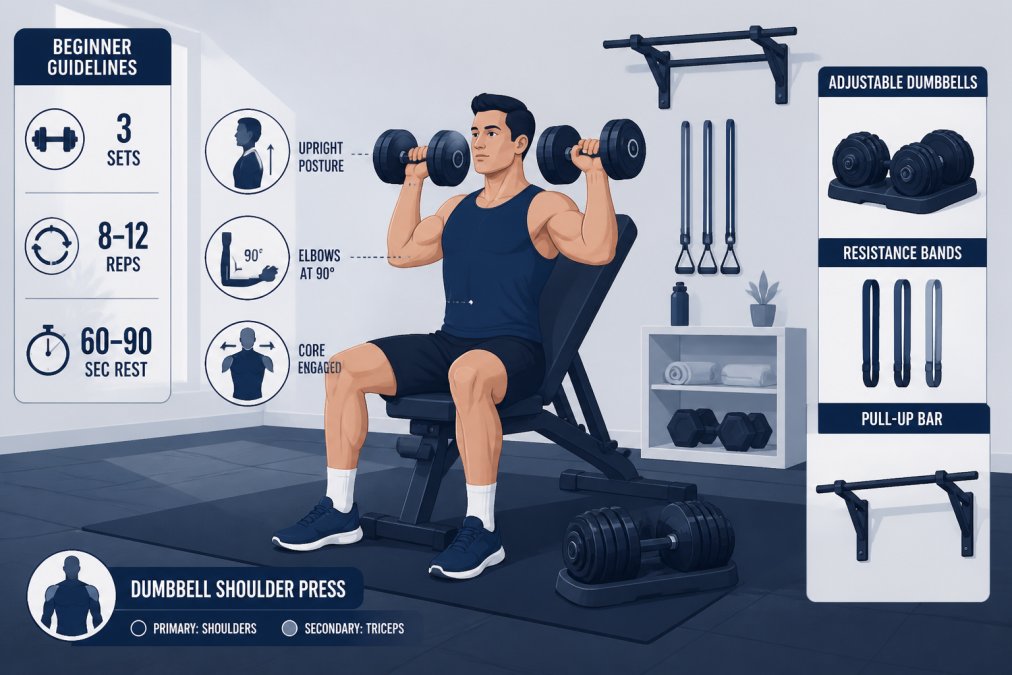
- Best Overall for Home Gyms: Bodyhackfitness curated selection, premium equipment combined with structured digital programs for accountability and progression
- Best Space-Saving Strength: Bowflex SelectTech 552 Adjustable Dumbbells, replaces 15 dumbbell sets in one compact unit
- Best Bodyweight Solution: TRX All-in-One Suspension Training System, portable, anchor anywhere, full-body workouts
- Best Budget Cardio: Sunny Health & Fitness SF-B901 Pro Indoor Cycling Bike, chain-drive stability at an entry-level price
- Best Portable Cardio: Prism Fitness Smart Jump Rope, ultra-affordable, requires zero space, builds cardiovascular endurance
How to Build a Home Gym on a Budget
Building a functional home gym on a budget means prioritizing multi-use equipment over single-purpose machines. Start with adjustable dumbbells or resistance bands, these cover roughly 80% of strength-training movements. A beginner can perform squats, presses, rows, deadlifts, and isolation work using just dumbbells and floor space. Add a pull-up bar or suspension trainer, and you've unlocked pull-ups, rows, and core work.
For cardio, jump ropes represent the best entry point: under $30, minimal space, measurable cardiovascular benefits. If you have an extra $200-300, an entry-level stationary bike like the Sunny Health & Fitness SF-B901 Pro provides consistent, low-impact cardio.
Many beginners buy equipment based on what looks impressive rather than what they'll actually use. A $1,200 treadmill collecting dust is worse than a $20 jump rope you use three times per week. Start small, prove consistency, then upgrade.
Home Gym Setup for Small Spaces
Small-space home gyms require equipment that compresses, folds, or serves multiple purposes. Avoid large single-purpose machines like treadmills or leg press machines that dominate a room and limit movement options.
Vertical storage is essential. Wall-mounted pull-up bars, resistance band anchors, and dumbbell racks keep your floor clear. Adjustable dumbbells are non-negotiable for small spaces because they replace an entire rack of fixed weights in a footprint smaller than a shoebox.
Suspension trainers like the TRX All-in-One system require only a door frame or ceiling anchor point and enable full-body strength training in a space the size of a yoga mat. Resistance bands roll into a small bag and can be anchored to a door, beam, or your own body weight.
For cardio in tight quarters, jump ropes win decisively. You need roughly 6 feet of clear ceiling height and a 4x4-foot floor space, far less than any stationary bike.
Essential Strength Training Equipment
Strength training forms the foundation of any complete home gym. Unlike cardio, which improves endurance, strength training builds muscle, increases metabolism, and creates the progressive overload stimulus that drives long-term fitness gains. Beginners need equipment that supports fundamental movement patterns: pushing, pulling, squatting, hinging, and carrying.
Adjustable Dumbbells: Space-Saving Strength
The Bowflex SelectTech 552 Adjustable Dumbbells replace 15 sets of traditional dumbbells in a single compact unit. They adjust from 5 to 52.5 pounds in 2.5-pound increments up to 25 pounds, then larger jumps at higher weights. This precision matters for beginners, the ability to increase weight by just 2.5 pounds means you can progress steadily without jumping too far and stalling on an exercise.
Adjustable dumbbells enable pressing, rowing, and isolation movements. The included year of JRNY app access provides guided workouts and form cues. The main limitation is that you cannot drop them from height, the internal mechanism is fragile, which restricts explosive movements. But beginners don't need those techniques yet.
For budget-conscious beginners, Amazon Basics Rubber Encased Hex Dumbbells offer a more affordable entry point. You purchase individual weights rather than an adjustable set, which means slower progression but lower initial cost. The tradeoff is storage space.
Power Racks: Foundational Investment
A power rack enables squats, bench presses, overhead presses, and pull-ups with safety. The REP Fitness PR-1100 Home Gym Power Rack supports up to 700 pounds. It includes safeties (which catch the bar if you fail), J-cups (which hold the bar at starting position), and a multi-grip pull-up bar.
Power racks intimidate beginners, but they're actually the safest way to learn compound movements. The safeties mean you can attempt heavy squats or bench presses without a spotter, if you can't complete the rep, the bar rests safely on the safeties. This psychological safety enables you to push harder and progress faster.
A power rack isn't essential for beginners, dumbbells alone enable effective strength training. However, if you plan to progress to barbell lifts, a rack becomes the most versatile single investment.
Suspension Training: Bodyweight Mastery
The TRX All-in-One Suspension Training System uses your body weight and gravity to create resistance. You anchor it to a door, pull-up bar, or tree, then adjust your body angle to increase or decrease difficulty. This makes it infinitely scalable, a beginner can perform easier variations while advanced athletes can perform brutally difficult progressions of the same exercise.
Suspension training excels at teaching movement patterns and building functional strength. Rows, presses, squats, lunges, and core work all translate directly to real-world movement. The instability of the straps forces your stabilizer muscles to engage.
The system includes indoor and outdoor anchors plus a travel bag. This portability is underrated, you can take your entire strength training system on vacation or to a park.
The limitation is that suspension training relies entirely on bodyweight. As you progress, you'll eventually need external load, dumbbells or a barbell, to continue building strength.
Cardio Equipment That Fits Your Space
Cardiovascular fitness improves aerobic capacity, burns calories, and supports recovery between strength sessions. The best cardio equipment is whatever you'll actually use consistently.
Indoor Cycling Bikes for HIIT and Steady-State
The Sunny Health & Fitness SF-B901 Pro Indoor Cycling Bike delivers a smooth, stable ride for both steady-state cardio and high-intensity interval training (HIIT). The 40-pound chrome flywheel creates smooth momentum, and the micro-adjustable resistance lets you dial in intensity precisely.
Stationary bikes excel for low-impact cardio, your joints absorb almost no impact, making them ideal for people with knee or ankle concerns. You can read, watch videos, or focus entirely on the workout. The seat and handlebar adjust fully.
The chain-drive system is noisier than belt-drive alternatives, which matters if you have neighbors. The bike lacks built-in screens or app integration, you'll use your phone or tablet for guided workouts. For beginners, this simplicity is actually an advantage.
Cycling bikes build leg strength and cardiovascular endurance without repetitive impact. They're particularly effective for HIIT workouts.
Jump Ropes for Portable Cardio
The Prism Fitness Smart Jump Rope delivers effective cardio in the smallest possible footprint. Jump rope builds coordination, calf strength, and cardiovascular endurance while requiring only 6 feet of ceiling height and a 4x4-foot floor space.
The rope comes in speed and weighted versions. Speed ropes are lighter and faster, suited for high-repetition work. Weighted ropes add resistance and intensity. Both versions feature adjustable lengths and rubber grip handles that reduce wrist strain.
Jump rope has a learning curve, but most people master basic technique within 2-3 weeks. The coordination challenge forces focus and engages your nervous system more than passive cardio.
The main limitation is that jump rope is high-impact. For healthy beginners, this impact is beneficial, strengthening bones and connective tissue.
Beginner Workout Routines for Home Gyms
Having equipment is only half the equation. Beginners need structured routines that teach proper movement patterns, build consistency, and create progressive overload.
Full-Body Strength Sessions
Full-body workouts performed 3 times per week represent the most efficient training approach for beginners. Each session targets all major movement patterns, pushing, pulling, squatting, hinging, in a single workout. This frequency allows each muscle group to recover between sessions while maintaining consistent training stimulus.
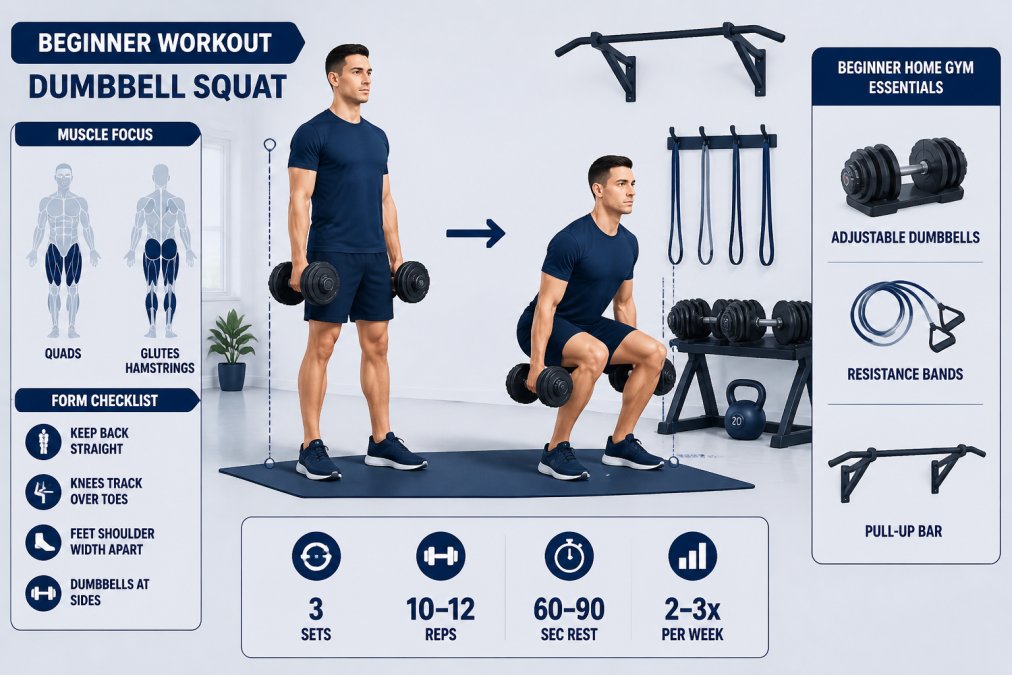
A sample full-body session using adjustable dumbbells and a pull-up bar might include:
- Dumbbell goblet squats: 3 sets of 8-12 reps
- Dumbbell bench presses: 3 sets of 8-12 reps
- Dumbbell rows: 3 sets of 8-12 reps
- Pull-ups or assisted pull-ups: 3 sets of 5-10 reps
- Dumbbell overhead presses: 3 sets of 8-12 reps
- Dumbbell deadlifts: 2 sets of 5-8 reps
Bodyhackfitness offers structured digital programs that guide you through proper form, progression strategies, and workout programming.
Progressive Overload Strategies
Progressive overload, gradually increasing the demands placed on your muscles, is the mechanism that drives strength and muscle gains. Without it, your body adapts and progress stalls.
The simplest strategy is adding weight. If you completed 12 reps of dumbbell squats with 30-pound dumbbells, your next workout you attempt the same exercise with 32.5-pound dumbbells. This small increase forces your muscles to adapt and grow stronger.
When you can't add weight, add reps. If you're stuck at 8 reps with a certain weight, your goal becomes hitting 9 reps, then 10, then 12. Once you hit 12 reps consistently, you increase the weight and drop back to 8 reps.
Adding sets is another strategy. Instead of 3 sets of 10 reps, perform 4 sets of 10 reps. Reducing rest periods between sets also increases difficulty.
The key is tracking your workouts. Write down the weight, reps, and sets for each exercise. Your only job each session is to match or exceed the previous week's performance.
Home Gym Safety Tips for Beginners
Injuries derail progress faster than anything else. Beginners often skip safety considerations in favor of jumping straight into heavy training, but the smartest approach is building a foundation of safe movement patterns first.
Proper form trumps weight every single time. A light weight performed with perfect form builds strength and teaches your nervous system correct movement patterns. A heavy weight performed with poor form risks injury and creates bad habits.
Warm up before every session. Five minutes of light cardio followed by dynamic stretches prepares your muscles and joints for training. A proper warm-up increases blood flow, elevates core temperature, and activates your nervous system.
Use appropriate weight. Start lighter than you think you need. If you can perform an exercise for 12 reps with perfect form and still have 3-4 reps left in the tank, that's the right weight.
Progress gradually. Adding 5 pounds per week to a lift is sustainable. Trying to jump from 50 pounds to 75 pounds overnight invites injury.
Recovery matters as much as training. Muscles grow during rest, not during workouts. Sleep 7-9 hours nightly, eat adequate protein (0.7-1 gram per pound of bodyweight), and take at least one full rest day per week.
Listen to your body. There's a difference between muscle soreness (normal, expected, harmless) and joint pain (warning sign, needs investigation). Muscle soreness peaks 24-48 hours after training and gradually subsides. Joint pain during or immediately after training suggests improper form or excessive load.
Building a home gym that actually gets used requires choosing equipment that fits your space, budget, and lifestyle. The best home gym equipment for beginners 2026 combines versatility, durability, and progressive potential. Start with adjustable dumbbells or resistance bands, add a pull-up bar or suspension trainer, and layer in cardio equipment based on your preferences.
Bodyhackfitness provides both premium equipment and structured digital programs that keep you accountable and progressing. Our carefully curated selection eliminates guesswork, and our fitness programs guide you through proper form and progression strategies. Shop now to build your complete home gym and unlock consistent progress toward your fitness goals.
Frequently Asked Questions
What is the most essential home gym equipment for a beginner?
Start with adjustable dumbbells and an exercise mat. Adjustable dumbbells replace multiple sets of weights, saving space and money while allowing progressive overload as you gain strength. Add a power rack or suspension trainer for compound movements, then incorporate cardio equipment based on your goals. This three-tier approach covers strength training, core stability, and cardiovascular fitness without overwhelming beginners with too many options.
How do I build a home gym on a budget?
Begin with resistance bands and bodyweight exercises using a suspension trainer, then add one pair of adjustable dumbbells. Invest in a basic yoga mat for floor work and mobility. A jump rope provides affordable cardio. Prioritize equipment that serves multiple exercises: dumbbells work for strength, suspension trainers for functional training, and bands for mobility. This layered approach lets you start small and expand as your budget allows without wasting money on single-purpose gear.
How much space do I need for a basic home gym?
A 6-by-8-foot area accommodates most beginner equipment. Adjustable dumbbells, a yoga mat, and resistance bands require minimal footprint. If adding a power rack or stationary bike, plan for 8-by-10 feet. Vertical storage solutions like wall-mounted racks and tension rods maximize small spaces. Consider your ceiling height for pull-up bars and overhead exercises. Even apartments can support a functional home gym using space-saving equipment and smart organization.
Do I need smart home gym equipment as a beginner?
Smart features like app integration and guided workouts help beginners stay consistent, but they're not essential to start. Many entry-level pieces like the Bowflex SelectTech dumbbells include free app access for structured programming. However, basic equipment paired with YouTube videos or fitness apps works equally well. Invest in smart tech only if you value guided instruction and real-time feedback enough to justify the extra cost; otherwise, prioritize durability and versatility first.
What are the best budget-friendly home gym options for beginners in 2026?
Resistance bands, jump ropes, and basic hex dumbbells offer excellent value. The Prism Fitness Smart Jump Rope costs under $26, while Amazon Basics hex dumbbells are affordable per-pound. The TRX suspension trainer at $135 on sale replaces dozens of expensive machines. The Sunny Health & Fitness indoor cycling bike at $299 provides cardio without breaking the bank. Focus on multi-purpose equipment that targets strength, cardio, and mobility rather than single-function machines.
This article was written using GrandRanker