

Table of Contents
- Why Home-Based Strength Training Works for Muscle Growth
- Essential Equipment vs. Bodyweight-Only Training
- Progressive Overload at Home: Techniques That Drive Hypertrophy
- Full-Body Workout Routines for Home Muscle Building
- Best Home Workout Equipment for Muscle Gain
- Muscle Building Nutrition Guide for Home Training
- Recovery, Rest Days, and Injury Prevention at Home
- Overcoming Psychological Barriers to Consistency
- Frequently Asked Questions
Last Updated: September 1, 2026
Why Home-Based Strength Training Works for Muscle Growth
Building muscle at home is entirely possible and often more practical than a gym membership. Muscle growth requires progressive overload, adequate nutrition, and consistent effort, not a specific location. According to research from the American College of Sports Medicine, progressive resistance training produces measurable increases in muscle mass and strength regardless of environment.
Home training removes friction: no commute, no membership fees, no waiting for equipment. The real advantage is control, you manage your environment, schedule, and intensity without distractions. At Bodyhackfitness, we empower fitness enthusiasts to train harder and recover faster by offering a seamless, customer-focused shopping experience for both training and recovery equipment, enabling you to create a more complete training environment at home.
Essential Equipment vs. Bodyweight-Only Training
You can build muscle using only bodyweight. Push-ups, pull-ups, dips, and pistol squats create significant mechanical tension and muscle damage, the primary drivers of hypertrophy. However, as you get stronger, bodyweight exercises become harder to progressively overload.
Adding external resistance, dumbbells, kettlebells, resistance bands, solves this problem and lets you maintain progression indefinitely. Equipment lets you adjust load precisely and train across different rep ranges, particularly the 6-12 rep range where many lifters find the hypertrophy sweet spot.
For most people building muscle at home, minimal equipment beats bodyweight-only training. Start with adjustable dumbbells, they're compact, versatile, and enable hundreds of exercises. The Adjustable 15lbs Rubber Hex Dumbbell Set from Bodyhackfitness ($55.80) provides a solid entry point. Add a resistance band and you've covered most pressing, pulling, and leg movements.

If you want to progress further, a weight bench and kettlebell expand your options. The Multi-Functional Adjustable Weight Bench ($121.91) anchors pressing movements and creates stability for single-leg work. A kettlebell adds ballistic training and unilateral strength work that dumbbells alone don't replicate as effectively.
Progressive Overload at Home: Techniques That Drive Hypertrophy
Progressive overload is non-negotiable for muscle growth. Your muscles adapt to stress by growing larger and stronger, but only if stress gradually increases. Without it, training plateaus and muscle growth stops.
At home, you have several methods to increase load. The most obvious is adding weight: if you did 10 reps with 25-pound dumbbells last week, do 10 reps with 30 pounds this week. Increasing volume, total reps and sets per muscle group weekly, also drives hypertrophy. Time under tension matters too: slowing the eccentric phase (lowering portion) increases muscle damage without requiring additional load.
Unilateral training, single-limb exercises like single-leg squats and single-arm rows, creates mechanical tension on each side independently. Density training, completing more work in the same timeframe, is another path: if you completed 12 sets in 40 minutes last week, complete them in 38 minutes this week.
You have five levers: weight, reps, sets, tempo, and density. Rotating between these methods keeps progression moving when one approach stalls.
Full-Body Workout Routines for Home Muscle Building
A full-body routine trains all major muscle groups in one session. This approach works well for home training because it's flexible, requires minimal equipment, and lets you train 3-4 times per week with adequate recovery.
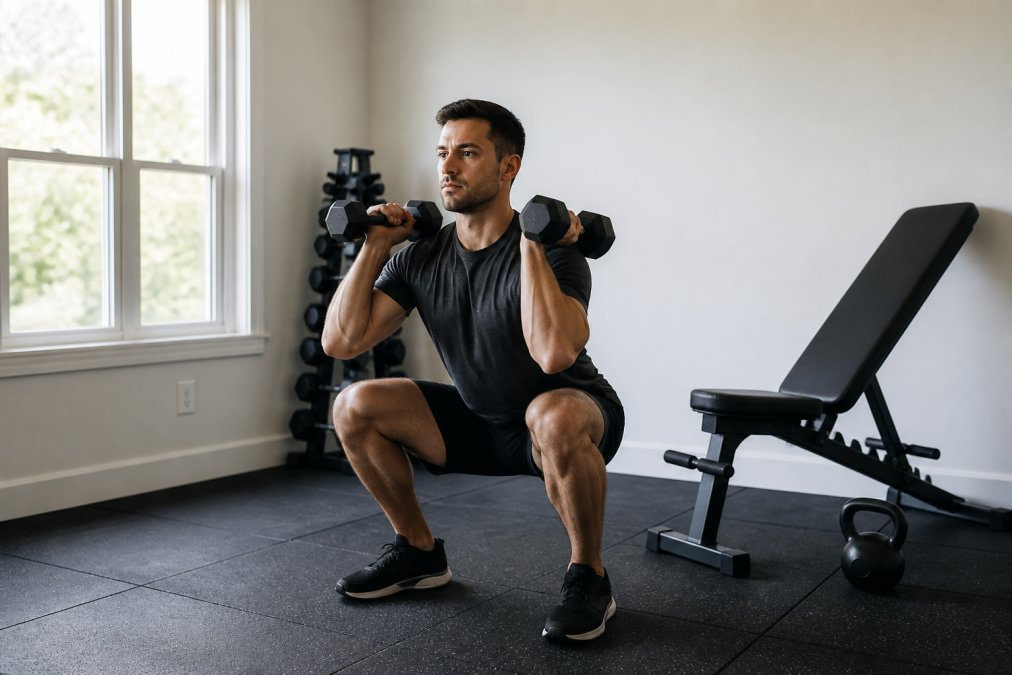
The structure includes one compound lower-body movement, one compound upper-body push, one compound upper-body pull, and one or two accessory movements:
Session A (Monday):
- Dumbbell Goblet Squats: 4 sets of 8-10 reps
- Dumbbell Bench Press: 4 sets of 8-10 reps
- Dumbbell Rows: 4 sets of 8-10 reps
- Dumbbell Curls: 3 sets of 10-12 reps
Session B (Wednesday):
- Dumbbell Romanian Deadlifts: 4 sets of 8-10 reps
- Dumbbell Overhead Press: 4 sets of 8-10 reps
- Resistance Band Pull-Aparts: 4 sets of 12-15 reps
- Tricep Dips: 3 sets of 8-12 reps
Session C (Friday):
- Dumbbell Bulgarian Split Squats: 3 sets of 10 reps per leg
- Dumbbell Floor Press: 4 sets of 8-10 reps
- Kettlebell Rows: 4 sets of 8-10 reps
- Lateral Raises: 3 sets of 12-15 reps
This rotation hits every major muscle group multiple times per week while allowing adequate recovery. Each session takes 45-60 minutes. Rest 2-3 minutes between heavy compound sets and 60-90 seconds between accessory work.
Compound Movements for Maximum Growth
Compound exercises involve multiple joints and muscle groups, creating the most mechanical tension and recruiting the most muscle fibers. They're the foundation of any muscle-building program.
The big four compounds you can do at home are squats, deadlifts, bench presses, and rows. A dumbbell squat recruits your quads, glutes, hamstrings, core, and stabilizer muscles simultaneously, driving systemic adaptation and hormone release that supports muscle growth across your entire body.
Control the eccentric phase of compound movements. When you lower a dumbbell during a bench press, you're creating significant muscle damage. A 3-second descent, 1-second pause, explosive up creates more hypertrophy stimulus than rushing.
Upper-Body and Lower-Body Focus Days
Some lifters prefer upper/lower splits, training upper-body movements one day and lower-body another, allowing more volume per muscle group while maintaining recovery.
Upper A (Monday):
- Dumbbell Bench Press: 4 sets of 8-10 reps
- Dumbbell Rows: 4 sets of 8-10 reps
- Dumbbell Overhead Press: 3 sets of 8-10 reps
- Pull-ups or Resistance Band Lat Pulldowns: 3 sets of 8-12 reps
- Dumbbell Curls: 3 sets of 10-12 reps
Lower A (Tuesday):
- Dumbbell Goblet Squats: 4 sets of 8-10 reps
- Dumbbell Romanian Deadlifts: 4 sets of 8-10 reps
- Dumbbell Bulgarian Split Squats: 3 sets of 10 reps per leg
- Calf Raises: 3 sets of 12-15 reps
Upper B (Thursday):
- Dumbbell Incline Press: 4 sets of 8-10 reps
- Kettlebell Rows: 4 sets of 8-10 reps
- Lateral Raises: 3 sets of 12-15 reps
- Face Pulls: 3 sets of 12-15 reps
- Tricep Dips: 3 sets of 8-12 reps
Lower B (Friday):
- Dumbbell Front Squats: 4 sets of 8-10 reps
- Dumbbell Deadlifts: 4 sets of 6-8 reps
- Dumbbell Lunges: 3 sets of 10 reps per leg
- Leg Curls: 3 sets of 12-15 reps
Upper/lower splits work well with varied equipment. With just dumbbells, full-body routines often provide better stimulus because you can't change exercises as dramatically between sessions.
Best Home Workout Equipment for Muscle Gain
Building muscle at home requires strategic equipment choices. Start with essentials and expand based on your needs.
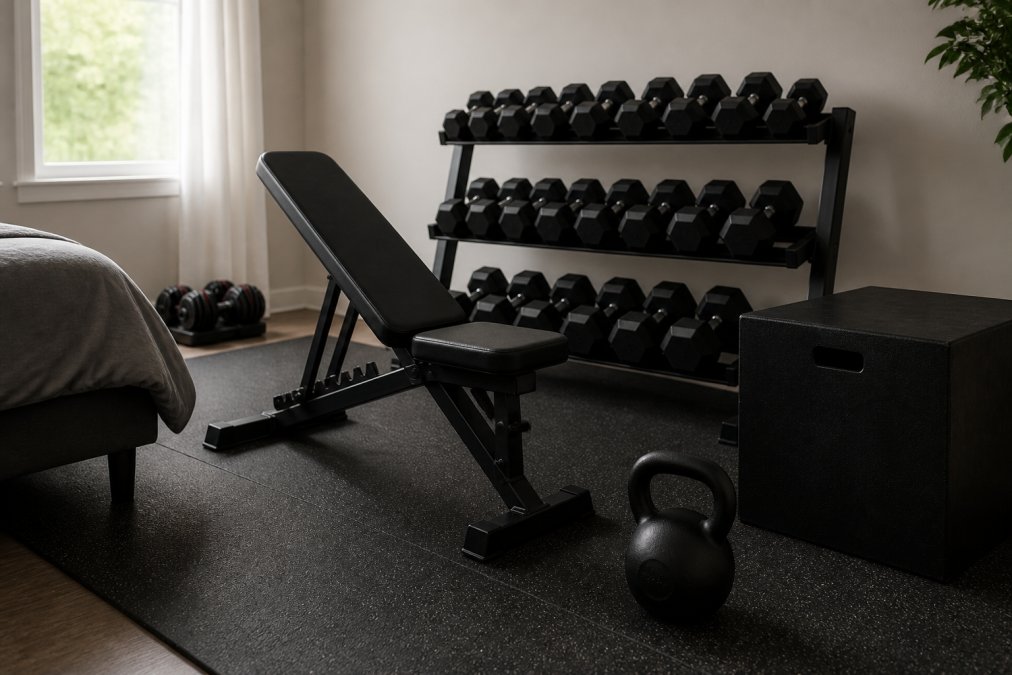
Adjustable Dumbbells are the foundation. The Adjustable 15lbs Rubber Hex Dumbbell Set ($55.80) provides a starting point. As you get stronger, you'll eventually need heavier dumbbells for pressing and deadlifts and rows.
A Weight Bench provides stability for pressing and creates options for single-leg work. The Multi-Functional Adjustable Weight Bench ($121.91) includes a squat rack and pull-up handles.
A Kettlebell handles ballistic movements and unilateral work that dumbbells don't replicate as effectively. The Versatile Adjustable Kettlebell with 7 Weight Levels ($117.02) lets you adjust load for different movements.
Resistance Bands add variety and train through ranges where free weights create joint stress. Use them for lat pulldowns, face pulls, and leg curls.
A Pull-up Bar (if you have a doorway) opens up pulling exercises. Many adjustable benches include pull-up handles.
A Plyometric Box (optional) enables explosive training and step-ups. The Versatile 3-in-1 Wooden Plyometric Jump Box ($66.14) provides adjustable heights.
Start with dumbbells and a bench. Add a kettlebell and resistance bands once comfortable with fundamentals.
| Equipment | Primary Use | Cost Range | Space Required |
|---|---|---|---|
| Adjustable Dumbbells | Pressing, pulling, single-limb work | $50-200 | Minimal |
| Weight Bench | Pressing stability, single-leg exercises | $100-300 | Moderate |
| Kettlebell | Ballistic movements, unilateral work | $50-150 | Minimal |
| Resistance Bands | Accessory work, joint-friendly options | $20-80 | Minimal |
| Pull-up Bar | Pulling exercises, bodyweight work | $30-100 | Minimal |
| Plyometric Box | Explosive training, step-ups | $60-150 | Moderate |
Muscle Building Nutrition Guide for Home Training
Perfect training fails without nutrition supporting growth. Muscle is built in the kitchen as much as in the gym.
Protein is the foundation. Most lifters need 0.7-1 gram of protein per pound of bodyweight daily. A 180-pound person should aim for 125-180 grams daily. Chicken, eggs, Greek yogurt, cottage cheese, and lean beef all work.
Caloric intake matters. Building muscle requires energy. A slight caloric surplus (300-500 calories above maintenance) supports muscle growth without excessive fat gain. Carbohydrates fuel your training and replenish glycogen stores, allowing higher intensity and volume. Fats support hormone production, aim for 20-30% of calories from fat sources like olive oil, nuts, avocados, and fatty fish.
Eating protein and carbs within a few hours post-workout supports recovery. A simple post-workout meal might be chicken with rice or a protein shake with a banana. Hydration affects performance and recovery, drink water consistently throughout the day, aiming for at least half your bodyweight in ounces daily.
Perfect training with poor nutrition yields slow progress. Average training with excellent nutrition yields faster progress.
Recovery, Rest Days, and Injury Prevention at Home
Muscle growth happens during recovery, not during training. Training creates the stimulus; rest allows adaptation. Rest days are mandatory, your muscles need 48 hours of recovery between intense sessions for the same muscle groups.
Sleep is where most adaptation happens. During deep sleep, growth hormone spikes and protein synthesis accelerates. Most lifters need 7-9 hours nightly. Less than 6 hours consistently sabotages progress.
Mobility work prevents injury. Spend 10 minutes daily on mobility: hip flexor stretches, shoulder dislocations, and ankle mobility drills. Form matters more at home because you lack a coach watching. Film yourself and compare to quality demonstration videos.
Progressive overload should be gradual. Add 5 pounds every 2-3 weeks. Common home training injuries are usually preventable: shoulder impingement from excessive pressing without adequate pulling, lower back strain from poor deadlift form, and knee pain from uncontrolled descent during squats.
Overcoming Psychological Barriers to Consistency
The biggest obstacle to building muscle at home isn't equipment or knowledge, it's consistency. Most people start strong and fade within weeks.
The first barrier is lack of external accountability. Build accountability: tell someone your plan, track workouts visibly, or use a training app that sends reminders. Instead of relying on motivation, build systems: same training days each week, same time, same location.
Progress feels slow at home because you're not comparing yourself to others. Track your workouts specifically: weight, reps, sets. Reviewing progress from three months ago is motivating. Rotate exercises every 4-6 weeks to prevent boredom.
Many people believe home training is "less serious" than gym training. This mindset sabotages effort. The person training at home with perfect form, progressive overload, and consistency builds more muscle than the person at a gym doing random exercises without a plan. Your environment doesn't determine results; your strategy and effort do.
Bodyhackfitness addresses this through digital fitness programs designed specifically for home training, providing structure, progression, and accountability without requiring a gym.
Building muscle at home is entirely achievable when you understand the fundamentals: progressive overload, compound movements, adequate nutrition, and consistent recovery. Start with essential equipment from Bodyhackfitness, follow a structured plan, and track your progress. Within 12 weeks of consistent training, you'll see measurable muscle growth and strength gains.
Frequently Asked Questions
Q: Can you build muscle with just home workouts?
A: Yes. Muscle growth depends on progressive overload, time under tension, and adequate protein, not location. Bodyweight training, dumbbells, kettlebells, and resistance bands create enough mechanical tension to trigger hypertrophy. The key is systematically increasing volume or intensity over time. Many people build significant muscle at home using compound movements like push-ups, squats, and rows paired with progressive resistance.
Q: How do you achieve progressive overload without a full gym?
A: Progressive overload at home works through multiple methods: increase reps or sets, reduce rest intervals, add tempo work (slow eccentric phase), use unilateral movements, or add resistance bands and adjustable dumbbells. For example, perform an extra rep each week on compound exercises, or add a 3-second pause at the bottom of a squat to increase time under tension. Small increments compound into significant strength and muscle gains.
Q: What role does nutrition play in muscle growth for home-based training?
A: Nutrition is non-negotiable. Muscle protein synthesis requires adequate protein intake (0.7-1g per pound of body weight daily), sufficient calories to support training recovery, and proper macronutrient balance. Post-workout nutrition matters, consume protein and carbs within 2 hours after training to optimize recovery. Without proper nutrition, even perfect training produces minimal muscle gain.
Q: How often should you train to build muscle at home?
A: Train 3-5 days per week, targeting each muscle group 2-3 times weekly. This frequency allows sufficient volume for hypertrophy while permitting adequate recovery between sessions. Full-body routines work well for beginners; intermediate lifters benefit from upper/lower or push/pull/legs splits. Recovery capacity matters, if you're not sleeping 7-9 hours or eating enough, reduce frequency rather than increase it.
This article was written using GrandRanker