

Table of Contents
- Can Tight Hip Flexors Actually Cause Knee Pain?
- Understanding Hip Flexor Anatomy and Function
- Symptoms of Tight Hip Flexors and Knee Dysfunction
- How Tight Hips Alter Gait and Create Compensatory Patterns
- Hip Flexor Stretches for Knee Pain Relief
- Best Recovery Tools for Tight Hips
- Ergonomic Adjustments and Preventative Care
- Frequently Asked Questions
Last Updated: September 19, 2026
Can Tight Hip Flexors Actually Cause Knee Pain?
Yes, can tight hip flexors cause knee pain? Absolutely, when they tighten, they pull your pelvis forward and alter your entire lower body's movement pattern, forcing your knees to work harder and bear stress they're not designed to handle. When they tighten, they pull your pelvis forward and alter your entire lower body's movement pattern, forcing your knees to work harder and bear stress they're not designed to handle. This connection between hip tightness and knee dysfunction is one of the most overlooked causes of lower-body pain.
Most people treat knee pain in isolation, stretching, icing, or resting the knee. But if tight hip flexors are the root cause, treating only the symptom never solves the problem. Understanding this connection is the first step to real relief.
Understanding Hip Flexor Anatomy and Function
Your hip flexors pull your leg up toward your chest. The two main players are the iliopsoas and the rectus femoris, both at the front of your hip, and both directly influence how your knee tracks and moves.
The Iliopsoas and Rectus Femoris
The iliopsoas connects your lower spine to your femur (thighbone) (Anatomy, Bony Pelvis and Lower Limb: Iliopsoas Muscle). The rectus femoris is part of your quadriceps and also crosses the hip joint. When these muscles tighten, they pull your femur forward and up, tilting your pelvis anteriorly so your hips shift forward and your lower back arches more.
The rectus femoris crosses both your hip and knee joints (Anatomy, Abdomen and Pelvis, Rectus Femoris Muscle). When tight, it pulls directly on your knee from above, changing how your kneecap tracks and creating uneven pressure inside the knee joint over time.
The Kinetic Chain Connection
Your body moves as one integrated chain. Your hips, knees, and ankles are connected through muscle, fascia, and bone alignment. Tight hip flexors disrupt this entire chain.
A tight iliopsoas prevents full hip extension, which is crucial for normal walking. Without it, your body compensates by rotating your pelvis or hyperextending your lower back, forcing your knee to absorb extra stress.
Symptoms of Tight Hip Flexors and Knee Dysfunction
Tight hip flexors often announce themselves first as knee discomfort rather than hip pain. You might notice pain on the inside of your knee just below the kneecap, a dull ache at the front during activity, or sharp pain when climbing stairs or sitting for long periods.
Common symptoms include:
- Pain at the front of the knee or inside the knee joint
- Knee pain that worsens with activities like running, cycling, or climbing stairs
- Stiffness in the hip that limits how far you can extend your leg backward
- Lower back pain or excessive lower back arch
- Difficulty standing upright for extended periods without discomfort
The knee pain often feels internal because tight hip flexors alter pressure distribution inside your knee. Your patella (kneecap) tracks differently, and cartilage surfaces experience uneven loading, creating internal knee pain even though the primary problem is hip tightness above.
How Tight Hips Alter Gait and Create Compensatory Patterns
When your hip flexors are tight, your gait changes predictably: your stride shortens, your pelvis tilts forward, and your foot strike pattern shifts. Your body compensates automatically, but compensation always creates new problems.
Pelvic Tilt and Femoral Alignment Issues
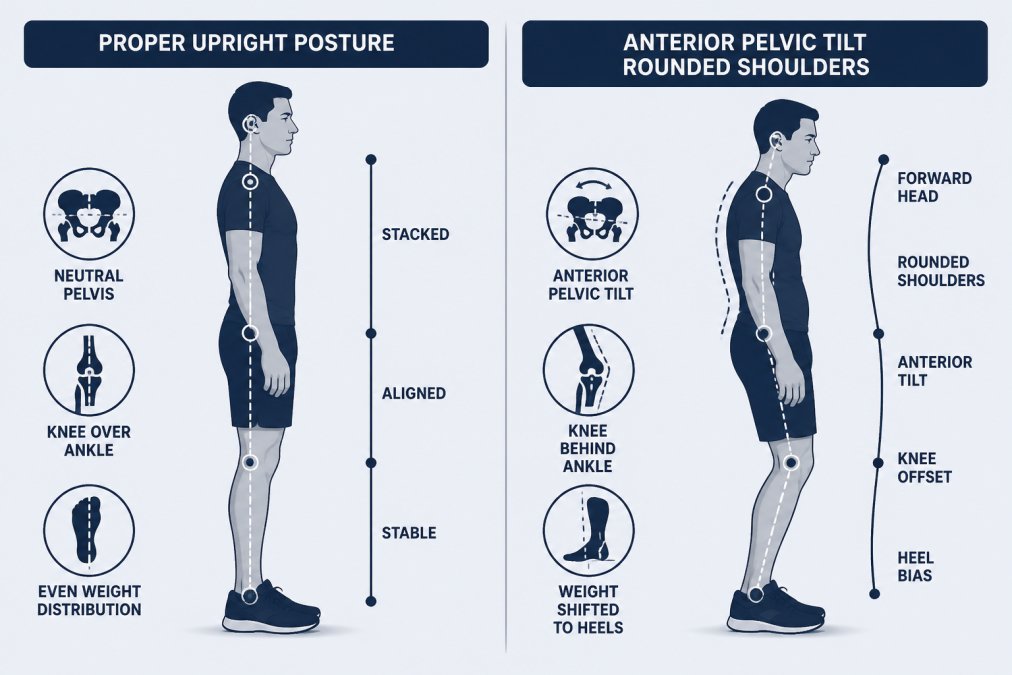
Anterior pelvic tilt occurs when tight hip flexors pull your pelvis forward, shifting your hips forward, arching your lower back excessively, and rotating your femur (thighbone) inside your hip socket.
This rotation changes everything downstream. Your knee tracks inward slightly instead of straight, creating valgus stress that damages inner knee cartilage and stresses your ACL and other ligaments over time.
Activity amplifies valgus stress. Your knee compensates by rotating outward at the ankle, your foot turns out, your arch flattens, and your ankle absorbs stress it shouldn't bear.
The Role of Gluteal Activation and Adductor Weakness
Your glutes are your hip extensors, meant to straighten your hip and drive your leg backward. But tight hip flexors dominate, making your glutes underactive and unable to fire with full strength, a condition called gluteal inhibition.
Weak glutes can't stabilize your pelvis during movement, causing pelvic drop that forces your knee to work harder. Weak adductors compound the problem by making your hip less stable, forcing your knee to compensate further.
Foam roller Roller For body Relief →
This creates a vicious cycle: tight hip flexors inhibit your glutes, weak glutes allow excessive pelvic motion, excessive motion forces your knee to stabilize, your knee develops pain, pain reduces activity, and reduced activity tightens your hip flexors further.
Hip Flexor Stretches for Knee Pain Relief
Stretching tight hip flexors is essential for knee pain relief, but it must be done correctly. Poor technique won't fix the problem and might aggravate it.
Static and Dynamic Stretching Techniques
Static stretches hold a position for 20-30 seconds after activity when muscles are warm. The classic hip flexor stretch is the low lunge: step one leg forward, keep your back heel on the ground, tilt your pelvis backward slightly to avoid lower back arch, and feel the stretch along the front of your back hip.
Dynamic stretches move your hip through a range of motion before activity. Leg swings are effective: stand on one leg and swing your other leg forward and backward in a controlled motion, letting gravity do the work. Do 10-15 swings per leg.
Frequency and Progression Guidelines
Stretch your hip flexors daily if you have knee pain, starting with 2-3 stretches per day for 20-30 seconds each. As flexibility improves, add more stretches or increase hold time to 45-60 seconds.
Progress gradually, don't force deeper stretches for faster results. Overstretching causes inflammation. Consistency matters more than intensity.
Track your progress.
Best Recovery Tools for Tight Hips
Soft tissue mobilization tools help release tension in your hip flexors and prepare them for stretching. Foam rolling and massage tools target muscle tension directly.
Soft Tissue Mobilization Equipment
The Foam Roller for Body Relief from Bodyhackfitness is a 33 cm high-density foam tool that applies pressure to tight muscles, breaking up adhesions and improving blood flow. Roll slowly along the front of your hip and thigh for 60-90 seconds per side.
The Foam Massage Roller for Muscle Relief provides high-density foam in a portable format for your hip flexors, quadriceps, and surrounding muscles.
Self-Assessment Tests to Diagnose Hip Flexor Tightness
Assess your current hip flexor tightness before starting a recovery program to track progress and confirm hip tightness is your issue.
Ergonomic Adjustments and Preventative Care
Hip flexor tightness develops over time, usually from sitting too much and moving too little. Preventing future tightness requires changing how you sit, work, and move throughout the day.
| Recovery Strategy | Frequency | Duration | Best For |
|---|---|---|---|
| Hip flexor stretching | Daily | 20-30 seconds per side | Improving flexibility and range of motion |
| Foam rolling | 3-4 times per week | 60-90 seconds per muscle | Breaking up muscle tension and adhesions |
| Massage gun use | 2-3 times per week | 30-60 seconds per area | Increasing blood flow and rapid tension release |
| Glute activation exercises | 3 times per week | 2-3 sets of 10-15 reps | Restoring proper movement patterns |
| Posture and ergonomic adjustments | Daily | Ongoing throughout day | Preventing future tightness and compensation |
Frequently Asked Questions
How do I know if tight hip flexors are causing my knee pain?
Tight hip flexors typically cause anterior knee pain (pain in the front of the knee) rather than behind or on the sides. You may notice your knee pain worsens when sitting for long periods or after activities that involve hip flexion. A simple test: lie on your back with one leg hanging off the edge of a table; if your thigh drops below horizontal, your hip flexors are tight. Pain that improves with hip flexor stretching and worsens with prolonged sitting suggests hip flexor involvement in your knee dysfunction.
What are the main symptoms of tight hip flexors?
Common symptoms include lower back pain, anterior pelvic tilt (excessive inward curve of the lower back), difficulty standing upright, and a shortened stride when walking. You may feel tightness in the front of the hip or groin area, and knee pain that worsens with activities like running, climbing stairs, or prolonged sitting. Some people experience hip flexor pain directly, while others only notice the compensatory knee pain that results from altered biomechanics and muscle imbalances.
How can hip flexor stretches help relieve knee pain?
Hip flexor stretches restore normal range of motion and reduce the compensatory stress placed on your knee joint. When hip flexors are tight, they create an anterior pelvic tilt that alters femoral alignment and increases patellofemoral stress. Regular stretching corrects this postural deviation, allowing your glutes and other stabilizer muscles to engage properly during movement. This restores proper gait mechanics and reduces abnormal loading on the knee, which decreases pain over time.
What recovery tools work best for tight hips?
Foam rollers and massage balls provide effective soft tissue mobilization for the iliopsoas, rectus femoris, and tensor fasciae latae. A high-density foam roller measuring 33 cm can target the hip flexors and surrounding muscles, improving flexibility and blood circulation. Massage guns with multiple heads allow targeted deep tissue work on specific trigger points. These tools can be used 3-4 times weekly for 60-90 seconds per muscle group, combined with stretching to address muscle tightness and support recovery.