


Table of Contents
- Why Home Gym Alternatives Beat a Single Expensive Machine
- The Real Cost Gap: Machines vs. Home Gym Alternatives
- Budget Home Gym Equipment That Covers Every Muscle Group
- Resistance Bands vs. Weight Machines: Which Builds More Strength?
- Cable Machine Alternatives You Can Set Up in Minutes
- Bodyweight Exercises at Home That Replace Machines Entirely
- What to Buy First: A Three-Tier Spending Plan
- Conclusion
- Frequently Asked Questions
Last Updated: October 18, 2026
Why Home Gym Alternatives Beat a Single Expensive Machine
A single high-end home gym machine can cost more than a complete set of free weights, bands, and bars combined, and it still only trains the movement patterns its designers chose, which is why so many buyers end up searching for alternatives to expensive home gym machines. That is the trade-off most buyers miss.
The alternatives to expensive home gym machines are not "cheap" in the sense of flimsy. They are modular. A dumbbell, a kettlebell, a band set, and a pull-up bar cover pressing, pulling, hinging, squatting, and carrying between them. One machine covers one or two of those at best.

Below, we break down the real cost gap, the equipment that covers every muscle group, and a three-tier spending plan so you know exactly what to buy first.
The Real Cost Gap: Machines vs. Home Gym Alternatives
The gap is not marginal. A single cable or functional trainer typically runs into four figures. You are paying for a frame, a weight stack, and a footprint.
Here is how the categories compare on the factors that actually affect your training:
| Option | Typical Cost Tier | Space Needed | Muscle Coverage | Expandable |
|---|---|---|---|---|
| Single home gym machine | High, four figures | Large, fixed footprint | Limited to its stations | No |
| Adjustable dumbbells or kettlebell | Low to mid hundreds | Small, storable | Full body | Yes, add pieces |
| Resistance band set | Low hundreds | Fits in a drawer | Full body, joint-friendly | Yes |
| Pull-up bar | Low hundreds | Door frame only | Upper body pulling | Yes |
| Bodyweight plus mat | Low hundreds | A mat's width | Full body with progressions | Yes |
The footprint difference matters as much as the price. A machine commits a room. A kettlebell, a band set, and a folding mat commit a corner and a drawer.

A common mistake is buying the machine first and the accessories later. Buy the accessories first, train for a month, and let your actual training habits tell you whether a bigger piece is worth the space.
Budget Home Gym Equipment That Covers Every Muscle Group
Budget home gym equipment works when it covers movement patterns rather than individual muscles. Press, pull, hinge, squat, carry, and rotate. Four or five pieces handle all six.
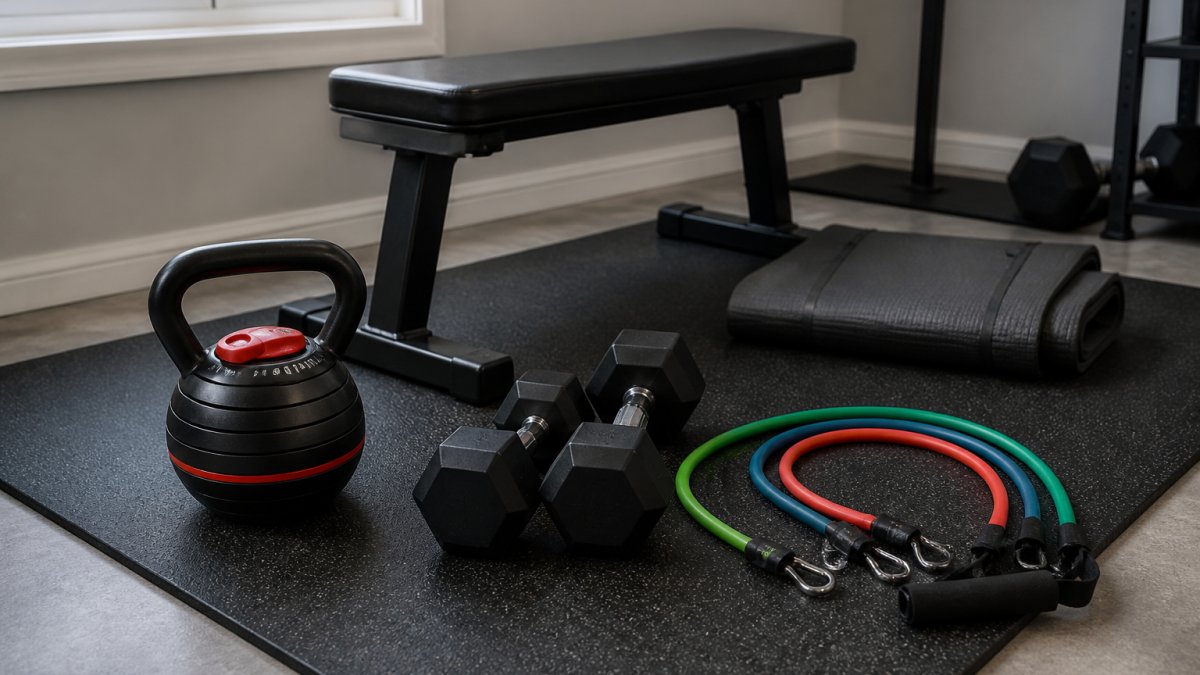
Dumbbells and Kettlebells: The Adjustable Route
Adjustable is the whole argument here. A fixed rack of dumbbells costs more and eats floor space; one adjustable piece replaces the rack.
Our Versatile Adjustable Kettlebell gives you seven weight levels in a single unit, with an aluminum alloy handle with an elegant electroplated finish, an ABS body designed to absorb shock, and a flat bottom for stable storage. It expertly tones and tightens your legs, core, and upper body, creating smoother, more defined lines that exude power and grace.
For pressing and rowing work, our Premium 20LB Rubber Coated Cast Iron Dumbbell has rubber-coated hexagon heads that will not roll, a threaded steel shaft, and a chromed, knurled handle that grips in any hand size. The rubber also protects your floor and cuts noise.

Bands, Bars, and Rollers Under $150
This is where the budget stretches furthest. Every piece below sits under $150 and covers a movement the others do not.
- 5-Piece Latex Resistance Training Band Set ($74.83): three latex bands, a handle, and a door anchor, with adjustable resistance for deltoid pushes, face pulls, and biceps curls.
- Ultimate Ab Roller Wheel ($86.69): a 3.55-inch ultra-wide wheel for stability, stainless steel shafts rated to 600 pounds, and a free knee pad included.
- Fitness Stick Pilates Bar ($95.58): a detachable steel bar with a foam grip, compatible with resistance bands and tubes, rated to 800 lbs.
- Doorway Pull-Up Bar ($134.85): heavy-duty steel, installs on door frames without drilling, and stores away between sessions.
Resistance Bands vs. Weight Machines: Which Builds More Strength?
Resistance bands build strength comparable to weight machines when you train to genuine effort, and they load the joints more gently on the way down. The catch is measurement: bands do not tell you the number.
Machines win on two things. Load is quantified, so progressive overload is easy to program. And the fixed path removes balance demands, which helps beginners and rehab cases.
Bands win on portability, cost, joint comfort, and the fact that resistance rises through the range of motion. That rising tension is why band work feels harder at lockout than a free weight does.
A practical split: use bands for accessory work, warm-ups, and travel; use dumbbells or a kettlebell for your main compound lifts. That combination covers what a machine does without the footprint.
Cable Machine Alternatives You Can Set Up in Minutes
A door anchor plus a band set is the closest thing to a cable machine you can build at home. It gives you adjustable height, constant-ish tension, and dozens of exercises.
Premium 20LB Rubber Coated Cast Iron Dumbbell with Ergonomic Chrome Handle →
Set it up in this order:
- Loop the door anchor strap through the hinge side of a closed door and latch it.
- Clip the band handle to the anchor at the height you need.
- Step back until the band is taut at the start of the movement.
- Check the door is latched and the strap sits above or below the latch, never on it.
From there, face pulls, triceps pushdowns, seated rows, chest press, and woodchops all work. Our 300lb Fitness Booty Resistance Elastic Band Set includes ankle straps and door attachments plus a 40-inch metal workout bar with a foam grip, so the same anchor handles lower-body work.
Bodyweight Exercises at Home That Replace Machines Entirely
Bodyweight exercises at home replace machines when you manipulate use, tempo, and range instead of load. Push-up variations cover the chest press. Rows under a table or with a band cover the seated row. Split squats and pistol progressions cover the leg press.
The progression ladder matters more than the exercise choice:
- Push: wall push-up, incline push-up, floor push-up, feet-elevated push-up, archer push-up.
- Pull: band row, table row, chin-up negative, full chin-up, weighted chin-up.
- Legs: box squat, split squat, rear-foot-elevated split squat, assisted pistol, full pistol.
- Core: dead bug, plank, ab roller rollout, hanging knee raise.
Our Ultimate Ab Roller Wheel is the natural step up from a plank once a minute of holding becomes easy. Our Thick Folding Fitness Yoga Mat gives you a 60 cm by 180 cm cushioned surface that folds to 60 cm square for storage, which matters if your training space doubles as a living room.
What to Buy First: A Three-Tier Spending Plan
Start with the tier that matches your current training, not your ambition. Buy the next tier only after four consistent weeks at the current one.
| Tier | What You Buy | What It Covers | Best For |
|---|---|---|---|
| Tier 1: Foundation | Band set plus folding mat | Full-body resistance, floor work, mobility | Beginners and small spaces |
| Tier 2: Load | Adjustable kettlebell plus doorway pull-up bar | Hinging, pressing, pulling with real load | Trainees ready for progressive overload |
| Tier 3: Specialization | Dumbbell, ab roller, Pilates bar, stepper | Heavier pressing, core, full-body tension, legs | Consistent trainees filling specific gaps |
A realistic sequence: Tier 1 first month, Tier 2 once band work feels easy, Tier 3 only when a specific weakness shows up in your training log.
Two things to watch for. First, do not buy Tier 3 before you have trained Tier 1 for a month; the equipment will sit unused. Second, check your door frames before ordering a pull-up bar. The Doorway Pull-Up Bar fits frames between 78 and 105 cm wide and installs without drilling, but a non-standard frame will not hold it safely.
Conclusion
The hardest part of building a home gym is not choosing equipment. Start modular, train for a month, and let your logbook decide what comes next.
That is exactly how we approach it at Bodyhackfitnesss. Our catalogue is built around pieces that stack into a complete training environment: an adjustable kettlebell with seven weight levels, a 300lb band set with door attachments, and a doorway pull-up bar that installs without drilling. Add a folding mat and you have a full gym in a corner.
Shop now and build the setup that fits your space, your budget, and the way you actually train.
Frequently Asked Questions
What can I use instead of an expensive home gym machine?
Most machine-based movements have a cheap equivalent. A doorway pull-up bar covers vertical pulling, resistance bands with a door anchor replace cable rows and face pulls, an adjustable kettlebell handles swings, squats, and presses, and an ab roller trains the core that a crunch machine targets. Put those four together and you cover pushing, pulling, hinging, squatting, and core work for well under $500 total, which is less than a single mid-range machine.
Can resistance bands replace a home gym machine?
For most home training, yes. Bands load muscles through a full range of motion and are far more forgiving on joints than stacked plates. The tradeoff is that resistance rises as the band stretches, so the top of a curl or press feels heavier than the bottom. That makes bands excellent for rows, pull-aparts, presses, and lateral work, while free weights still win for heavy squats and deadlifts. Pair both and you get the benefits of each without buying a machine.
What is the cheapest way to build a home gym?
Start with bodyweight exercises at home, which cost nothing: push-ups, split squats, planks, and inverted rows under a sturdy table. Add a resistance band set for around $75 and a doorway pull-up bar for around $135, and you have a full upper and lower body program for about $210. Add a folding mat for floor work and you are still under $350, with everything storable in a closet.
Are adjustable dumbbells worth it for a home gym?
They are one of the highest-value purchases you can make. A single adjustable kettlebell with seven weight levels covers swings, goblet squats, presses, and rows across a wide strength range, and it takes up about as much space as a shoebox. Compare that to a rack of fixed weights or a plate-loaded machine that eats a whole wall. If you have room for only one piece of equipment, make it adjustable.
How can I do cable exercises without a cable machine?
A resistance band anchored in a door frame replicates most cable movements. Loop the band through the anchor at chest height for rows and face pulls, at ankle height for woodchops and glute kickbacks, and overhead for lat pulldowns. A pilates bar with band clips adds straight-bar pressing and curling. The tension curve differs from a cable stack, but the movement pattern and muscle recruitment are close enough that most people cannot tell the difference in results.