

Table of Contents
- What Direct-to-Consumer Actually Means
- Why Control Over Your Customer Journey Matters
- DTC Marketing Strategies That Drive Real Results
- Building Your DTC Tech Stack Tools
- DTC Business Model Examples Across Industries
- Unit Economics and Profitability: The Numbers That Matter
- Scaling Your Direct-to-Consumer Operation
- Conclusion
Last Updated: August 10, 2026
What Direct-to-Consumer Actually Means
Direct-to-consumer is the business model where brands sell products directly to end customers, eliminating wholesalers, distributors, and retail intermediaries. DTC companies own the entire customer relationship from purchase through post-sale support. At Bodyhackfitness, we've built our entire operation around this model, curating premium gym products and digital fitness programs that reach customers without the markup layers that traditional retail adds.
The DTC approach fundamentally changes how brands interact with their audience. You control the storefront experience, set pricing, capture customer data, and manage fulfillment directly. This shift has become viable because e-commerce platforms have matured, shipping infrastructure has improved, and consumers now expect direct brand relationships.
Why Control Over Your Customer Journey Matters
When you eliminate intermediaries, you gain complete visibility into how customers discover, evaluate, and purchase your products. Traditional retail fragments this journey, manufacturers never see transaction data, customer behavior, or return patterns. DTC flips this entirely. Every interaction generates data you control, from ad impressions through post-purchase follow-up.
This data becomes your competitive advantage. Brands that understand customer behavior can optimize pricing, personalize marketing, and identify product gaps faster than competitors relying on retail reports. Control also means you build brand loyalty directly. Retail commoditizes products; DTC lets you create community, tell your brand story authentically, and reward repeat customers with exclusive offers or early access.
DTC Marketing Strategies That Drive Real Results
Most DTC brands fail because they treat marketing as a volume game. Successful ones optimize for customer acquisition cost relative to lifetime value, build retention strategies before scaling acquisition, and use owned channels to reduce dependence on paid advertising.
First, understand your unit economics before spending aggressively on customer acquisition. Calculate gross margin per product, estimate repeat purchase frequency, and set a maximum acceptable acquisition cost. This prevents acquiring customers you can't afford to keep.

Content marketing becomes essential in DTC. You can own search rankings, build audiences on social platforms, and create educational content that attracts customers searching for solutions your products address. A fitness brand might publish workout guides, recovery tips, or equipment reviews that rank in search and build trust before customers see a product page.
Email remains the highest-ROI channel because you own the list. Segmentation matters, new customers need onboarding, repeat customers respond to loyalty rewards, inactive customers need win-back campaigns. Referral programs also convert satisfied customers into acquisition channels at lower cost than paid ads.
Building Your DTC Tech Stack Tools
Your tech stack determines whether you can execute efficiently or manually manage processes that should be automated. The minimal viable stack includes an e-commerce platform, email marketing software, analytics, and fulfillment integration.
The e-commerce platform handles product catalogs, shopping carts, payment processing, and customer data. Your choice depends on technical comfort and customization needs. Email marketing software connects to your customer list and automates messaging based on behavior triggers. Analytics platforms track which channels drive traffic, which products generate revenue, and which customer segments have highest lifetime value.
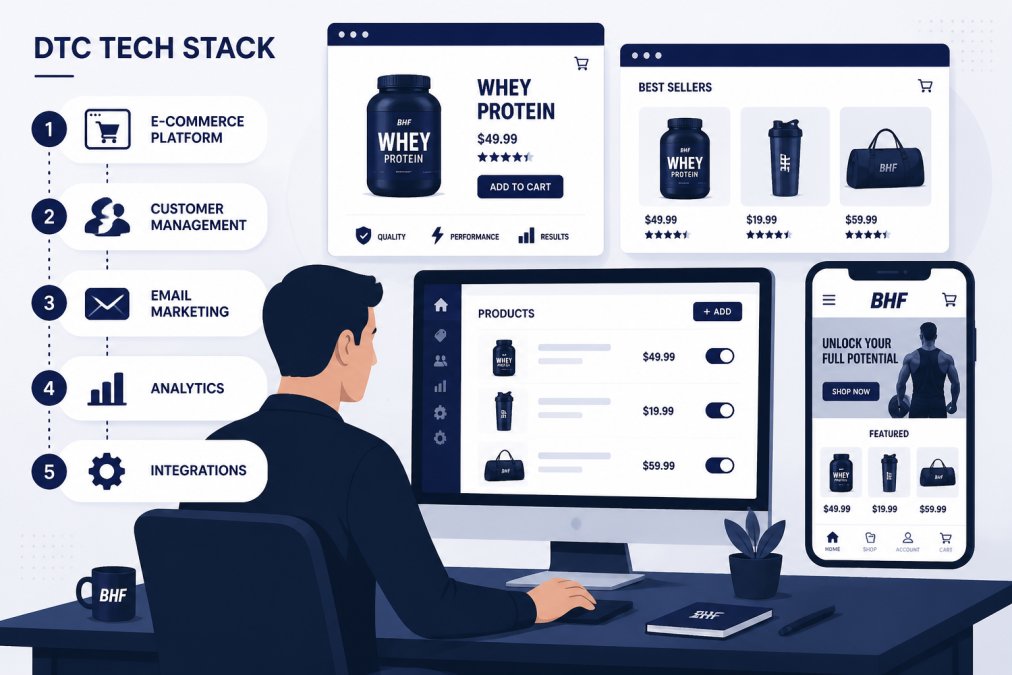
Fulfillment integration connects your e-commerce platform to shipping providers so orders automatically flow to your warehouse and tracking information reaches customers. Payment processing affects transaction fees, fraud protection, and customer experience, the cost difference can be substantial at scale.
DTC Business Model Examples Across Industries
The DTC model works across virtually every product category, but execution varies significantly by industry.
Fitness equipment brands like Bodyhackfitness operate where direct relationships matter. Customers buying premium home gym equipment want expert guidance and confidence they're making the right choice. DTC eliminates retail markups and allows investment in digital content, workout programs, and recovery protocols that retail environments can't provide.
Apparel brands use DTC to control brand narrative and pricing. Manufacturing in Asia and selling directly at retail price rather than wholesale at 50% discount allows investment in customer experience and faster product iteration. Supplement companies use DTC for subscription models, customers receive monthly shipments automatically, creating predictable revenue and reducing acquisition cost per order. Beauty brands use DTC to build community around skin health and customer connection.
Unit Economics and Profitability: The Numbers That Matter
Unit economics determine whether your DTC business survives. The core metrics are simple but essential.
Gross margin is revenue minus cost of goods sold. If you sell a product for $100 and it costs $30 to manufacture and ship, your gross margin is $70. Everything else, marketing, salaries, technology, comes out of gross margin.
Customer acquisition cost is marketing spend divided by new customers acquired. If you spend $5,000 on ads and acquire 50 customers, CAC is $100. This matters in relation to customer lifetime value, the total profit expected from a customer over their relationship with your brand.
Repeat purchase rate tells you what percentage of customers buy more than once. A 30% repeat purchase rate means 70% never return, signaling product or retention issues. Payback period is how long it takes for a customer's purchases to cover acquisition cost. Shorter payback periods mean you recover capital faster and reinvest sooner.
These metrics interconnect. A business with high CAC needs either high average order value, high repeat purchase rate, or both. Understanding these relationships helps you identify which levers to pull for profitability.
Scaling Your Direct-to-Consumer Operation
Scaling DTC is fundamentally different from starting it. Early stage, you can manually manage orders and personally respond to emails. At scale, every manual process becomes a bottleneck.
The first scaling challenge is fulfillment. At 500 orders per week, you need either a dedicated warehouse or a third-party fulfillment partner. Third-party fulfillment costs more per order but eliminates capital investment and operational complexity.
Inventory management becomes critical. Stock too much and you tie up capital; stock too little and you lose sales. Many DTC brands use demand forecasting software that predicts future demand based on historical patterns.
Customer service scales through automation. Early stage, you answer every email personally. At scale, you need ticketing software, knowledge bases for self-service, and clear escalation paths. Many brands use chatbots for initial triage, then route to humans when needed.
Marketing efficiency becomes more important as acquisition gets expensive. Early stage, every customer is profitable. At scale, CAC rises and you need sophisticated targeting, messaging, and channel optimization. Supply chain complexity increases, you might source from multiple suppliers and manage inventory across regions. Team structure must evolve from generalists to specialists in marketing, customer service, and operations.
The direct-to-consumer model gives you control over your brand story, customer relationships, and profitability. It requires more operational complexity than wholesale distribution, but the upside is complete ownership of your business. Start with clear unit economics, build systems that automate manual processes, and invest in retention alongside acquisition. The brands winning in DTC understand their customers deeply enough to deliver experiences competitors can't replicate.
At Bodyhackfitness, we believe premium fitness equipment and digital programs deserve direct relationships with customers. When you buy from us, you're joining a community of people committed to training harder and recovering faster. Explore our curated selection of premium gym products and digital fitness programs designed to support your fitness journey at every stage.
Frequently Asked Questions
What does direct-to-consumer mean?
Direct-to-consumer (DTC) means selling products directly to customers without intermediaries like wholesalers or retail stores. You own the entire customer journey, from marketing and sales to fulfillment and post-purchase support. This model gives you direct access to customer data, allows you to set pricing and brand messaging, and creates opportunities to build lasting customer relationships and brand loyalty.
What are the primary benefits of a direct-to-consumer business model?
DTC offers control over brand presentation, higher profit margins by eliminating middlemen, direct customer insights through data collection, the ability to build community and loyalty, and flexibility to respond quickly to market feedback. You also own customer acquisition cost metrics and lifetime value data, enabling data-driven decision making that wholesale models can't provide.
What are the biggest challenges in direct-to-consumer fulfillment?
Fulfillment complexity includes managing inventory across multiple touchpoints, handling returns and customer service at scale, optimizing logistics costs while maintaining fast delivery, and ensuring consistent post-purchase experience. Many DTC brands struggle with supply chain visibility, last-mile delivery costs, and the operational overhead of managing fulfillment in-house versus outsourcing to third-party logistics providers.
How do you transition from wholesale to a direct-to-consumer strategy?
Start by building an e-commerce platform and establishing direct customer channels. Develop a DTC marketing strategy focused on customer acquisition through digital channels. Invest in fulfillment capabilities or partner with logistics providers. Simultaneously, analyze unit economics to ensure DTC margins justify the investment. Gradually shift marketing spend from wholesale support to direct channels while maintaining existing wholesale relationships during transition.
This article was written using GrandRanker