

Table of Contents
- Common Causes of Wrist Pain During Dumbbell Training
- Proper Wrist Alignment for Dumbbell Exercises
- Wrist Strengthening Exercises for Lifters
- When and How to Use Wrist Wraps for Weightlifting
- Warm-Up Routine and Load Management for Wrist Health
- Post-Injury Return-to-Training Protocol
- When to Seek Professional Medical Advice
- Conclusion: Building a Wrist-Safe Dumbbell Practice
- Frequently Asked Questions
Last Updated: September 12, 2026
Common Causes of Wrist Pain During Dumbbell Training
Dumbbell training wrist safety usually comes down to two problems: the wrist drifting out of alignment under load, and a strength gap between the muscles that move the weight and the ones that stabilize it. We often see lifters chase heavier dumbbells long before their forearms and grip can support the load. That mismatch is where most nagging wrist pain starts.
Overextension and Poor Grip Mechanics
Overextension is the backward bending of the wrist beyond its natural straight line, and it is the single most common cause of dumbbell-related wrist pain. It happens when the wrist collapses backward at the top of a curl or press instead of staying stacked over the forearm.
A common mistake is letting the dumbbell roll the hand back as fatigue sets in. The fix is a grip adjustment: squeeze the handle so the knuckles stay roughly in line with the forearm, and stop the set the moment that line breaks.
Muscular Imbalance and Repetitive Strain
The forearm flexors and wrist extensors rarely develop at the same rate. Pressing and curling build the flexors quickly, while the extensors lag behind, leaving the joint without balanced support. Repeated sessions with that gap create repetitive strain on the connective tissue around the wrist.
Rotating movement patterns and adding direct forearm work closes the gap faster than any brace can. If one side of your forearm is visibly larger, you have found your imbalance.
Proper Wrist Alignment for Dumbbell Exercises
Proper wrist alignment for dumbbell exercises means keeping the wrist in a neutral position, straight from the elbow through the hand, so force travels through the bones rather than the soft tissue. A neutral wrist keeps the load stacked over the forearm and reduces strain on the joint.
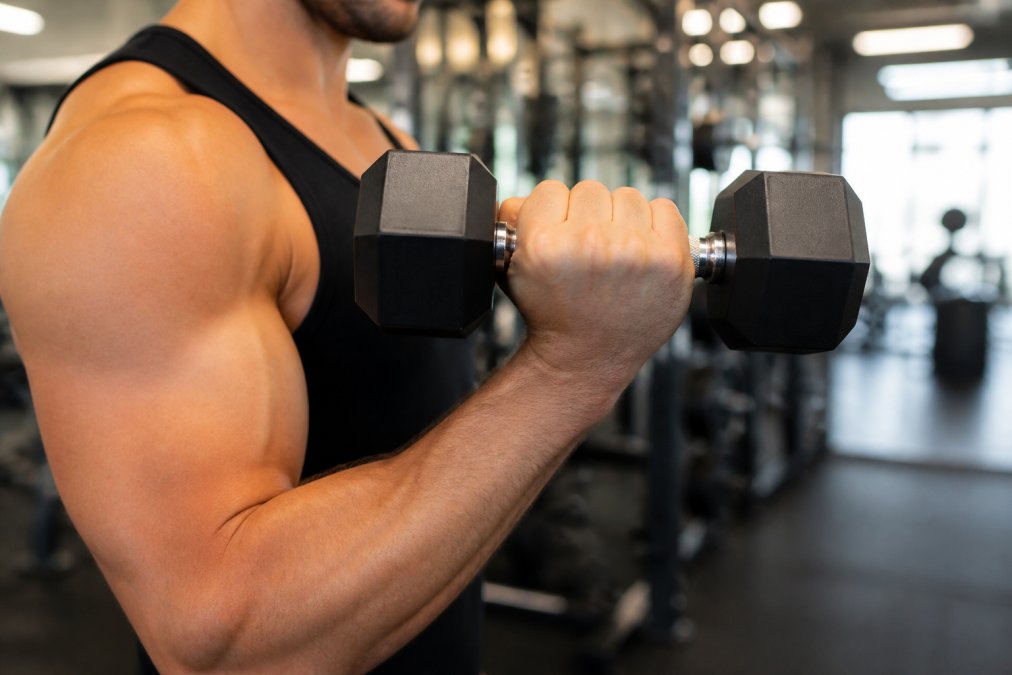
Neutral Grip vs. Pronated Grip: When to Use Each
A neutral grip (palms facing each other) keeps the wrist in its strongest, most stable position (PubMed). Use it for hammer curls, neutral-grip presses, and any movement where the wrist feels vulnerable.
A pronated grip (palms facing down) is standard for bench press and overhead press. It is fine when the wrist stays stacked, but it puts more torque on the joint, so it demands stricter form. When in doubt, the neutral grip wins.
Dumbbell-Specific Biomechanics: Why They Differ from Barbells
Dumbbells move independently, so each wrist has to control its own path instead of sharing a fixed bar. That freedom builds stabilizer muscles, but it also means a wobble in one hand has no bar to correct it.
This is the biomechanics most guides skip. With a barbell, the bar enforces alignment. With dumbbells, you enforce it, rep by rep, which is exactly why wrist strength matters more here.
Wrist Strengthening Exercises for Lifters
Wrist strengthening exercises for lifters build the stabilizer muscles and grip strength that keep the joint safe under load. Stronger forearms mean less overextension and better control on every rep, and with dumbbells, that control is doing more work than it does on a barbell, because each hand has to manage its own path.
Why Dumbbells Demand More From the Wrist
A barbell locks both hands to one bar, so the wrist only has to resist backward overextension. A dumbbell moves independently, so the wrist also has to resist side-to-side wobble and rotation. That extra demand is why lifters who press a barbell comfortably can still feel their wrists give out on dumbbell presses, the stabilizers are being asked to do a job the bar used to do for them.
Training the wrist directly is the foundation of dumbbell training wrist safety, and it closes that gap faster than any brace.
The Core Routine
Do this twice a week, ideally after your main lifts or on a separate day:
- Wrist curls with a light dumbbell, palms up, 2 sets of 15. Start at a weight you could curl 20 times and stop at 15.
- Reverse wrist curls, palms down, 2 sets of 15, to hit the extensors. This is the half most lifters skip.
- Wrist circles for joint mobility, 10 each direction, before and after loading.
- Dumbbell holds for grip strength, 3 holds of 20-30 seconds at a weight you can hold without the wrist rolling back.
- Pronation and supination with a light dumbbell held at one end, 2 sets of 12 each direction, to train the rotational control dumbbells demand.
Resistance bands work well for the curls if you do not have light dumbbells. Add a dedicated wrist exerciser to hit the forearm from multiple angles, and progress slowly, the wrist responds to consistency, not heavy loads.
Progression and Load Management
Treat wrist work like any other lift: add reps before weight, and add weight in small jumps. A common pattern is to add one rep per set per week until you hit the top of the rep range, then add the smallest available increment and drop back to the bottom of the range.
If a wrist exercise produces sharp pain rather than a burn, stop the set. Dull fatigue in the forearm is the goal; joint pain is a signal to back off.
Grip Width and Handle Thickness
Grip setup changes how much the wrist has to work:
- Narrower grip on dumbbell presses: the dumbbell sits closer to the midline, which can reduce the lever arm on the wrist but also reduces stability. Find the width where the wrist stays stacked without the dumbbell drifting inward.
- Wider grip on curls: shifts load toward the inner forearm and can aggravate the wrist if the extensors are weak. Keep the grip roughly shoulder-width unless a specific variation calls for otherwise.
- Thick handles: increase grip demand and fatigue the wrist faster. If you train with fat grips, cut the load and the set length until your grip catches up.
When and How to Use Wrist Wraps for Weightlifting
Wrist wraps for weightlifting support the joint during heavy pressing and overhead work by limiting backward overextension. They are a tool for your heaviest sets, not a permanent crutch, and with dumbbells specifically, they behave differently than they do on a barbell.
Why Dumbbells Change the Wrap Equation
On a barbell, the bar itself enforces a shared path, so a wrap mainly resists the wrist rolling backward under a fixed load. With dumbbells, each hand controls its own path, so the wrist has to resist both backward overextension and side-to-side wobble. That means a wrap helps most on the movements where the dumbbell wants to drift, heavy overhead presses, incline presses, and the top of a hammer curl when fatigue sets in.
A wrap does nothing for the lateral instability that dumbbells introduce. If your wrist is collapsing sideways rather than backward, the fix is grip and forearm strength, not more wrap tension.
How Tight, and How Often
Wrap snug enough to feel support, not so tight that your fingers tingle or the hand goes cold. A common pattern is to wrap for working sets above roughly 70-80% of your top weight and loosen or remove them between sets so circulation and proprioception recover.
- Heavy press or overhead day: wrap for top sets, unwrap for back-off sets.
- Light or technique day: skip the wraps entirely and let the stabilizers work.
- High-rep dumbbell work: wraps tend to mask fatigue rather than prevent injury, so use them sparingly.
Wearing wraps on every set is the most common way lifters quietly weaken the very stabilizer muscles that protect the wrist. If you cannot press a given dumbbell without wraps, that is a signal to drop the weight, not to tighten the wrap.
Wraps vs. Lifting Straps: What Each Does
These two get confused constantly, and they do opposite jobs.
| Gear | What It Does | Best For | Watch Out For |
|---|---|---|---|
| Wrist wraps | Limits wrist overextension | Heavy press, overhead work | Overuse weakens stabilizers |
| Lifting straps | Takes load off the grip | Heavy pulls, deadlifts, rows | Reduces grip training |
Wraps protect the wrist joint. Straps protect your grip by transferring load to the wrist, which is why using straps on every pull can quietly add wrist stress, especially with dumbbells, where the strap has no fixed bar to anchor against and the wrist absorbs more of the rotational load.
Equipment-Specific Safety: Handle Thickness and Rotating Handles
Most guides ignore how the dumbbell itself changes wrist strain, and this is where dumbbell training diverges most from barbell work.
- Thick handles (fat grips or fat-handle dumbbells): a larger diameter forces a more open hand, which reduces how much you can wrap the fingers around the handle. Grip fatigues faster, and as it fails, the wrist drifts backward. If you train with fat handles, drop the load and shorten sets until your grip catches up.
- Rotating or swivel handles: these let the dumbbell spin, which can reduce torque on the wrist during curls and presses, but they also remove the feedback that tells you the wrist is drifting. Lifters often feel safer than they are, so keep the same alignment cues you would use with a fixed handle.
- Fixed hex vs. round dumbbells: hex heads sit flat and reduce the urge to over-grip when you set them down; round heads roll, which encourages a tighter, more fatiguing grip between sets.
Warm-Up Routine and Load Management for Wrist Health
A warm-up routine raises tissue temperature and prepares the joint for load, which lowers injury risk (PubMed). Skip it and you load cold connective tissue, the fastest route to a strain.
Spend five minutes before pressing or curling:
- Wrist circles, 10 each direction
- Light wrist curls and reverse curls, 1 set of 15
- Banded wrist stretches, 20 seconds each
- One ramp-up set at half your working weight
Load management matters just as much. Apply progressive overload in small jumps, and if the wrist aches, drop the weight rather than pushing through. Pain is data, not a challenge.
Post-Injury Return-to-Training Protocol
Returning after a wrist injury follows a staged ramp, not a jump back to your old numbers. This is a gap most guides ignore, and it is where re-injury happens.
Work through these stages, spending at least a few sessions on each:
- Pain-free range of motion. Restore full movement with no load.
- Isometric holds. Light, static tension with no joint movement.
- Light resistance. Bands and very light dumbbells, high reps.
- Neutral-grip training. Rebuild with hammer curls and neutral presses.
- Full load. Return to your normal lifts, watching alignment every rep.
If pain returns at any stage, step back one level. The wrist heals on its own schedule, and rushing the ramp is the most common reason lifters re-injure.
When to Seek Professional Medical Advice
See a doctor or physical therapist if wrist pain lasts more than a week or two, worsens with rest, or comes with numbness, tingling, or weakness in the hand (orthoinfo.aaos.org). Those signs can point to nerve involvement such as carpal tunnel or to a structural injury that rest alone will not fix.
Sharp pain during a lift, visible swelling, or an inability to bear weight on the hand all warrant prompt evaluation. A clinician can assess joint stability and range of motion and rule out fractures or ligament damage.
Ignoring persistent symptoms is how an acute injury becomes a chronic one. Getting it checked early is the fastest path back to training.
Conclusion: Building a Wrist-Safe Dumbbell Practice
Wrist pain rarely comes from one bad rep. It builds from poor alignment, imbalanced forearms, and loads that outrun your joint's readiness. Fix those three and most dumbbell wrist pain disappears.
Bodyhackfitness stocks the training and recovery gear that makes this easier: an adjustable Gym Fitness Exercise Arm wrist and forearm exerciser to build the stabilizer muscles, plus compression gloves for support during recovery. Our digital programs coach proper form rep by rep, so you are never guessing whether your wrist is stacked.
Get started with Bodyhackfitness and build a dumbbell practice your wrists can keep up with.
Frequently Asked Questions
How do I get my wrists to stop hurting when lifting dumbbells?
Start by checking your grip. A neutral wrist position, where your hand stays in line with your forearm, reduces overextension and soft tissue strain. If pain continues, drop the weight by 20-30% and focus on controlled reps. Add wrist strengthening exercises for lifters, like wrist curls and extensions, twice a week. Wrist wraps for weightlifting can support heavier sets, but they should not replace fixing your form. If pain lasts more than a week, see a doctor.
What is the correct wrist position for dumbbell curls?
Keep your wrist straight and aligned with your forearm throughout the entire curl. Avoid letting the dumbbell pull your hand backward into overextension at the bottom of the movement. A neutral grip, where your palms face each other, is often easier on the wrist than a fully supinated grip. If you feel strain, lighten the load and slow the tempo. Proper wrist alignment for dumbbell exercises protects connective tissue and reduces joint inflammation.
When should I use wrist wraps for weightlifting?
Use wrist wraps during heavy pressing or curling sets when your wrists feel unstable under load, typically above 80% of your one-rep max. They limit overextension and add joint stability. Do not wear them for every set, because your stabilizer muscles need to work on their own to build grip strength. For moderate weights, lifting straps can help with grip fatigue without masking wrist weakness. Save wraps for your heaviest working sets.
Are wrist stretches effective for preventing lifting injuries?
Yes, when paired with strengthening. Wrist circles and gentle flexion-extension stretches before training improve joint mobility and range of motion. But stretching alone will not prevent injury if your form is poor or you progress too fast. Combine a five-minute warm-up routine with progressive overload and forearm flexor work. If you have acute injury or carpal tunnel symptoms, stop stretching and see a medical professional before continuing.