

Table of Contents
- Why Most Fitness Journeys Stall (And How to Fix Yours)
- How to Set SMART Fitness Goals at Every Stage
- The Best Ways to Track Fitness Progress Without Obsessing
- The Importance of Recovery in Fitness: Why Rest Days Matter
- How to Stay Consistent When Life Gets in the Way
- Overcoming Fitness Plateaus and Motivation Dips
- Building Your Sustainable Home Fitness Routine
- Conclusion: Consistency Beats Intensity Every Time
- Frequently Asked Questions
Last Updated: September 4, 2026
Most fitness journeys fail not from a lack of effort, but from a lack of a system designed for consistent progress. At Bodyhackfitness, we understand that fitness is a lifelong practice.
The key difference between those who sustain results and those who quit is the ability to adapt a routine to the specific psychological and physical demands of each phase. Below, we will show you exactly how to structure your approach so that consistency, not perfection, becomes your default setting.
Why Most Fitness Journeys Stall (And How to Fix Yours)
The most common reason a fitness journey stalls is not a lack of willpower but a mismatch between how the brain processes long-term goals and the immediate demands of behavior change. Most people assume motivation drives action, but research on habit formation suggests the opposite: action drives motivation.
A critical, often overlooked factor is "present bias", the brain's tendency to prioritize immediate comfort over future benefits. To counter this, create a system that reduces the cognitive load of starting.
One effective mechanism is the "2-Minute Rule" adapted from behavioral psychology: any new habit should take less than two minutes to initiate. Instead of telling yourself you will run for 30 minutes, tell yourself you will put on your running shoes and step outside. Once you are in motion, the psychological friction drops dramatically.
Another barrier is perfectionism, which manifests as an all-or-nothing mindset. A missed workout on Monday often leads to a completely abandoned week because the brain interprets the slip as a failure of identity, the "what-the-hell effect." To break this cycle, separate your identity from your daily performance.
A practical framework to address these barriers is habit stacking: After [current habit], I will [new fitness habit] (peer-reviewed research). For example, after I pour my morning coffee, I will do 10 squats. This works because it piggybacks on existing automatic neural pathways, reducing the need for conscious decision-making.
Finally, pre-plan for the "motivation dip" that typically occurs between weeks 6 and 8, when the novelty of a new routine wears off. Schedule a "maintenance week" during this period where you reduce training volume by 50% but protect the daily habit.
By understanding these psychological mechanisms, present bias, the what-the-hell effect, and the power of habit stacking, you can design a system that works with your brain, not against it.
How to Set SMART Fitness Goals at Every Stage
SMART goals are the foundation of any successful plan, but they must evolve as you do. A goal that works for a beginner is useless for someone in their second year of training.
Stage 1: Starting Out (Weeks 1-4)
In the first month, SMART fitness goals focus almost entirely on adherence, not performance. The primary objective is to build the neural pathway that makes exercise a non-negotiable part of your day.
- Specific: Walk for 20 minutes on the treadmill during your lunch break.
- Measurable: Complete this 4 days per week.
- Achievable: The intensity is low enough that you never dread it.
- Relevant: It fits your current schedule without requiring you to wake up at 5 AM.
- Time-bound: Re-evaluate after 4 weeks.
The goal here is not to lose weight or build muscle rapidly; it is to prove to yourself that you can show up.
Stage 2: Building Momentum (Months 2-6)
Once the habit is established, your SMART goals must shift toward performance indicators and training volume. This is where you start to push intensity and increase aerobic activity or strength training loads.
A sustainable routine at this stage involves progressive overload. For example, if you are using a walking pad, you might increase the incline by one degree every two weeks. Your goals should now be specific to outcomes you can measure, such as "increase my walking speed to 3.5 mph for 30 minutes" or "complete 12 full push-ups without stopping."

The Best Ways to Track Fitness Progress Without Obsessing
Tracking fitness progress is essential, but the best ways to do so are those that do not consume your mental energy or lead to obsessive behavior. The scale is often a poor indicator of success because it fluctuates with water retention.
Focus on a mix of subjective and objective data. How do your clothes fit? How is your energy at 3 PM? Can you climb a flight of stairs without getting winded? These are health metrics that matter more than a daily weigh-in.
A practical approach is to track only two numbers per week: weigh yourself once, on the same day, at the same time, and record your workout performance once. If you find yourself checking metrics more than once a week, you are likely moving from tracking toward obsession.
The Importance of Recovery in Fitness: Why Rest Days Matter
The importance of recovery in fitness cannot be overstated; progress does not happen during the workout itself, but during the rest that follows. When you train, you create micro-tears in muscle tissue and stress your central nervous system. Only during rest does your body repair this damage and build back stronger.
Many enthusiasts treat rest days as "do nothing" days, which often leads to feeling sluggish. Instead, view recovery as an active process involving walking, stretching, or foam rolling.
Consider scheduling a "deload" week every 6-8 weeks where you cut your training volume by half. This allows your joints and nervous system to fully recover, which prevents hitting a plateau and keeps you mentally fresh for the long haul.
How to Stay Consistent When Life Gets in the Way
Life transitions, a new job, a baby, a move, an illness, or a family crisis, are the number one killer of fitness routines. The standard advice to "just make time" is useless when you are operating on three hours of sleep or managing a sick child. The key to staying consistent is to have a pre-planned, tiered system that allows you to scale your effort up or down based on your current capacity.
The first step is to define your "Minimum Viable Workout" (MVW): a 10-minute, equipment-free routine you can perform anywhere. It should include bodyweight movements that require no setup: 20 squats, 10 push-ups (on knees if needed), a 30-second plank, and 20 glute bridges, repeated twice. It is designed to preserve the neural pathway of exercise and prevent the all-or-nothing abandonment that occurs when you cannot do your "real" workout.
For travel, plan for the environment, not the workout. If you are flying, pack a resistance band (weighing less than a pound) and a jump rope. These two items allow you to perform a full-body strength routine and cardio session in any hotel room. The portable equipment is your insurance policy.
For illness, the rule is simple: if the symptoms are above the neck (runny nose, sneezing), light exercise is generally acceptable (acsm.org). If symptoms are below the neck (chest congestion, fever, body aches), rest is mandatory. Attempting to train through a systemic illness not only prolongs recovery but also increases the risk of injury. The goal during illness is not to maintain fitness but to return to baseline as quickly as possible.
For high-stress periods, such as a major work deadline or a family move, the strategy is to reduce the cognitive load of decision-making. Pre-decide your workout time and content for the entire week. The specific time is irrelevant; the non-negotiable habit is the anchor.
- The "Non-Negotiable Minimum": Define a 10-minute version of your workout that you can do anywhere. If that is all you do, consider it a win.
- Schedule it like a meeting: Block time on your calendar. If it is not scheduled, it is optional.
- Prepare for disruption: Accept that you will miss days. The goal is to never miss two consecutive days. This rule prevents a minor slip from becoming a complete abandonment of your wellness journey.
- The "Travel Trio": Pack a resistance band, a jump rope, and a pair of lightweight sneakers. This covers strength, cardio, and mobility in a carry-on.
The most critical shift is to stop viewing life disruptions as interruptions to your fitness journey and start viewing them as part of the journey itself. By building a tiered system, full routine, MVW, and recovery mode, you ensure that no single event is ever powerful enough to derail your long-term consistency.
Overcoming Fitness Plateaus and Motivation Dips
Hitting a fitness plateau is a normal physiological response to a repeated stimulus. Your body has adapted to the current training volume and intensity, so it no longer needs to change.
To overcome a plateau, you must change the variable. If you have been walking on a flat surface, add an incline. If you have been doing 3 sets of 10 reps, switch to 5 sets of 5 with heavier weight. This variation in movement patterns and training volume shocks the system out of homeostasis.
A motivation dip is different from a plateau. A plateau is physical; a dip is psychological. When you lose the desire to train, stop and ask why. Often, it is because your goal has lost its meaning. Reconnect with your initial "why" or find a new challenge, such as signing up for a 5K race.
Building Your Sustainable Home Fitness Routine
Creating a sustainable home fitness routine requires you to design an environment that makes the right choice the easy choice. If your equipment is packed away in a closet, you will not use it.
A sustainable routine is built on variety and convenience. You do not need a garage full of iron to see results. A compact walking pad for low-impact cardio, a set of adjustable dumbbells, and a yoga mat are enough to cover strength training, cardiovascular health, and flexibility.
| Stage | Primary Goal | Key Metric | Equipment Focus |
|---|---|---|---|
| Starting Out (Wk 1-4) | Habit formation | Sessions completed | Walking pad, mat |
| Building Momentum (Mo 2-6) | Progressive overload | Incline/speed/duration | Adjustable weights |
| Maintenance (Mo 6+) | Adherence & variety | Consistency rate | Full home setup |
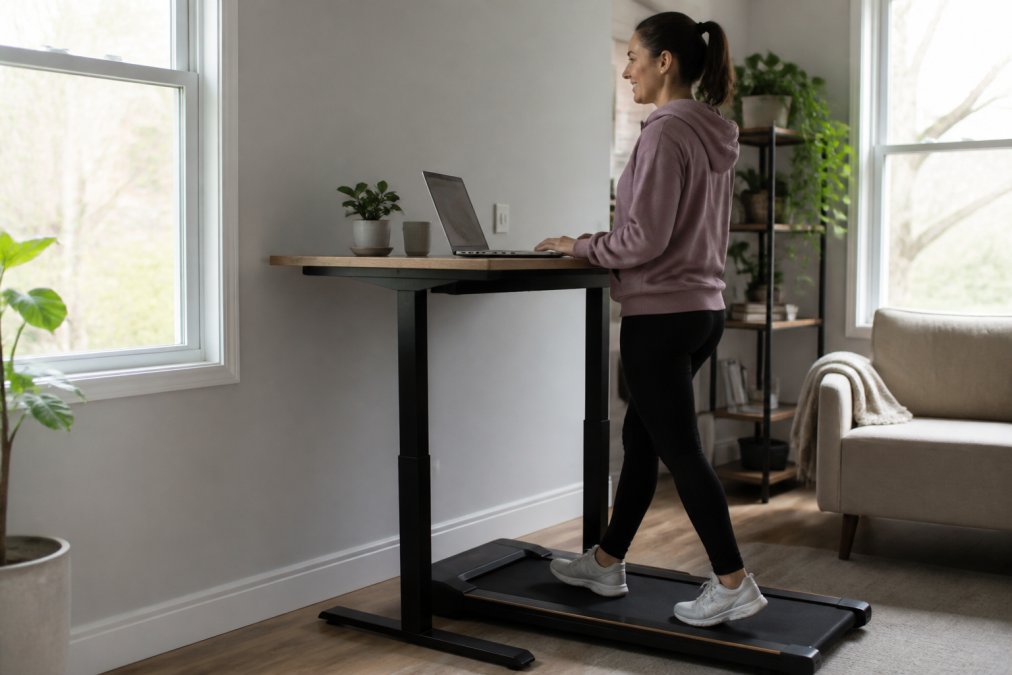
For those with limited space, the 2.5HP Under Desk Treadmill ($105.01) offers a quiet, portable solution that slides under a desk. This allows you to increase your daily step count without sacrificing work time, which is often the biggest barrier to consistency for busy professionals.
Conclusion: Consistency Beats Intensity Every Time
The greatest results in fitness come not from occasional heroic efforts, but from the accumulation of small, consistent actions performed over months and years. There will be weeks where you miss every workout; these do not define your journey. What defines it is your ability to return to the routine the next day.
Building a sustainable home fitness routine with the right equipment removes the logistical friction that causes most people to quit. Whether you are walking on a treadmill while you work or lifting weights in your living room, the goal is to make fitness so convenient that it becomes a permanent part of your life.
Frequently Asked Questions
What are some good goals for health and fitness?
Good fitness goals are specific, measurable, and time-bound. Instead of saying "get in shape," try "walk 8,000 steps per day for the next 30 days" or "complete three 20-minute strength sessions weekly." The SMART framework works well: make goals Specific, Measurable, Attainable, Relevant, and Time-bound. For beginners, focusing on behavior-based goals like session frequency is more effective than outcome-based goals like weight loss. Start with goals you can control, and you will build consistency that leads to results.
How can you maintain consistent progress in a fitness routine?
Consistency comes from building habits that fit your life. Schedule workouts at the same time daily, prepare your equipment in advance, and start with sessions short enough that you cannot talk yourself out of them. Tracking progress helps: log your workouts, steps, or sessions each week so you can see the trend. When motivation dips, reduce intensity rather than stopping completely. A walking pad treadmill makes it easy to stay active during work hours, which helps you accumulate daily movement without blocking out gym time.
What role does recovery play in long-term fitness success?
Recovery is where your body adapts and gets stronger. Training breaks down muscle tissue, but growth happens during rest. Skipping recovery leads to fatigue, poor performance, and eventual burnout. Plan at least one or two full rest days each week, prioritize seven to nine hours of sleep, and include lighter active recovery sessions like walking. If you feel persistently sore or exhausted, take an extra rest day or reduce training volume. Recovery is not a sign of weakness; it is a training tool that protects your long-term progress.
How do you track physical wellness goals effectively?
Track metrics you can measure consistently. For steps, use a phone or fitness band. For strength, log the weight and reps for each exercise. For cardio, record duration and distance or pace. Check in weekly rather than daily to avoid overreacting to normal fluctuations. Progress photos and how your clothes fit also provide useful feedback. The goal is to spot trends over weeks, not to obsess over single-day numbers. If your trend moves in the right direction, your program is working.
Your fitness journey is a marathon, and the gear you use should help you stay the course. Bodyhackfitness supports consistent progress across every stage of your health and wellness journey with curated home training and recovery equipment, from compact walking pads to full recovery tools. Get started with Bodyhackfitness and build a routine that lasts a lifetime.
This article was written using GrandRanker