

Table of Contents
- Why Hip Flexor Mobility Drills for Athletes Decide Performance
- Assess Before You Stretch: A 5-Minute Hip Mobility Screen
- Dynamic Hip Mobility Warm-Up: 6 Drills Before You Train
- Hip Flexor Mobility Drills for Athletes: The Numbered Sequence
- Hip Flexor Strengthening Exercises That Hold Your New Range
- Soft Tissue Release and Neurological Inhibition Techniques
- Best Recovery Tools for Hip Mobility at Home
- Sport-Specific Mobility Periodization: In-Season vs Off-Season
- Frequently Asked Questions
Last Updated: September 17, 2026
Why Hip Flexor Mobility Drills for Athletes Decide Performance
Tight hip flexors quietly steal speed, power, and stride length from athletes who never suspect them. When your hip flexors cannot lengthen fully, your pelvis tilts and your glutes stop firing on schedule, limiting hip extension, the engine behind sprinting, jumping, and changing direction. Below is a complete system: a five-minute screen, a dynamic warm-up, numbered drills, strengthening work, and soft tissue techniques.
What Tight Hip Flexors Actually Cost You
Restricted hip flexors reduce your effective stride and force the lumbar spine to compensate. The psoas and iliopsoas connect your lumbar spine to your femur, so when they stay short, your pelvis tips forward and your posterior chain goes quiet. This shows up as:
- Shorter stride length and reduced explosive power
- Low back tightness after sprinting or squatting
- Hip impingement sensations at end range
- Slower recovery between sessions
Assess Before You Stretch: A 5-Minute Hip Mobility Screen
Assessment is the step most athletes skip, and it changes everything. Before you stretch anything, measure what you actually have. A simple screen tells you whether your limitation lives in the muscle, the joint capsule, or your neuromuscular control.
Run this five-minute check:
- Thomas test: Lie on a bench, pull one knee to your chest. If the other thigh rises off the surface, your hip flexors are short.
- 90/90 seated test: Sit with both knees bent at 90 degrees. Note which hip cannot reach the floor.
- Active straight-leg raise: Compare each side. A large gap signals a control problem, not just stiffness.
- Prone hip extension: Lie face down, lift one leg without arching your back. If your lumbar spine moves first, your glutes are not doing the work.
Dynamic Hip Mobility Warm-Up: 6 Drills Before You Train
A dynamic hip mobility warm-up prepares the joint through its full range instead of holding one position. Static stretching before training can temporarily reduce power output, so save long holds for after. Dynamic work raises tissue temperature and wakes up neuromuscular control.
Work through these six drills for two rounds:
- Leg swings (front-to-back and side-to-side), 10 each direction
- Walking lunge with reach, 8 per side
- World's greatest stretch, 6 per side
- Hip circles standing on one leg, 8 each way
- Inchworm to hip opener, 6 reps
- Lateral shuffle with pause, 20 seconds
Hip Flexor Mobility Drills for Athletes: The Numbered Sequence
This numbered sequence is the core of the program. Perform it three to four times per week, ideally after training when tissue is warm. Move slowly and breathe into each stretch.
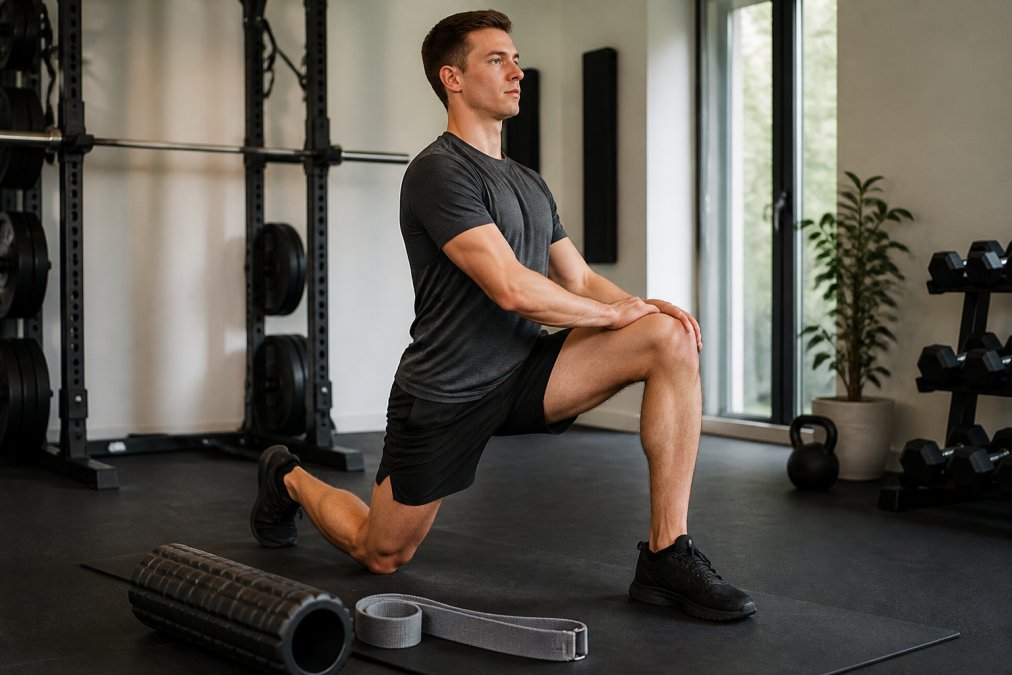
- Half-kneeling hip flexor stretch: Tuck your pelvis, squeeze the glute of the back leg, and hold 30 seconds per side. Keep the ribs down.
- Couch stretch: Back foot elevated on a bench, knee down. Hold 45 seconds per side. This targets the rectus femoris.
- 90/90 hip switch: Sit with both knees at 90 degrees, rotate side to side for 10 slow transitions.
- Controlled articular rotations (CARs): Draw the largest possible circle with your knee, 5 per direction, per leg.
- Prone hip extension with glute squeeze: 10 reps per side, pausing two seconds at the top.
90/90 Transitions and Controlled Articular Rotations
The 90/90 position trains hip internal rotation and hip external rotation at once, which most athletes neglect. Controlled articular rotations take it further: you actively explore your full available range across the sagittal plane, frontal plane, and transverse plane.
Hip Flexor Strengthening Exercises That Hold Your New Range
New range means nothing if you cannot control it. Most mobility programs fall apart here: an athlete stretches for twenty minutes, gains a few degrees, then loses it within a week because the nervous system has no reason to keep that range. Strength training tells your brain the new range is safe and worth keeping. Weak hip flexors let the pelvis drift and the lumbar spine overwork, recreating the tightness you just released.
The Four-Pattern Strength Block
Run this twice per week on non-consecutive days, after a training session or as a standalone 15-minute block. Rest 45 to 60 seconds between sets and stop each set two reps short of failure, this is a control drill, not conditioning.
- Standing banded knee drive, 3 sets of 10 to 12 reps per side. Anchor a light band behind you at ankle height, drive the knee up to hip height, then lower over a slow three-count. The slow return is the point: you are training the hip flexor to lengthen under tension, which is the exact quality that carries over to sprinting and kicking.
- Reverse Nordic, 2 to 3 sets of 6 to 8 reps. Kneel tall with hips locked, then lean back from the knees as far as you can control, and pull yourself up. This loads the rectus femoris at length, which is the hip flexor most athletes cannot reach with a standard stretch. If bodyweight is too hard, hold a band anchored in front of you for assistance.
- Copenhagen plank, 2 sets of 15 to 20 seconds per side. Start with the bottom knee on a bench and the top leg straight. This trains the adductors, which share fascial connections with the hip flexors and often limit hip extension more than athletes realize.
- Single-leg glute bridge, 2 sets of 8 to 10 reps per side, two-second hold at the top. This is your posterior chain anchor. Squeeze the glute hard at the top; if you feel it in your hamstring or low back, you have lost the position.
How to Progress Without Losing Range
- Weeks 1-2: Bodyweight or light band only. Focus on tempo and end-range control.
- Weeks 3-4: Add a heavier band on the knee drive, or slow the reverse Nordic eccentric to a four-count.
- Weeks 5+: Add a light weight to the reverse Nordic, or move the Copenhagen plank to a full straight-leg version.
Glute activation matters as much as hip flexor strength. Strong glutes keep the pelvis neutral so your hip flexors do not overwork, and give the nervous system a reason to allow hip extension at the end of your new range.
Foam roller Roller For body Relief →
Soft Tissue Release and Neurological Inhibition Techniques
Soft tissue mobilization and neurological inhibition are the advanced layer most guides ignore. When a muscle stays tight because your nervous system keeps it switched on, stretching alone will not hold. You have to change the signal.
Two techniques work well:
- Contract-relax (PNF): Contract the hip flexor for five seconds, then relax and lengthen. Repeat three times.
- Reciprocal inhibition: Actively squeeze the opposing glute to tell the hip flexor to release.
Best Recovery Tools for Hip Mobility at Home
The best recovery tools for hip mobility are simple, portable, and used consistently. You do not need a full gym to maintain hip health. According to the American College of Sports Medicine, flexibility and mobility work should be part of every training week, not an occasional add-on.
| Tool | Primary Use | Best For | Price |
|---|---|---|---|
| High-density foam roller | Myofascial release | Quads, hip flexors, glutes | $80.72 |
| Foam massage roller | Muscle tension relief | Post-workout recovery | $81.11 |
| Adjustable yoga strap | Assisted stretching | Reaching end range safely | $15.92 |
| Aerial yoga strap | Decompression and stretch | Deep hip and spine work | $22.88 |
Sport-Specific Mobility Periodization: In-Season vs Off-Season
Sport-specific mobility periodization means matching your hip work to your training calendar and your sport's demands. Most guides stop at "maintain in-season, build off-season", true but incomplete, because a sprinter and a powerlifter need different hip qualities from the same joint. Below: the general calendar, then the sport-specific adjustments most programs skip.
The General Calendar
Off-season (8-12 weeks): Two to three dedicated mobility sessions per week, longer holds (45 to 60 seconds), and heavier soft tissue work. This is when you chase new range. Pair it with the strength block above so the new range has a place to live.
Sport-Specific Adjustments
The same joint needs different things depending on how you use it.
How to Track It Across a Season
Periodization keeps hip flexor mobility from disappearing when the games matter most. Match the work to the phase, the drill to the sport, and let screen results tell you when to adjust.
Frequently Asked Questions
How often should athletes perform hip flexor mobility drills?
Most athletes do well with short daily sessions of 8-12 minutes plus two longer sessions per week. The dynamic hip mobility warm-up runs before every training session, while static holds and soft tissue work fit better after practice. Frequency beats duration: five brief sessions weekly produce more lasting range of motion than one long weekend stretch, and the nervous system adapts faster to repeated, low-stress exposure.
Can tight hip flexors cause lower back pain in athletes?
Yes. A short, overactive iliopsoas pulls the pelvis into an anterior pelvic tilt, which increases compression through the lumbar spine. Sprinters, cyclists, and hockey players often notice this as low-back ache after repeated hip extension. Adding hip flexor mobility drills for athletes, paired with glute activation and posterior chain work, usually reduces that ache because the pelvis can return to a neutral position under load.
What is the difference between hip flexibility and hip mobility?
Flexibility is passive range of motion, how far a muscle can be pushed. Mobility is active range you control yourself. An athlete can have flexible hip flexors and still fail a deep lunge because the joint capsule, glutes, and neuromuscular control are not doing their share. That is why hip flexor mobility drills for athletes combine stretching, controlled articular rotations, and strengthening instead of relying on passive holds alone.
What activities make tight hip flexors worse?
Prolonged sitting is the biggest culprit, since the iliopsoas stays shortened for hours and the glutes switch off. Long cycling blocks, heavy squat volume without hip extension work, and repeated sprinting without a cool-down also tighten the front of the hip. Breaking up sitting every 45 minutes and pairing any high-volume hip flexion sport with soft tissue mobilization keeps the tissue from adapting into that shortened position.