

Table of Contents
- What Are Hip Flexors and Why Do They Get Tight?
- What You'll Need Before You Start
- 7 Hip Flexor Stretch Exercises (Step-by-Step)
- How Long to Hold Hip Flexor Stretches for Real Results
- Hip Flexor Strengthening Exercises to Pair With Your Stretches
- How to Perform Hip Flexor Stretch Exercises Safely
- How to Build Hip Flexor Stretches Into Your Daily Routine
- Conclusion
Last Updated: August 7, 2026
What Are Hip Flexors and Why Do They Get Tight?
Hip flexors are muscles at the front of the hip joint that control bringing your knee toward your chest or torso toward your thighs. They are essential for walking, running, climbing stairs, and nearly every lower-body movement.
Prolonged sitting keeps hip flexors in a shortened, contracted position for hours at a time. Over weeks and months, this repeated shortening leads to chronic muscle tightness, reduced range of motion, and nagging hip and lower back pain. According to Cleveland Clinic's overview of hip flexor injuries, hip flexor strains are common among sedentary individuals, and addressing tightness early prevents more serious joint and spine complications.
The Muscles Involved: Psoas, Iliopsoas, and Rectus Femoris
Three muscles do most of the work. The psoas runs from the lumbar spine through the pelvis to the femur and is the deepest hip flexor. It pairs with the iliacus muscle to form the iliopsoas, the primary driver of hip flexion. The rectus femoris, part of the quadriceps, also crosses the hip joint and contributes significantly to tightness, especially in runners and cyclists.
When any one of these muscles becomes restricted, the others compensate, turning localized tightness into a whole-body posture problem.
How Anterior Pelvic Tilt Makes Tightness Worse
Anterior pelvic tilt occurs when tight hip flexors pull the front of the pelvis downward and forward, exaggerating the lumbar curve. Your lower back arches more than it should, your glutes become underactive, and your core stability suffers.
Stretching alone will not correct anterior pelvic tilt without also addressing glute activation and core engagement. The hip flexor stretches below are designed with this in mind.
What You'll Need Before You Start
You do not need a fully equipped gym for these exercises. A few basics make the session safer and more effective:
- A yoga mat or exercise mat for cushioning
- A small pillow or folded towel for the kneeling lunge if you have sensitive knees
- A sturdy wall or chair for balance during standing variations
- Comfortable, non-restrictive clothing that allows full hip extension
- A foam roller for pre-stretch tissue preparation (optional)
Set up in a space where you can fully extend one leg behind you without obstruction. A 6-by-6-foot clear area is usually sufficient.
7 Hip Flexor Stretch Exercises (Step-by-Step)
The exercises below progress from basic to more demanding. Start with the first three if you are new to hip flexor work, then build from there as your flexibility improves.
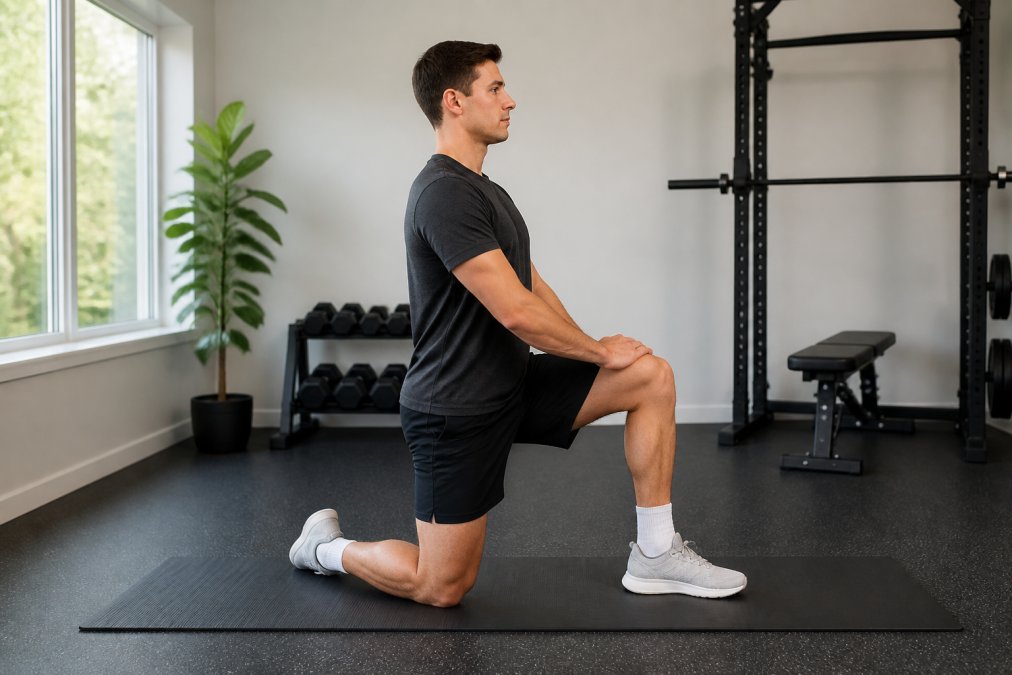
1. Kneeling Lunge Stretch
The kneeling lunge stretch is the single most effective hip flexor stretch for most people. It directly targets the iliopsoas and psoas by placing the hip in full extension.
How to perform:
- Kneel on your right knee with your left foot flat on the floor in front of you, forming a 90-degree angle at both knees.
- Keep your torso upright. Do not lean forward.
- Engage your core and gently push your right hip forward until you feel a stretch in the front of your right hip.
- Hold for 30 to 45 seconds, breathing steadily.
- To deepen the stretch, raise your right arm overhead and lean slightly to the left.
- Switch sides and repeat.
Common mistake: Letting the front knee collapse inward. Keep it tracking directly over the second toe.
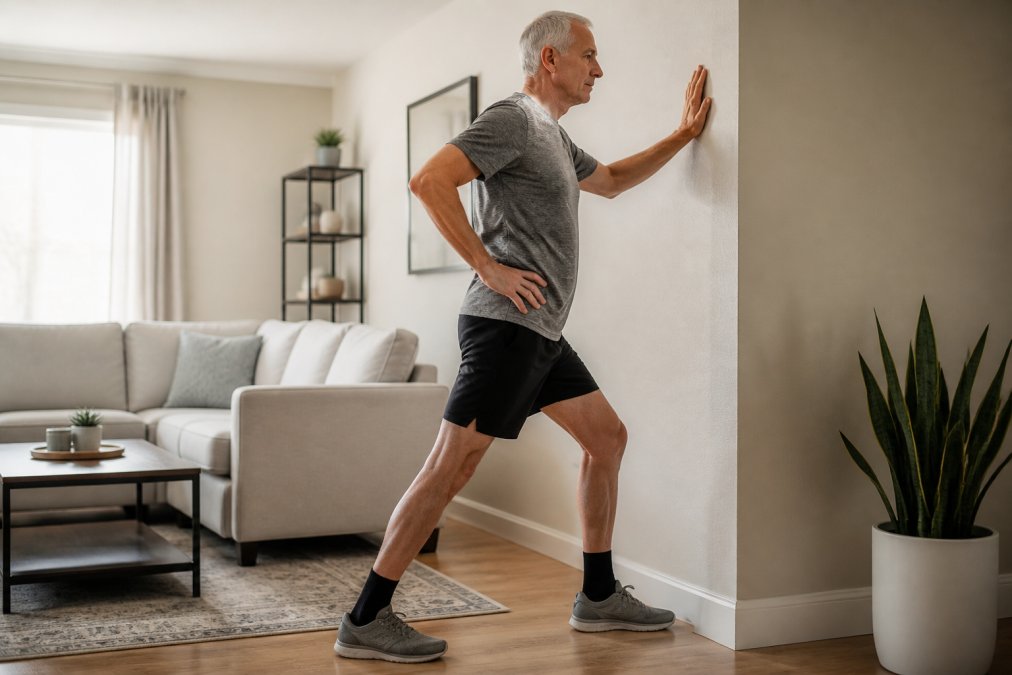
2. Standing Hip Flexor Stretch
For those who cannot kneel comfortably, the standing hip flexor stretch is an equally effective alternative that also challenges your balance and core stability.
How to perform:
- Stand tall near a wall for support.
- Step your right foot back into a split stance, keeping both feet pointing forward.
- Bend your left knee slightly and tuck your pelvis under by squeezing your right glute.
- You should feel the stretch along the front of your right hip and thigh.
- Hold for 30 seconds, then switch sides.
The pelvic tuck is critical. Without it, you are simply standing in a split stance, not stretching the iliopsoas.
3. Pigeon Pose (and Modifications)
Pigeon pose targets the deep hip rotators and the tensor fasciae latae (TFL), complementing the lunge-based stretches above.
How to perform:
- Start in a tabletop position on hands and knees.
- Bring your right knee forward and place it behind your right wrist, with your right foot angled toward your left hip.
- Extend your left leg straight behind you, top of the foot on the floor.
- Lower your hips toward the floor. Use a folded blanket under your right hip if it does not reach the ground.
- Hold for 45 to 60 seconds, then switch sides.
Modification: If full pigeon pose is too intense, perform a supine figure-four stretch instead. Lie on your back, cross your right ankle over your left thigh, and gently pull both legs toward your chest.
4. Glute Bridge
The glute bridge is a strengthening exercise that earns its place in a hip flexor stretch routine because it directly counteracts anterior pelvic tilt by activating the posterior chain. Tight hip flexors inhibit glute activation; this exercise reverses that pattern.
How to perform:
- Lie on your back with knees bent, feet flat on the floor hip-width apart.
- Press through your heels and lift your hips until your body forms a straight line from shoulders to knees.
- Squeeze your glutes hard at the top and hold for 2 seconds.
- Lower slowly and repeat for 10 to 15 repetitions.
5. Supine Hip Flexor Stretch (Thomas Stretch)
The Thomas stretch is used in physical therapy to assess and address hip flexor tightness. It is precise and highly effective for isolating the rectus femoris and iliopsoas.
How to perform:
- Sit on the edge of a firm bed or bench.
- Lie back and pull both knees to your chest.
- Slowly lower your right leg toward the floor while keeping your left knee hugged to your chest.
- If your right thigh does not reach parallel with the floor, your hip flexors are tight. If your knee does not bend to 90 degrees, your rectus femoris is the primary restriction.
- Hold for 30 seconds per side.
6. Butterfly Stretch
The butterfly stretch targets the inner thighs and hip adductors, which frequently contribute to overall hip tightness and reduced joint mobility.
How to perform:
- Sit on the floor with your spine tall.
- Bring the soles of your feet together and let your knees fall out to the sides.
- Hold your feet with both hands and gently press your knees toward the floor using your elbows.
- Lean forward slightly from the hips to deepen the stretch.
- Hold for 30 to 45 seconds.
7. Dynamic Hip Circle Warm-Up
Unlike the static stretches above, this dynamic movement prepares the connective tissue and joint capsule for activity. Use it at the start of a workout, not the end.
How to perform:
- Stand with feet hip-width apart, hands on hips.
- Slowly rotate your hips in a large circle, 5 times clockwise and 5 times counterclockwise.
- Progress to larger, more controlled circles as you warm up.
- Focus on full hip extension at the back of each circle.
How Long to Hold Hip Flexor Stretches for Real Results
Static hip flexor stretches should be held for a minimum of 30 seconds per side to produce meaningful changes in muscle length. Longer holds (45 to 60 seconds) are associated with more lasting improvements in flexibility. For most adults, 2 to 3 repetitions per side per session is sufficient. Consistency across multiple sessions per week matters far more than volume in any single session. As documented in American College of Sports Medicine's flexibility guidelines, static stretching held for 10 to 30 seconds improves flexibility in most populations, with longer holds recommended for individuals with significant tightness.
Static vs. Dynamic Stretching: Timing Differences
| Stretch Type | Best Timing | Hold Duration | Primary Benefit |
|---|---|---|---|
| Static stretching | Post-workout or standalone | 30-60 seconds | Increases muscle length |
| Dynamic warm-up | Pre-workout | 5-10 reps per direction | Improves joint mobility |
| PNF stretching | Post-workout | 6 sec contract + 30 sec hold | Fastest flexibility gains |
Static stretching before intense activity can temporarily reduce force output. Dynamic movements are the right choice before training. Save the long holds for after your workout or during a dedicated flexibility session.
Hip Flexor Strengthening Exercises to Pair With Your Stretches
Stretching alone addresses only half the problem. When hip flexors are weak, they stiffen protectively. Strengthening them through their full range of motion reduces chronic tension over time.
The most effective hip flexor strengthening exercises include standing knee raises (3 sets of 12 per side), resistance band hip flexion, hanging leg raises, and dead bugs (lie on your back with arms pointing to the ceiling and knees at 90 degrees; lower opposite arm and leg simultaneously while keeping your lower back pressed to the floor). Pairing strengthening with stretching is the approach physical therapists use in rehabilitation programs for hip impingement and chronic hip flexor pain.
How to Perform Hip Flexor Stretch Exercises Safely
Safe hip flexor stretching means avoiding overstretching and compensating with the lumbar spine. Both produce more harm than the original tightness.
Never push into sharp or stabbing pain. A productive hip flexor stretch feels like a deep, sustained pull in the front of the hip or thigh. If you feel pinching in the groin or front of the joint, stop immediately. That sensation often indicates hip impingement, which requires assessment from a licensed physical therapist.
Modifications for Limited Mobility and Older Adults
The kneeling lunge is uncomfortable for many older adults or anyone with knee joint issues. These modifications preserve the stretch while reducing joint stress: seated hip flexor stretch (sit on the edge of a chair and slide one foot back behind you), supine lunge variation (lie on your back at the edge of a bed and let one leg hang off the side while hugging the opposite knee to your chest), or wall-supported pigeon (stand facing a wall and place one shin against it at hip height, then lean forward gently). The National Institute on Aging's exercise guidelines for older adults recommend daily flexibility work as a core component of healthy aging, emphasizing that consistency and proper form matter more than intensity.
Post-Stretch Recovery: Hydration and Cool-Down
Stretching increases circulation to connective tissue and temporarily alters the mechanical properties of muscle fascia. Without adequate hydration, fascia becomes less pliable and recovery slows. Drink water before and after your stretching session. After your hip flexor stretch routine, spend 3 to 5 minutes in light movement: walking, gentle leg swings, or slow marching. This helps clear metabolic byproducts from the stretched tissue and reduces post-stretch soreness.
How to Build Hip Flexor Stretches Into Your Daily Routine
The biggest obstacle to improving hip flexor flexibility is not knowing which stretches to do. It is doing them consistently. A structured routine removes the decision-making barrier.
Here is a practical daily integration framework:
Morning (5 minutes):
- Dynamic hip circles: 5 reps each direction
- Standing hip flexor stretch: 30 seconds per side
Post-workout or evening (10 minutes):
- Kneeling lunge stretch: 45 seconds per side
- Pigeon pose or figure-four: 45 seconds per side
- Glute bridge: 3 sets of 12 reps
- Supine hip flexor stretch: 30 seconds per side
At your desk (2 minutes, every 2 hours):
- Stand up, step one foot back, tuck your pelvis, and hold for 20 seconds per side. This single habit, done consistently throughout the day, does more for chronic hip tightness than a single long session once a week.
The ergonomics of your workspace also matter. A chair height that places your knees above your hips increases anterior pelvic tilt during sitting. Adjust your seat so your hips are level with or slightly above your knees.
The Bodyhackfitness catalog includes recovery equipment and fitness accessories designed to support exactly this kind of structured daily routine. Consistent progress comes from having the right tools in place.
Summary: Hip Flexor Stretch Routine at a Glance
| Exercise | Type | Hold/Reps | Best For |
|---|---|---|---|
| Kneeling Lunge Stretch | Static | 45 sec per side | Iliopsoas, psoas |
| Standing Hip Flexor Stretch | Static | 30 sec per side | Mobility-limited, balance |
| Pigeon Pose | Static | 45-60 sec per side | Deep hip rotators, TFL |
| Glute Bridge | Strengthening | 3 x 12 reps | Glute activation, pelvic tilt |
| Supine Thomas Stretch | Static | 30 sec per side | Rectus femoris, iliopsoas |
| Butterfly Stretch | Static | 30-45 seconds | Hip adductors, inner thigh |
| Dynamic Hip Circle | Dynamic | 5 reps each direction | Pre-workout warm-up |
Tight hip flexors are a fixable problem, but they require more than an occasional stretch. The combination of consistent hip flexor stretch exercises, targeted glute activation, and daily movement habits is what produces lasting change in posture, pain levels, and range of motion.
Bodyhackfitness offers a curated selection of recovery tools, mats, resistance bands, and digital fitness programs built for home-based exercisers who want professional-grade results without the gym. If you are ready to build a complete mobility and recovery routine, shop now and find the equipment that fits your training environment.
Frequently Asked Questions
How long should you hold a hip flexor stretch?
For static hip flexor stretches, hold each position for 20 to 30 seconds and repeat 2 to 3 times per side. Physical therapy guidelines generally support this range for improving flexibility in the psoas and iliopsoas. If you are working on chronic tightness, extending holds to 45 to 60 seconds can increase connective tissue length over time. Dynamic warm-up movements, like hip circles, do not require a hold, 10 to 15 repetitions per side is enough before a workout.
What are the symptoms of tight hip flexors?
Common signs include a persistent ache at the front of the hip or groin, lower back pain that worsens after sitting for long periods, and reduced hip extension during walking or running. Many people also notice an exaggerated anterior pelvic tilt, where the lower back arches forward and the pelvis tips down at the front. Muscle tightness in the quadriceps and tensor fasciae latae often accompanies tight hip flexors, since these muscles share similar movement roles.
Should I stretch my hip flexor if it hurts?
Mild tension during a hip flexor stretch is normal, but sharp, stabbing, or radiating pain is a signal to stop. Pain that persists after stretching, or that runs down the leg, warrants evaluation by a physical therapist or physician before continuing. Hip impingement, muscle strains, and labral tears can all produce hip pain that stretching may aggravate. Start with gentle range-of-motion movements and progress gradually. If you have a known injury or rehabilitation history, get clearance before adding static stretching to your routine.
What activities make tight hip flexors worse?
Prolonged sitting is the most common driver, since it keeps the psoas and iliopsoas in a shortened position for hours at a time, reinforcing muscle tightness. Other contributors include running without adequate hip extension work, cycling, and exercises that over-train the hip flexors without balancing them with glute activation and posterior chain work. Poor ergonomics at a desk, sleeping in a fetal position, and skipping dynamic warm-ups before training all compound the problem over time.
This article was written using GrandRanker