


Last Updated: October 27, 2026
Quick Summary
Home gym lighting works best in layers: a bright overhead source for the whole floor, task light over the lifting zone, and accent light for atmosphere. LED panels, high bays, tube lights and bulbs each suit different ceiling heights and room sizes. Size the fixtures by calculating lumens from your target foot-candles and floor area.
- Use LED fixtures, which are generally the best choice for workout spaces.
- Target roughly 40 foot-candles over the lifting and cardio zones in most training spaces.
- A 400 sq ft two-car garage gym needs about 16,000 lumens for 40 foot-candles.
- Choose one consistent 5,000K color temperature with high CRI for filming.
- Check circuit capacity and fixture damp ratings before installing overhead lighting in a garage.
Table of Contents
- What Makes Lighting Work in a Professional Home Gym
- Choosing Fixture Types: LED Panels, High Bays, Tubes, and Bulbs
- Home Gym Lighting Brightness: Calculating Lumens by Room Size and Zone
- Color Temperature, CRI, and Flicker for Training and Filming
- Garage Gym Lighting: Low Ceilings, Layouts, and Installation Safety
- Home Gym Lighting Ideas: Layering, Glare Control, and Smart Presets
- Booking a Lighting Plan for Your Gym With Bodyhackfitness
- Frequently Asked Questions
What Makes Lighting Work in a Professional Home Gym
Good lighting turns a spare room into a training space you actually want to use. Home gym lighting is not just about brightness. It shapes how you see your form, how safe the space feels, and how well your recordings look if you film your sets. Many home gym owners find that a dim, uneven room makes workouts feel harder and sessions shorter.
According to Govee's gym lighting guide, which says LED lighting is generally the best choice for workout spaces, LED fixtures are the prevailing option for gym lighting. Panels, high bays, and tube lights each suit different room sizes and ceiling heights. That gives you a starting point, but the right pick depends on how you train.
Lighting works best in layers. A bright overhead source covers the whole floor, task lighting covers the lifting zone, and accent light adds atmosphere. Keeping those three roles separate makes the space easier to set up and easier to adjust later.
Choosing Fixture Types: LED Panels, High Bays, Tubes, and Bulbs
Most home gyms rely on one of four fixture types. LED panels are flat, even, and easy to mount flush to a ceiling, which makes them a common pick for basements and finished rooms. High bays suit taller ceilings and garages, where their focused output reaches the floor. Tube lights are long and linear, so they cover wide, narrow spaces well. Bulbs fit existing sockets and are the simplest upgrade.
Smart bulbs deserve a closer look. Philips Hue's guidance on smart home gym lighting promotes controllable bulbs that let you shift brightness and color for different workouts, and home gym users on forums often pair them with LED strips for accent light.
Best for: Panels suit finished rooms with standard ceilings. High bays suit garages with taller ceilings.
Skip if: You need broad, shadow-free light across a large space. A single bulb rarely does that job.
Watch out: buying a bulb rated for a lamp socket and fitting it into a fixture that needs a different base can leave you with dim, flickering light. Check the base type before you order.
Home Gym Lighting Brightness: Calculating Lumens by Room Size and Zone
Brightness is measured in lumens, and the total you need depends on floor area and how much detail you need to see.
A common pattern for training spaces is roughly 30 to 50 foot-candles over active lifting and cardio zones, 15 to 25 foot-candles over circulation and storage, and 50 or more foot-candles directly over a bench or platform where you check form.
Here is the calculation worked through for three common room sizes. These use round fixture outputs so you can substitute the actual lumen rating printed on the box.
Two-car garage gym, 20 ft by 20 ft (400 sq ft), 9 ft ceiling. At 40 foot-candles across the floor you need about 16,000 lumens. Four 4-ft LED shop lights at roughly 4,000 lumens each get you there, spaced in a 2-by-2 grid so the gaps between fixtures stay small.
Finished basement room, 12 ft by 14 ft (168 sq ft), 8 ft ceiling. At 40 foot-candles you need about 6,700 lumens.
Single-car garage gym, 12 ft by 20 ft (240 sq ft), 10 ft ceiling. At 40 foot-candles you need about 9,600 lumens. Two 4-ft shop lights at 4,000 lumens plus one 2,000-lumen panel over the lifting zone is a workable starting layout; step up to three shop lights if the walls are dark.
Break the room into zones before you buy. The lifting platform, the cardio area, and the storage wall do not need identical light. Put the highest output over the lifting zone, keep cardio at the mid target, and drop storage to the lower target.
Ceiling height changes the math. A fixture mounted at 8 ft spreads light over a smaller area than the same fixture at 12 ft, so tall garages need either more fixtures or higher-output high bays to hit the same foot-candle target at the floor.
Brightness that works in a bright white room can feel harsh in a dark garage, so test before you commit. Some users report that very strong light is more than they want, which is why diffusion and dimming matter as much as raw output. A dimmer on the main circuit lets you run the room at 60 percent for warm-ups and full output for heavy sets without changing fixtures.
The article's worked examples give the room sizes, targets and fixture counts you need to size your lighting.
| Room | Target foot-candles | Lumens needed | Suggested fixtures |
|---|---|---|---|
| Two-car garage, 400 sq ft | 40 | ~16,000 | Four 4-ft LED shop lights, ~4,000 lm each |
| Finished basement, 168 sq ft | 40 | ~6,700 | Two 2x4 LED panels, ~3,500 lm each |
| Single-car garage, 240 sq ft | 40 | ~9,600 | Two 4-ft shop lights plus one 2,000 lm panel |
Color Temperature, CRI, and Flicker for Training and Filming
Color temperature, measured in kelvins, changes how the room feels. Warmer light is softer and suits evening sessions. Cooler light feels alert and daylight-like. Hyperlite's creator guide to lighting a home gym for video recommends consistent 5,000K fixtures for a daylight-like look on camera, and says to prioritize color rendering and flicker reduction.
Color rendering index, or CRI, indicates how accurately a light shows true colors. For filming and for checking skin tone or equipment finish, a higher CRI matters. Flicker is less visible to the eye but shows up clearly on video, so choose fixtures marketed as flicker-reduced if you record sets.
Consistency matters more than any single number. Mixing fixtures with different color temperatures makes footage look uneven and makes the room feel disjointed. Buy from one color temperature range where you can.
Garage Gym Lighting: Low Ceilings, Layouts, and Installation Safety
Garages present their own problems. Low ceilings limit how far a fixture can sit from the floor, so glare becomes a bigger issue. Mount panels flush where possible, and place fixtures so they light the work area without shining straight into your eyes during overhead lifts.
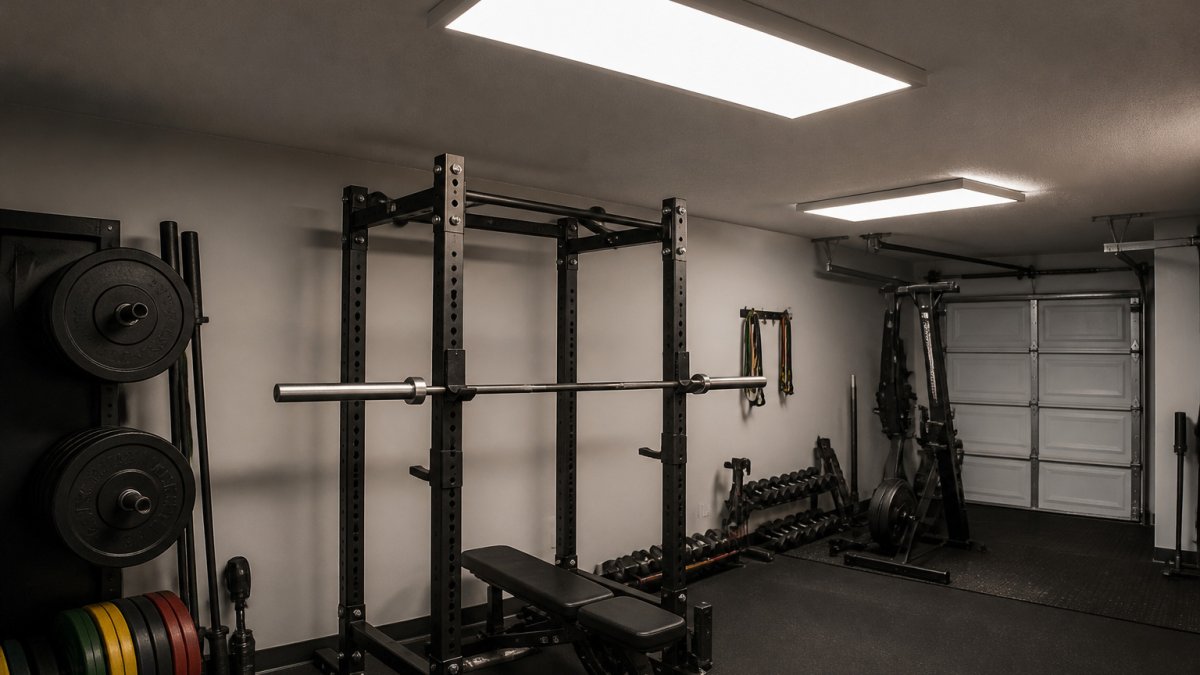
Layout comes first. Plan where the rack, bench, and free weight storage will sit before you choose fixture positions. Our guide on how to set up a home gym in a small space covers layout planning in more detail.
Electrical safety is where most garage gym projects go wrong, and it is the part competitors skip. Garages often sit on circuits shared with openers, freezers, or outdoor outlets, and damp conditions raise the risk. Work through these checks before you install anything overhead.
Circuit capacity. A typical residential garage circuit is 15 or 20 amps at 120 volts. Add up the wattage of your planned fixtures, divide by 120 to get amps, and leave headroom for the opener and any tools.
Fixture ratings. Look for fixtures rated for damp locations if the garage is unheated or sees condensation, and for enclosed or gasketed fixtures in dusty shops. A fixture rated only for dry locations can fail prematurely in a garage that swings between humid summers and cold winters. Check the label rather than the marketing copy.
Cable management. Run cable in conduit or raceway where it crosses walking paths, keep cords off the floor, and secure pendant fixtures with a safety cable so a bumped bar cannot bring one down. Extension cords should not substitute for permanent wiring to overhead fixtures.
When to hire an electrician. Hire a licensed electrician for any new circuit, any work inside the panel, and any fixture that requires opening a ceiling junction box you are not confident about. The National Electrical Code published by the NFPA sets the baseline for wiring in most US jurisdictions, and local amendments vary, so confirm local rules before installing overhead fixtures.
Dust is the other garage-specific factor. Sawdust, tire dust, and chalk settle on fixture lenses and reduce output over time, so choose fixtures with smooth, wipeable covers and plan to clean them a couple of times a year. In a dusty shop, an enclosed fixture keeps that maintenance simple.
Home Gym Lighting Ideas: Layering, Glare Control, and Smart Presets
Layering is where a home gym starts to feel professional. Combine a ceiling fixture for general light, a task light near the lifting zone, and accent strips along a wall or behind a mirror. Users in home gym communities often describe mixing downlights with LED strips to create a workout atmosphere without adding harsh overhead glare.
Glare control and mirror placement deserve attention. Avoid placing fixtures directly in your line of sight during presses or squats, and angle mirrors so reflected light does not hit your eyes. Diffusion sheets or frosted covers soften output for a more comfortable room.
Smart presets make switching between modes simple. Save one preset for warm-up, one for heavy lifting, and one for filming. A dimmable multi-color touch lamp can serve as an accent source for a vanity or mirror area. Smart presets are a practical way to match lighting to each session without touching a switch.
Booking a Lighting Plan for Your Gym With Bodyhackfitness
Planning is easier when you have a clear picture of your room. Measure the floor area, note the ceiling height, mark where your equipment will sit, and decide whether you record sets. Those four details will narrow your fixture choices quickly.
If you want help turning those measurements into a plan, Bodyhackfitness can help you put the pieces together. Our team reviews your layout and suggests fixture types and placement, and you can browse our smart lighting and gym accessories for your setup. For current pricing, check our site directly.
Start with the lifting zone, add layers around it, and test before you commit. A clear plan can help you organize your setup.
Frequently Asked Questions
What is the best lighting for a home gym?
LED fixtures are the most practical choice for a home gym. LED panels suit standard ceilings, high bays fit taller spaces, and tube lights work well over mirrors and along walls. Choose fixtures that output enough light for your floor area and deliver consistent color across the room. Review your ceiling height and workout zones before you buy.
How bright should home gym lighting be?
Brightness depends on room size and what you do there. Plan for enough lumens per square foot to light lifting areas evenly, and add task light over the platform or rack. Measure your room, identify each workout zone, and calculate total lumen output per zone rather than relying on a single fixture. Avoid lights so bright they cause glare off mirrors and bar surfaces.
What color temperature is best for workout lighting?
Most home gyms use neutral to cool white light between roughly 4,000K and 5,000K, which feels alert and resembles daylight. Warmer light can suit a relaxed space, while consistent color across all fixtures matters more than the exact number. If you film workouts, keep every fixture at the same temperature so skin tones and equipment look natural on camera.
Are smart lights useful in a home gym?
Smart lights are useful when you want workout-specific presets, such as bright full-room light for lifting and dimmer accent light for stretching or recovery. Look for dimmable fixtures with adjustable color and reliable app or voice control. Smart bulbs add cost, so confirm they fit your existing fixtures and that you will actually use the scenes you set up.
