

Table of Contents
- How to Choose the Right Dumbbell Weight for Beginners: Start Here
- General Weight Guidelines for Men and Women
- How to Perform a Test Set to Find Your Starting Weight
- Weight Selection by Movement: Compound vs. Isolation Exercises
- Adjustable vs Fixed Dumbbells: Which Should Beginners Buy?
- Dumbbell Exercises for Beginners: A Simple Starting Routine
- When to Increase Weight in Strength Training
- Common Mistakes Beginners Make (and How to Avoid Them)
- Frequently Asked Questions
Last Updated: September 10, 2026
How to Choose the Right Dumbbell Weight for Beginners: Start Here
Walk into any fitness retailer and you'll see a wall of dumbbells ranging from 5 pounds to 100-plus pounds, and the labels rarely tell you which one your body can actually handle. Learning how to choose the right dumbbell weight for beginners starts with one principle: the correct weight is the one you can control through a full range of motion for every prescribed repetition, not the one that looks impressive on the rack. This guide from Bodyhackfitness breaks down test sets, movement-specific selection, and the mistakes that send new lifters to the sidelines. Get this decision right and strength training becomes a repeatable habit; get it wrong and you're nursing a strained shoulder by week three.
Why Starting Weight Matters More Than You Think
An overly heavy dumbbell forces your body to compensate with momentum, shortened range of motion, and joints that weren't built for the load. That compensation pattern is where most beginner injuries begin.
Too light, and you never reach muscle fatigue, which means no meaningful strength adaptation and a workout that feels like wasted time. The right starting weight sits in a narrow window: challenging enough that the last two reps of a set feel genuinely hard, light enough that your form holds from rep one to rep twelve.
General Weight Guidelines for Men and Women
Generic guidelines are a starting point, not a prescription. Most beginner men can begin with 10-20 pound dumbbells for pressing movements and 15-25 pounds for rows, while most beginner women often start with 5-10 pounds for pressing and 8-15 pounds for rows (acefitness.org). These ranges reflect typical strength differences, but individual variation is enormous. A smaller person with a physical job may out-lift a larger sedentary person on day one.
What the ranges don't tell you is why they differ, and that's the part that lets you adjust them for your own body. Three factors drive where you land inside any range:
- Lever length. Longer arms mean a longer moment arm at the shoulder and elbow, so the same weight feels heavier on a press or curl. If you're tall with long limbs, start at the bottom of the range and add slowly.
- Training history. Anyone coming from manual labor, climbing, rowing, or years of push-ups carries a strength base that a desk-bound beginner doesn't. Past activity, not current appearance, predicts your first session.
- Bodyweight relative to the load. A 5-pound lateral raise is a much larger relative load for a 110-pound lifter than a 220-pound lifter. When in doubt, scale the starting weight to roughly 5-10% of your bodyweight for isolation work and 10-20% for compound work, then adjust from the test set.
Leg exercises tolerate far more load than arm exercises because your lower body moves your bodyweight all day. Don't expect your lateral raise and your goblet squat to use the same weight. They won't. As a rough anchor, most beginners squat and deadlift with 2-4x the load they use for a lateral raise, and press with roughly 1.5-2x their lateral raise weight.
Light, Medium, and Heavy: What Those Labels Actually Mean
Light weight is a load you can lift for more than 15 controlled repetitions before reaching failure. It builds muscular endurance and is useful for warm-ups, rehabilitation work, and isolation movements like lateral raises.
Medium weight is a load you can lift for roughly 8-12 repetitions before form breaks down. This is the hypertrophy range, and it's where most beginners should spend the bulk of their training time.
Heavy weight is a load you can only move for 1-6 repetitions with good technique. Beginners rarely need to train here. The injury risk outweighs the strength benefit until your connective tissue has adapted to resistance training.
How to Perform a Test Set to Find Your Starting Weight
A test set is a single working set performed with a weight you believe you can handle for 10-12 reps, used to calibrate your actual starting load. Here's the protocol:
- Warm up with 5 minutes of light cardio and a set of 10 reps using the lightest dumbbell available.
- Select a weight you estimate you can lift 12 times.
- Perform as many clean repetitions as possible with controlled movement, stopping when form breaks.
- If you complete 12 reps easily, rest 2 minutes and repeat with the next increment up.
- If you fail before 8 reps, drop down one increment and retest after resting.
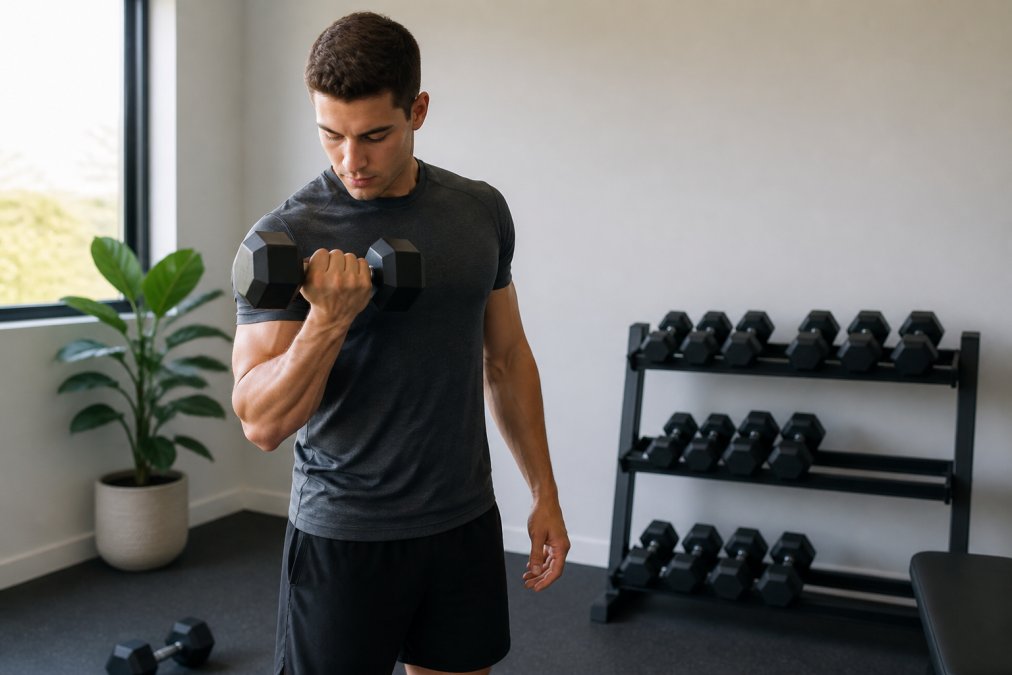
Your working weight is the load that lets you finish 8-12 reps with the last two feeling difficult but achievable. Write it down. Memory is unreliable, and progress tracking depends on knowing exactly where you started.
Weight Selection by Movement: Compound vs. Isolation Exercises
Compound movements recruit multiple muscle groups and joint actions, which means they tolerate significantly more load than isolation exercises. A beginner who rows 20 pounds per hand will typically press only 12-15 pounds overhead and lateral raise just 5-8 pounds.
| Movement Type | Example Exercise | Typical Beginner Load | Rep Range |
|---|---|---|---|
| Lower body compound | Goblet squat | 15-30 lb | 8-12 |
| Upper body compound | Dumbbell row | 10-25 lb | 8-12 |
| Upper body press | Overhead press | 8-20 lb | 8-12 |
| Isolation | Lateral raise | 3-10 lb | 12-15 |
| Isolation | Bicep curl | 5-15 lb | 10-12 |
The pattern is consistent: the more muscle mass and joint action involved, the more weight you can move. Beginners routinely overestimate what their shoulders and biceps can handle because they benchmark against their legs.
Adjustable vs Fixed Dumbbells: Which Should Beginners Buy?
Fixed-weight dumbbells are single-weight units that can't be changed, while adjustable dumbbells use a dial, pin, or plate system to let one pair cover many loads. For beginners, the choice usually comes down to space, budget, and how much weight progression you expect. Most buying guides stop there. The part they skip is the math, how much floor space a useful range actually eats, and what it costs to build versus buy.
The space reality nobody mentions
A single pair of fixed dumbbells takes up roughly 1-2 square feet of floor or rack space. That sounds trivial until you do the progression math. A beginner who starts at 5 pounds and adds 5 pounds per hand every few weeks will outgrow a pair within a month or two. To cover a realistic first-year range from 5 to 30 pounds in 5-pound increments, you're looking at six pairs, and a two-tier rack to hold them safely. That's typically 4-6 square feet of dedicated floor space, plus clearance to pull dumbbells off the rack without banging your knuckles on a wall.
Adjustable dumbbells collapse that entire range into one pair. A dial or pin system that spans 5-50 pounds per hand occupies about the same footprint as a single fixed pair, often 1-2 square feet, and stores under a bed, on a shelf, or in a closet. If you train in a spare bedroom, a garage corner, or an apartment where every square foot is spoken for, that difference is usually the deciding factor.
The budget-to-value question: one pair or a full set?
The honest answer depends on your program, not on a generic "buy the set" recommendation.
- Buy one pair first if your routine is built around a handful of movements and you're still learning form. A single pair of 10-15 pound dumbbells covers goblet squats, rows, presses, curls, and lateral raises for most true beginners. You'll add a second pair only when the first stops being challenging.
- Buy adjustable if you plan to train at home three or more days a week and expect to progress for six months or longer. One adjustable pair replaces the entire rack, and the per-pound cost drops the more you use it.
- Buy a small fixed set (three to four pairs) if you share the space with a partner at a different strength level, or you dislike the slight rattle and longer setup time of dial adjustables. Fixed dumbbells feel more solid in the hand and let you switch weights instantly between sets.
Fixed dumbbells offer better stability and grip feel, and they're what you'll use in most commercial gyms. The downside is cost and storage: building a useful range from 5 to 30 pounds means buying six or more pairs. Bodyhackfitness stocks fixed-weight options like the Adjustable 15lbs Rubber Hex Dumbbell Set and the Premium 20LB Rubber Coated Cast Iron Dumbbell, both of which protect floors with rubber-coated hex heads and resist rolling between sets.


Adjustable dumbbells win on space and long-term value, since one pair replaces an entire rack. They lose on convenience and, at the budget end, on durability. If you're tight on square footage or plan to progress steadily, adjustable is usually the smarter first purchase.
Dumbbell Exercises for Beginners: A Simple Starting Routine
A beginner routine should hit every major muscle group twice per week with compound movements first and isolation work last. This three-day structure works well:
- Day 1: Goblet squat, dumbbell row, overhead press, bicep curl
- Day 2: Romanian deadlift, floor press, lateral raise, tricep extension
- Day 3: Reverse lunge, rear delt fly, hammer curl, calf raise
Perform 3 sets of 8-12 reps for compound movements and 2-3 sets of 12-15 reps for isolation work. Rest 60-90 seconds between sets. Total training volume matters more than any single session, so keep the routine simple enough to repeat consistently.
When to Increase Weight in Strength Training
Increase weight when you can complete all prescribed sets and reps with clean form and the final rep still feels manageable. That's the practical signal of progressive overload, the principle that drives every strength adaptation you'll ever make.
Add the smallest available increment, usually 5 pounds for upper body and 10 pounds for lower body, then rebuild your reps from the bottom of the range. If your gym or home setup only has 5-pound jumps, that's fine; smaller increments are actually easier to manage. Track every session so you know exactly when the last weight stopped being challenging. If you can't complete the target reps at the new weight, drop back and add one more rep to your previous load before trying again.
Common Mistakes Beginners Make (and How to Avoid Them)
Ego lifting tops the list. Choosing a weight because it looks impressive guarantees sloppy form and stalled progress.
Other frequent errors include skipping the warm-up set, training through joint pain instead of muscle fatigue, and changing weights every single session instead of letting adaptation happen. Beginners also tend to neglect grip strength and core stability, both of which limit how much weight they can safely move on compound lifts.
Choosing the right dumbbell weight is genuinely the hardest part of starting, and most people quit because they either go too heavy and get hurt or too light and see nothing change. Bodyhackfitness exists to remove that guesswork, with rubber-coated hex dumbbells that protect your floors and a curated range of weights that covers every stage of a beginner's progression. Pair that equipment with a digital program built for your actual fitness level, and consistency stops being a willpower problem. Shop now and build the home training environment that makes showing up the easy part.
Frequently Asked Questions
How do I know which dumbbell weight to start with?
Start with a weight you can lift for 10 to 12 controlled reps with good form. If you can't complete 8 reps, it's too heavy. If you can easily do 15 or more, it's too light. For most beginners, women often start with 5 to 10 pounds for upper body and 10 to 20 pounds for lower body, while men typically start with 10 to 20 pounds for upper body and 20 to 30 pounds for lower body. Always prioritize form over the number on the dumbbell.
Is a 20 lb dumbbell good for beginners?
A 20 lb dumbbell can work for beginners, but it depends on the exercise. It's usually too heavy for isolation moves like lateral raises or bicep curls if you're just starting out. However, it can be appropriate for compound movements like goblet squats, lunges, or dumbbell rows where larger muscle groups share the load. Try a test set: if you can't complete 8 controlled reps with proper form, drop to a lighter weight like 10 or 15 pounds.
When should I increase my dumbbell weight?
Increase weight when you can complete your target rep range (usually 10 to 12 reps) with good form and the last two reps feel challenging but manageable. This is the principle of progressive overload. A good rule is to increase by 5 to 10 percent, or the smallest available increment. For most beginners, that means moving up by 2.5 to 5 pounds. If your form breaks down or you feel joint pain, stay at your current weight a bit longer.
Do I need different weights for different exercises?
Yes. Different exercises recruit different muscle groups and joint angles, so the ideal weight varies. Compound movements like squats, rows, and presses let you handle more weight because multiple muscle groups work together. Isolation exercises like lateral raises, bicep curls, and tricep extensions require lighter weights. A beginner home setup with 5, 8, 15, and 20 pound dumbbells covers most needs, or an adjustable set can replace several fixed pairs.