

Table of Contents
- Why Sitting All Day Tightens Your Hip Flexors
- How Long to Hold Hip Flexor Stretches for Real Results
- The Best Stretches to Release Tight Hip Flexors
- Hip Flexor Strengthening Exercises That Balance Your Hips
- Best Recovery Tools for Tight Hips
- Desk Setup and Micro-Breaks That Prevent Tightness
- Frequently Asked Questions
Last Updated: September 14, 2026
Why Sitting All Day Tightens Your Hip Flexors
Sitting for long stretches shortens the hip flexors, the muscles that connect your pelvis, lumbar spine, and thigh bone. This guide explains what happens to those muscles after hours in a chair and how to fix tight hip flexors from sitting before stiffness turns into chronic pain.
The anatomy is simple. Your iliopsoas (the psoas muscle fused with the iliacus) runs from your lower spine through your pelvis and attaches to the femur. When you sit, that muscle stays in a shortened position for hours. Over time, the muscle fibers and surrounding connective tissue adapt to that length, and standing up feels like pulling against a taut band.
The Anatomy Behind the Tightness
The iliopsoas is the only major muscle group connecting your lumbar spine to your legs. In a seated position, the hip sits at roughly 90 degrees of flexion, which keeps the psoas in a permanently shortened state (pubmed.ncbi.nlm.nih.gov). The result is anterior pelvic tilt, a forward rotation of the pelvis that pulls on the lumbar spine and creates the lower-back ache desk workers know well.
Symptoms You Should Not Ignore
Warning signs go beyond a general feeling of stiffness:
- A pulling sensation in the front of the hip when you stand up
- Lower-back tightness that eases when you walk
- A forward-leaning posture that worsens through the day
- Reduced hip extension, meaning your leg won't travel behind you comfortably
How Long to Hold Hip Flexor Stretches for Real Results
Hold each hip flexor stretch for 30 to 60 seconds, and repeat it two to three times per side (pubmed.ncbi.nlm.nih.gov). Research on static stretching consistently shows that shorter holds do little for lasting flexibility, while holds beyond 60 seconds add fatigue without extra benefit (pubmed.ncbi.nlm.nih.gov).
The common mistake is rushing. Most people hold a stretch for 10 seconds, feel a mild pull, and move on. That's not enough time for the muscle fibers and connective tissue to respond. Aim for a slow, controlled hold where you breathe through the tension rather than forcing it.
A practical approach:
- 30 seconds for a maintenance routine you do daily
- 45 to 60 seconds when you're actively working on range of motion
- 2 to 3 rounds per side, with a short rest between
If you're coming from a full day of sitting, expect the first 15 seconds to feel intense. Ease into it rather than pushing to your maximum immediately.
The Best Stretches to Release Tight Hip Flexors
The most effective stretches combine a static hold with controlled movement. Static work lengthens the tissue; dynamic movement teaches the muscle to use that new range. You need both, and you need to sequence them correctly.
Static Stretches That Work
Kneeling hip flexor stretch. Kneel on one knee with the other foot flat in front of you. Tuck your pelvis under (posterior tilt) before you shift forward, this is the step most people skip, and without it the stretch goes into your lower back instead of the front of the hip. Shift your weight forward until you feel a stretch in the front of the hip of the kneeling leg. Hold 30 to 60 seconds, 2 to 3 rounds per side.
Couch stretch. Place your back foot against a wall or the seat of a couch with the knee on the floor. Drive the knee down and back while keeping your ribs down and your glute engaged on the stretching side. This is more intense than the kneeling version and is best saved for after you have warmed up. Hold 30 to 45 seconds, 2 rounds per side.
Supine hip flexor stretch. Lie on your back near the edge of a bed or bench with one leg hanging off. Pull the opposite knee toward your chest and let the hanging leg drop. This is the gentlest option and a good choice if kneeling is uncomfortable on your knees.
Side-lying quad and hip stretch. Lie on your side, grab the top ankle, and pull the heel toward your glute while keeping the knee in line with the hip. This catches the rectus femoris, the one quad muscle that crosses both the hip and the knee and often gets missed by hip-only stretches.
Dynamic Movement for Daily Mobility
Static stretching alone won't undo eight hours in a chair. Add dynamic movement to restore hip extension:
- Leg swings, forward and back, controlled, 10 to 12 per side
- Walking lunges, 8 to 10 per side, driving the back hip into extension at the bottom
- Glute bridges, 10 to 12 reps, squeezing at the top
- 90/90 hip switches, 8 per side, moving slowly between the two seated positions
- World's greatest stretch, 5 per side, adding a thoracic rotation at the end range
Form Errors That Kill the Stretch
Three mistakes show up again and again:
- Arching the lower back instead of tucking the pelvis. If you feel it in your lumbar spine, you have lost the posterior tilt. Reset before you push further.
- Bouncing. A bouncing stretch triggers a stretch reflex that makes the muscle tighten, not lengthen. Hold still and breathe.
- Chasing the deepest possible position. Range you cannot control is range you do not own. Stop where you can breathe and hold, not where it hurts.
How to Sequence a Session
Do your dynamic work before static stretching, not after. A cold muscle held in a deep stretch resists; a warmed-up muscle releases. A practical order for a desk worker:
- 3 to 5 minutes of light movement (walking, leg swings)
- Dynamic drills, 1 round each
- Static holds, 2 to 3 rounds per side
- One glute activation drill to finish
If you are coming from a full day of sitting, expect the first 15 seconds of any hold to feel intense. Ease in rather than pushing to your maximum immediately, and let the last 20 seconds be the part where the tissue actually gives.
Hip Flexor Strengthening Exercises That Balance Your Hips
Stretching a tight muscle without strengthening its opposite is a losing battle. The psoas pulls your pelvis forward; your glutes pull it back. When the glutes are weak from sitting, nothing counterbalances the pull.
This is the angle most stretch-only guides miss. Glute activation is not optional. Prioritize:
- Glute bridges, 2 sets of 12, squeezing at the top
- Dead bugs, 2 sets of 8 per side, keeping the lower back flat
- Standing hip extensions, 12 per side, using a band for resistance
The goal is not to build a tight, overworked hip flexor. It's to create balance, so the front and back of the hip share the load. If you're unsure whether your form is correct, that's where a structured program beats random YouTube videos. Digital programs can walk you through each movement with clear cues so you're not guessing.
Best Recovery Tools for Tight Hips
Recovery tools won't replace stretching and strengthening, but they make both more effective. A foam roller works on the surrounding tissue, while a massage gun reaches deeper into stubborn knots.
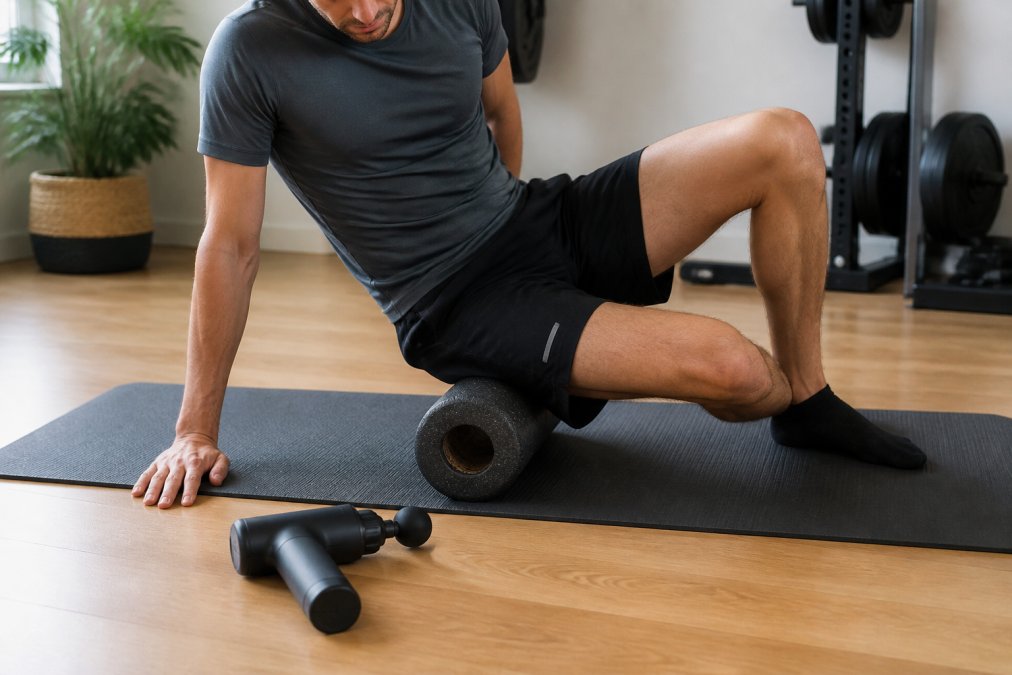
For myofascial release at home, the tools that earn their place:
| Tool | Best For | How to Use |
|---|---|---|
| Foam roller | Broad tissue release | Roll the quads and outer hip, 60 seconds per area |
| Massage gun | Pinpoint knots | 30-60 seconds on tender spots, low to medium speed |
| Mini massage gun | On-the-go relief | Keep at your desk for quick mid-day work |
A foam roller is the workhorse. The Foam Massage Roller for Muscle Relief is a solid starting point, and its high-density foam holds up to daily use. For targeted work on a specific knot, the NNEDSZ Green Massage Gun gives you six speed settings and four heads to match the muscle group. If you want something portable for the office, the NNETM Portable Mini Massage Gun fits in a bag and runs on USB-C.
Desk Setup and Micro-Breaks That Prevent Tightness
The best stretch routine in the world won't hold if you spend the other 23 hours reinforcing the problem. Most articles tell you to "move more" and stop there. This section gives you the specific adjustments and the exact 60-second routines that fit inside a workday, no mat, no getting on the floor.
Ergonomic Adjustments That Actually Change Your Hip Angle
Chair height. Set the seat so your hips sit slightly higher than your knees. This opens the hip angle past 90 degrees and reduces how much the psoas stays shortened. If your chair will not go high enough, a firm cushion under the seat is a cheap fix.
Seat depth. You should be able to fit two to three fingers between the back of your knee and the edge of the seat. If the seat is too deep, you will slide forward and lose back support; too shallow, and your thighs take the load.
Footrest. If your feet dangle after raising the chair, a footrest restores a flat, supported base. Feet flat and knees near 90 degrees keeps the pelvis neutral instead of tucked or tilted.
Lumbar support. A small roll or the chair's built-in curve should sit in the natural arch of your lower back. This holds the pelvis in a neutral position so the psoas is not being pulled taut all day.
Monitor distance and height. The top of the screen should be at or just below eye level, roughly an arm's length away. If the monitor is too low, you slump forward, which rounds the lower back and drags the pelvis into a posterior tilt, the opposite of what you want for hip extension.
Keyboard and mouse. Keep elbows near 90 degrees and wrists neutral. Reaching forward all day pulls the shoulders and upper back into a rounded position that feeds the same slumping pattern.
The 60-Second Desk Routine
Set a timer for every 30 to 45 minutes. When it goes off, pick one of these and do it standing or seated at your desk. None of them require a mat or a change of clothes.
Standing hip flexor press (60 seconds). Stand with one foot forward and one back, both feet flat. Tuck your pelvis under and press the back hip gently forward until you feel a stretch in the front of the back hip. Hold 20 seconds, switch sides, repeat once.
Seated figure-four (60 seconds). Sit tall, cross one ankle over the opposite knee, and hinge forward from the hips until you feel it in the outer hip. Hold 30 seconds per side.
Standing leg swings (60 seconds). Hold the desk or chair for balance. Swing one leg forward and back, controlled, 15 times, then switch.
Chair hip extension (60 seconds). Stand behind your chair, hold the backrest, and drive one leg straight back, squeezing the glute at the top. 12 reps per side.
Standing calf and hip reset (60 seconds). Rise onto your toes, then lower slowly, and finish with a gentle posterior pelvic tilt held for 10 seconds. Repeat three times.
Build the Habit, Not the Hero Session
A short routine done consistently beats a long routine done once. Two practical rules make it stick:
- Attach the break to something you already do. Refill your water, finish a meeting, or send an email, use the trigger, not the clock alone.
- Track it for a week. A simple tally on a sticky note is enough. Most people find they hit 8 to 10 breaks a day once they can see the count.
Frequently Asked Questions
Can tight hip flexors from sitting be reversed?
Yes, in most cases tight hip flexors respond well to consistent stretching, strengthening, and movement breaks. The psoas and iliopsoas shorten when you sit for hours, but they can lengthen again with regular static stretching and dynamic movement. Combining hip flexor strengthening exercises with foam rolling and better ergonomics speeds up the process. Severe or long-standing tightness may need physical therapy, especially if you have hip impingement or chronic pain.
How long does it take to unlock tight hip flexors?
Most people notice less stiffness within 2 to 4 weeks of daily stretching and movement breaks. Full range of motion improvements typically take 6 to 8 weeks of consistent work. Hold each stretch for 30 to 60 seconds, repeat 2 to 3 times per side, and stretch at least once a day. Pairing stretches with hip flexor strengthening exercises and micro-breaks every 30 minutes gives faster results than stretching alone.
What are the symptoms of tight hip flexors from sitting?
Common signs include a pulling sensation in the front of the hip, lower back tightness, an anterior pelvic tilt, and difficulty standing fully upright after long sitting sessions. Some people feel stiffness when walking or climbing stairs. Left unaddressed, tight hip flexors can contribute to muscle imbalance, altered posture, and hip impingement. If you notice these symptoms, start a daily routine of stretching, foam rolling, and hip flexor strengthening exercises.
Are there specific exercises to prevent hip tightness while working?
Yes. Stand up every 30 minutes and do a 60-second hip flexor stretch or a standing lunge. Add glute activation moves like seated glute squeezes or standing hip extensions at your desk. A quick micro-break routine with dynamic movement keeps the hip joint mobile and reduces tissue tension. Pair this with an ergonomic chair setup and a footrest to keep your pelvis neutral. Consistency matters more than intensity for preventative care.