


Table of Contents
- Why Home Workouts Cause Uneven Muscle Growth
- Self-Assessment Tests to Identify Your Weak Side
- Unilateral Exercises for Muscle Imbalances
- How to Strengthen Weak Muscles at Home
- Building a Muscle Imbalance Workout Routine
- How Long to Fix Muscle Imbalance
- Recovery, Nutrition, and the Mind-Muscle Connection
- Conclusion: Train Both Sides, Build Even Strength
- Frequently Asked Questions
Last Updated: October 12, 2026
Why Home Workouts Cause Uneven Muscle Growth
Uneven muscle growth from home workouts happens when one side does more work than the other and your training never corrects it.
Your dominant side takes over without asking permission. When you press, row, or squat, the stronger side recruits more muscle fibers and finishes the rep first.
Home training makes this worse because you often lack mirrors, spotters, and matching weights.
The Dominant Side Problem
Dominant side bias is your stronger limb handling more of the load during two-limb exercises.
Handedness plays a role. If you're right-handed, your right arm and shoulder have years of extra practice carrying, opening, and lifting.
The fix isn't to train harder. It's to train one side at a time so the weak side can't hide.
Home Setup Flaws That Worsen Asymmetry
Most home gyms have three problems that feed asymmetry:
- One heavy weight and one light weight, so you grab whatever's closest
- No mirror to check body alignment during reps
- Benches or bands positioned so one side gets a better angle
A common mistake is loading a barbell evenly and assuming both sides lift evenly. They don't. The strong side pushes harder and the bar tilts, even if you can't see it.
Self-Assessment Tests to Identify Your Weak Side
You can't fix uneven muscle growth until you know which side lags and by how much. Guessing wastes weeks. These tests give you a repeatable score per movement pattern so you can measure the gap, program around it, and re-test to prove progress.
Run all three tests the same day, after a 5-minute warm-up, and log the numbers. Re-test every four weeks.
Test 1: The Single-Arm Rep Max at a Fixed Load
This measures raw strength deficit directly.
- Pick a dumbbell you can lift for exactly 10 clean reps with your strong arm. No matching pair? Use the same single dumbbell for both sides.
- Rest 2 minutes.
- Do as many clean reps as possible with the weak arm, stopping when form breaks (no torso swing, no shoulder shrug).
- Record both numbers.
Score your gap:
- 0-1 rep difference: balanced, maintain.
- 2-3 rep difference: mild imbalance, address with unilateral work.
- 4-5 rep difference: moderate, prioritize the weak side for 6-8 weeks.
Run the same test with single-arm rows, single-arm overhead presses, and single-leg step-ups. Your weaker leg usually shows the largest gap because daily life rarely loads one leg in isolation.
Test 2: The Tempo Failure Test
Rep count alone hides endurance and control deficits. This test exposes them.
- Use a load you can move for 12 reps on the strong side.
- Perform reps with a 3-second lower and a 1-second lift.
- Stop when you can no longer control the 3-second lowering phase.
- Repeat on the weak side with the same load and tempo.
A weak side failing 3+ reps earlier than the strong side has a control problem, not just a strength problem. That matters: control deficits respond to slow eccentrics and lighter loads, while pure strength deficits respond to added volume.
Test 3: The Mirror and Tape Measure Check
Size differences lag behind strength differences but confirm whether your programming works.
Stand relaxed in front of a full-length mirror and compare:
- Shoulder height and roundness
- Arm circumference at the midpoint between shoulder and elbow
- Thigh circumference at the same distance above the knee
Use a soft tape measure and mark the exact spot with a washable marker so you measure the same point each time. Track monthly. A quarter-inch is normal variation; half an inch or more on arms or thighs is worth flagging.
What Your Scores Mean
Combine the three tests into a profile:
- Strength gap only: add unilateral volume and match reps to the weak side.
- Control gap only: slow the eccentric to 3-4 seconds and reduce load 10-20%.
- Both: start with control work for 2 weeks, then add load.
Write the numbers down. A tape measure and a rep count remove guesswork and give you a baseline to beat.
Unilateral Exercises for Muscle Imbalances
Unilateral exercises for muscle imbalances train one side at a time so the weak side does its full share. They're the single most effective tool for closing a strength gap.
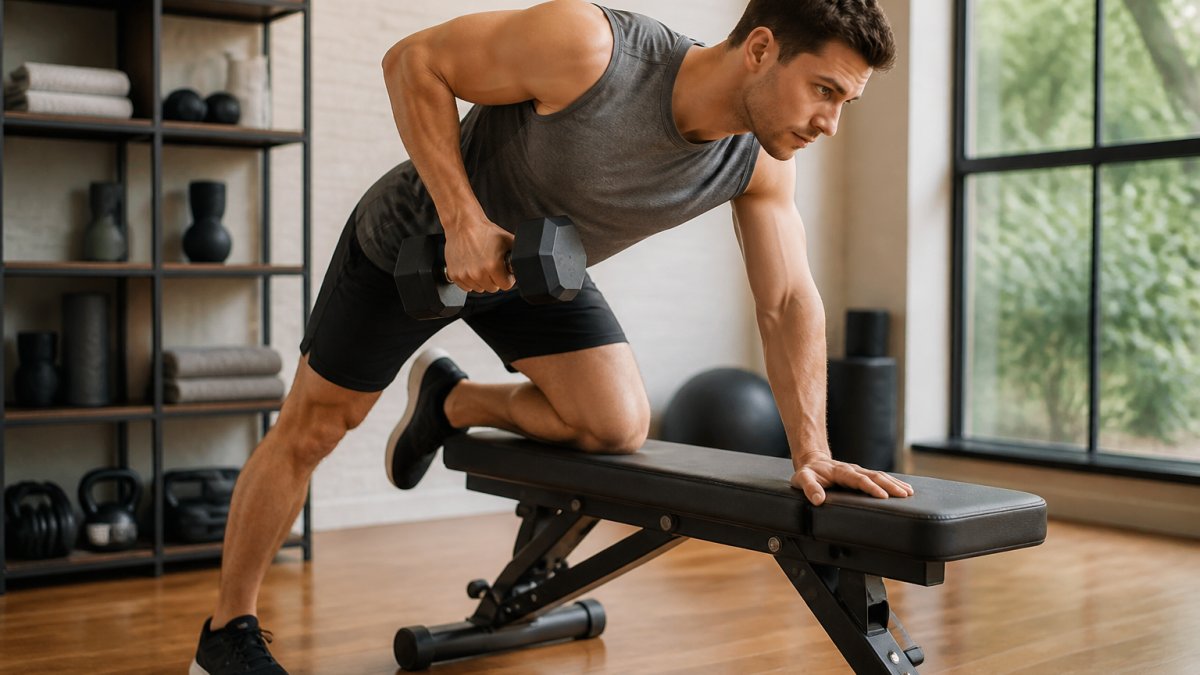
Start with these movements:
- Single-arm dumbbell row
- Single-arm overhead press
- Split squats and Bulgarian split squats
A pair of Premium 20LB Rubber Coated Cast Iron Dumbbells covers most of these. The knurled chrome handle gives a firm grip, and the rubber-coated hexagon heads won't roll across your floor between sets.

For lighter isolation work, the 8LB Rubber Coated Dumbbells let you dial in the weak side without ego lifting. Bands work too: the 5-Piece Latex Resistance Training Band Set adds adjustable tension for face pulls and bicep curls, and it packs away in seconds.

How to Strengthen Weak Muscles at Home
To strengthen weak muscles at home, give the weak side first attention in every set and slow the lowering phase. These two changes do more than any new equipment.
Start With the Weak Side Every Set
Always train the weak side first. Match the strong side to whatever the weak side completes.
The rule: if your weak arm gets 8 reps, your strong arm stops at 8. No extra reps, no "one more for good measure." It's the fastest way to close a strength deficit.
It feels wrong. You'll want to push the strong side. Don't.
Premium 20LB Rubber Coated Cast Iron Dumbbell with Ergonomic Chrome Handle →
Slow Down the Eccentric Phase
The eccentric phase is the lowering part of a rep, when the muscle lengthens under load.
Try a three-second lower on every rep. Count it out loud at first. You'll likely need less weight, and that's fine.
Slow eccentrics also improve neuromuscular control, the brain's ability to fire the right muscles at the right time.
Building a Muscle Imbalance Workout Routine
A muscle imbalance workout routine follows one rule: the weak side sets the pace, and the strong side matches it. Everything else is detail.
| Phase | Focus | Frequency | What to Do |
|---|---|---|---|
| Weeks 1-2 | Assess and reset | 2-3 sessions | Test both sides, note the gap, drop weight |
| Weeks 3-6 | Unilateral build | 3 sessions | Single-side moves, weak side first |
| Weeks 7-10 | Balance and load | 3-4 sessions | Add weight, keep reps matched |
| Week 11+ | Maintain | 2-3 sessions | Re-test monthly, keep one unilateral day |
Keep the structure simple. A 30-minute session works:
- Warm up for 5 minutes
- Two unilateral pushes, two unilateral pulls
- One single-leg movement
Add progressive overload by increasing weight only when both sides hit the top of your rep range. If the weak side stalls, hold the weight steady for another week.
How Long to Fix Muscle Imbalance
Most people see real progress in 6 to 12 weeks of consistent unilateral training, with the gap fully closed in 3 to 6 months depending on how large it was.
The timeline depends on three things:
- How big the original strength deficit was
- How often you train each side
- Whether you keep training both sides evenly once it's fixed
Expect the first visible change around week four. Strength evens out before size does, so trust the rep counts, not the mirror.
If you've trained unevenly for years, give it a full training cycle. Rushing it by adding extra sets for the weak side often backfires, causing joint pain and poor form.
Recovery, Nutrition, and the Mind-Muscle Connection
Lagging muscles need more than extra sets. They need sleep, protein, and a brain that actually fires them. Most articles stop at "get 8 hours and eat protein." The details below are what actually move a weak side.
Does the Weak Side Need Different Recovery?
No, and that's the trap. A common mistake is hammering the weak side with extra sets every session, which leaves it chronically fatigued and unable to adapt.
Practical rules:
- Keep weak-side training to 2-3 sessions per week, not daily.
- Leave at least 48 hours between hard unilateral sessions for the same muscle group.
- If the weak side is still sore on the next session, reduce volume rather than pushing through.
Sleep is the biggest lever. Most adults need 7 to 9 hours. Below 7 hours, strength recovery and motor learning both suffer, and motor learning is exactly what closes a neuromuscular gap.
Protein and Nutrition for a Lagging Side
You can't spot-grow a muscle with food, but you can undercut recovery by eating too little. General guidance from sports nutrition bodies is roughly 1.6 to 2.2 grams of protein per kilogram of body weight per day for people doing resistance training.
Spread it across 3-4 meals rather than loading it all at dinner. A palm-sized portion of a protein source at each meal is a workable home standard.
The Mind-Muscle Connection: A Trainable Skill
The mind-muscle connection is your ability to consciously feel and direct a specific muscle during a lift. Research on attentional focus suggests that internally focusing on the target muscle can increase its activation during resistance training, especially at lighter loads.
Drill it before every weak-side set:
- Touch the target muscle with your free hand.
- Do 2 slow practice reps with no weight or very light band tension, feeling the muscle shorten and lengthen.
- Keep that sensation as you add load.
- Stop the set when you can no longer feel the target muscle working, even if you have reps left.
The Adjustable Resistance Band (6.6-33LB) is useful here. Light tension and a slow tempo make it easy to feel the weak muscle working before you add real load.

Daily Habits That Reinforce the Imbalance
Your training is one hour. The other 23 hours can undo it. Watch for:
- Carrying a bag or backpack on the same shoulder every day
- Sitting with weight shifted to one hip
- Always leading stairs, doors, and heavy carries with the same side
Swap the bag shoulder weekly, alternate which hand carries groceries, and lead with the weak side on stairs when it's safe. These small swaps cost nothing and stop the gap from reopening.
The weak side improves fastest when you train it first, load it lighter, slow the lowering phase, and give it the same recovery as the strong side. Strength evens out before size does.
Conclusion: Train Both Sides, Build Even Strength
Uneven muscle growth rarely fixes itself, and ignoring it usually makes the gap wider.
That's where Bodyhackfitness comes in. Our rubber-coated dumbbells protect your floors, our adjustable bands fit any strength level, and our programs give you structure instead of random YouTube workouts.
Shop now and build a home gym that trains both sides equally.
Frequently Asked Questions
How long does it take to fix a muscle imbalance?
Most people notice visible and strength improvements within 6 to 12 weeks of consistent unilateral training. The exact timeline depends on how long the imbalance has existed, how often you train, and whether you address the root cause, such as always using your dominant side for daily tasks. Commit to at least three sessions per week and track your weak-side numbers monthly to see measurable progress.
Should I train the weaker side more when correcting uneven muscle growth?
Yes, but with a specific approach. Start every set with your weaker side and match that rep count with your stronger side. This prevents the dominant side from dictating the pace. You can also add one extra set for the weak side during isolation exercises. Avoid drastically overtraining the weak side, as this can lead to overuse injuries and slow your overall progress.
Can one-sided exercises help correct uneven muscle growth from home workouts?
Absolutely. Unilateral exercises like single-arm rows, split squats, and single-leg deadlifts force each side to work independently. This eliminates the stronger side compensating for the weaker one, which is common with barbells or bilateral machines. Using adjustable resistance bands or dumbbells at home makes it easy to isolate each side and progressively load the weak side without a spotter.
What causes one side to grow more than the other during home workouts?
The most common causes are handedness, habitual movement patterns, and bilateral exercises that let the dominant side take over. For example, during a standard push-up, your stronger arm may bear more weight without you realizing it. Other factors include old injuries, limited joint mobility on one side, and always starting a set with the same arm or leg. Identifying these triggers is the first step toward fixing the imbalance.