

Table of Contents
- What Causes Tight Hip Flexors and Why Quick Relief Matters
- How Long to Hold Hip Flexor Stretches for Results
- Essential Stretches to Release Hip Flexor Tightness
- Best Tools for Hip Flexor Release at Home
- Hip Flexor Stretches for Lower Back Pain Relief
- Glute Activation and Strengthening to Fix Muscle Imbalance
- Ergonomic Adjustments and Prevention Strategies
- When to Avoid Stretching: Hip Impingement vs. Tightness
- Frequently Asked Questions
Last Updated: September 21, 2026
What Causes Tight Hip Flexors and Why Quick Relief Matters
Tight hip flexors are muscles connecting your upper leg to your pelvis and lower back. They help you lift your knee and bend at the hip. When they tighten, they pull your pelvis forward, creating problems throughout your body.
The psoas muscle and iliopsoas are the main culprits. These deep muscles shorten when you sit for hours. A sedentary lifestyle is the biggest cause of tight hip flexors.
Other common causes include:
- Sitting for more than 4 hours daily
- Intense running or sprinting without proper warm-up
- Weak glute muscles that don't balance hip flexor strength
- Poor posture that shifts your pelvis forward
- Skipping stretching routines after workouts
Tight hip flexors pull your pelvis into anterior pelvic tilt, changing your posture and straining your lower back. Many experience low back pain without realizing their hip flexors are the root cause. Quick relief prevents chronic pain.
You can release tight hip flexors in days, not weeks with consistent stretching and targeted myofascial release.

How Long to Hold Hip Flexor Stretches for Results
Hold each stretch for 30 to 60 seconds to allow muscles to relax without triggering the stretch reflex. Five to ten seconds does almost nothing; thirty seconds is the minimum for real change.
Here's the timing breakdown:
- 30 seconds: Minimum effective hold for beginners
- 45 seconds: Sweet spot for most people
- 60 seconds: Best for tight muscles that need deep release
- Beyond 60 seconds: Diminishing returns; move to a new stretch instead
Perform 2 to 3 repetitions of each stretch with 15 seconds rest between reps. Frequency matters more than duration, stretch daily for best results. Consistency beats intensity.
Essential Stretches to Release Hip Flexor Tightness
The right stretches target the iliopsoas and rectus femoris directly, the main problem areas that standard routines often miss.
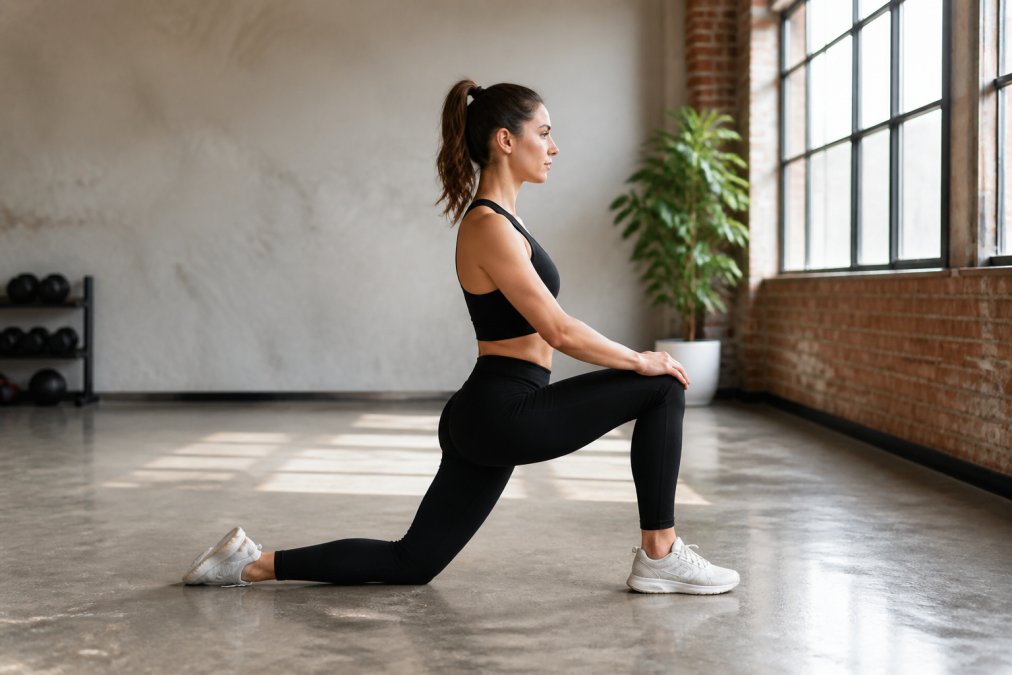
The Kneeling Lunge Stretch
The kneeling lunge is the gold standard for hip flexor release, isolating the iliopsoas better than any other stretch.
How to perform it:
- Kneel on your right knee on a soft surface (yoga mat or folded towel)
- Step your left foot forward into a lunge position
- Keep your back knee directly under your hip
- Tilt your pelvis backward slightly to maintain neutral spine
- Lean forward gently until you feel a stretch in the front of your right hip
- Hold for 45 seconds
- Repeat on the other side
The key is maintaining neutral pelvis by tucking your tailbone slightly under, this small adjustment dramatically improves effectiveness. Perform 3 sets of 45 seconds on each side daily.
The Couch Stretch
The couch stretch is intense but highly effective, stretching the entire front of your hip and thigh at once.
How to perform it:
- Kneel facing away from a couch or low chair
- Place your right shin on the couch behind you
- Step your left foot forward into a lunge position
- Keep your torso upright and shoulders back
- Breathe deeply and relax into the stretch
- Hold for 45 to 60 seconds
- Switch sides
Ease into the position gradually and stay relaxed for better release. This stretch addresses hip extension range of motion, crucial for proper walking and running mechanics.
Pigeon Pose and Yoga Variations
Pigeon pose targets the hip joint from a different angle. It's excellent for releasing deep tension in the glute and external rotators.
How to perform pigeon pose:
- Start in a tabletop position on hands and knees
- Bring your right knee forward toward your right wrist
- Keep your right shin as parallel to your body as possible
- Lower your hips toward the ground
- Fold forward gently if you want more intensity
- Hold for 60 seconds
- Switch sides
Both the kneeling lunge and pigeon pose are necessary, the former targets hip flexors directly, the latter addresses the posterior chain and hip joint mobility. Yoga variations like low lunge and crescent lunge also work well, improving range of motion while building strength.
Best Tools for Hip Flexor Release at Home
Stretching alone works, but tools accelerate the process through myofascial release and assisted stretching.

Foam Rolling for Myofascial Release
Foam rolling breaks up muscle tension and improves blood flow. The Foam roller Roller For body Relief from Bodyhackfitness features high-density foam and is portable at 33 cm in length.
Foam roller Roller For body Relief →
How to foam roll hip flexors:
- Lie face down on the floor
- Place the foam roller under your hip flexors
- Support yourself with your forearms
- Roll slowly from your hip to mid-thigh
- Pause on tender spots for 20 to 30 seconds
- Roll for 2 to 3 minutes total
Foam rolling feels intense at first, this is normal as muscles release tension.
Massage Guns and Deep Tissue Relief
The NNEDSZ Green Massage Gun features 6 adjustable speed levels and 4 professional massage heads for targeting tight hip flexors. Start at lower speeds and increase as your muscles adapt.

How to use a massage gun on hip flexors:
- Sit in a chair or lie on your back
- Apply the massage gun to the front of your hip
- Use gentle pressure; let the vibration do the work
- Move slowly across the muscle
- Spend 30 to 60 seconds per area
- Use 3 to 4 times per week
Yoga Straps for Assisted Stretching
The 1pc Multifunctional Adjustable Yoga Strap from Bodyhackfitness is a home fitness accessory for stretching.
How to use a yoga strap:
- Loop the strap around your foot or leg
- Use your hands to gently pull the strap
- Increase tension gradually
- Hold for 45 to 60 seconds
- Breathe deeply throughout
Hip Flexor Stretches for Lower Back Pain Relief
Lower back pain often stems from tight hip flexors pulling your pelvis forward, forcing your lumbar spine to compensate. Releasing tight hip flexors can help relieve low back pain.
Glute Activation and Strengthening to Fix Muscle Imbalance
Your glutes are your hip flexors' antagonists. Weak glutes cause hip flexors to tighten and compensate. Strengthening your glutes fixes the root cause by building posterior chain strength.
Essential glute exercises:
- Glute bridges: Lie on your back, bend your knees, and push through your heels to lift your hips. Hold for 2 seconds at the top. Perform 3 sets of 12 reps.
- Single-leg glute bridges: Same movement, but with one foot elevated. This increases difficulty and targets each side independently.
- Clamshells: Lie on your side, bend your knees, and open your top knee toward the ceiling. Perform 3 sets of 15 reps per side.
- Monster walks: Use a resistance band around your legs and walk forward with small steps, keeping tension in the band. This activates your glutes throughout the movement.
- Hip thrusts: Sit with your back against a bench, feet on the ground, and push your hips upward. This is the most powerful glute exercise.
Ergonomic Adjustments and Prevention Strategies
Prevention is easier than treatment. Fix poor ergonomic habits and the problem won't return.
Desk setup adjustments:
- Keep your knees at 90 degrees when sitting
- Position your monitor at eye level
- Keep your feet flat on the floor or footrest
- Sit with your back against the chair
- Avoid crossing your legs
Movement breaks:
Daily stretching routine:
Warm-up before activity:
When to Avoid Stretching: Hip Impingement vs. Tightness
Not all hip pain comes from tightness. Sometimes stretching makes things worse. You need to know the difference.
Signs of hip impingement:
- Sharp, pinching pain in the front of your hip
- Pain that worsens with deep hip flexion
- Clicking or catching sensation inside the joint
- Pain that doesn't improve with stretching
Signs of tight hip flexors:
- Dull, aching tension in the front of your hip
- Pain that improves with stretching
- Postural changes (anterior pelvic tilt)
- Discomfort after sitting for long periods
Frequently Asked Questions
What is the root cause of tight hip flexors?
Tight hip flexors typically develop from prolonged sitting, sedentary lifestyle habits, and repetitive activities that shorten the psoas muscle and iliopsoas. Muscle imbalance from weak glutes, poor posture, and anterior pelvic tilt also contribute. Understanding your specific cause helps determine whether you need stretching, strengthening, or ergonomic changes to address the underlying issue.
How long should you hold hip flexor stretches to see results?
Hold static stretches for 30-60 seconds per side, repeating 2-3 times. Most people notice improved range of motion within 2-3 weeks of consistent daily stretching. Breathing deeply during holds increases muscle relaxation and flexibility gains. Consistency matters more than duration, daily 5-minute sessions beat occasional long sessions for lasting hip flexor release.
Can tight hip flexors cause lower back pain?
Yes. Tight hip flexors pull the pelvis into anterior pelvic tilt, increasing lumbar spine curvature and compressing the low back. This muscle tightness restricts hip extension and forces your lower back to compensate, causing pain. Stretching the psoas and iliopsoas, combined with glute activation and neutral pelvis work, directly reduces this mechanical stress on your lumbar spine.
How do I know if I have hip impingement instead of just tight hip flexors?
Hip impingement causes sharp pinching pain in the front of the hip during specific movements, especially deep hip flexion or internal rotation. Tight hip flexors feel like muscle tension or stiffness. If you experience sudden sharp pain, clicking, or locking, avoid aggressive stretching and consult a physical therapist. Stretching can worsen impingement, making proper diagnosis essential before starting a release routine.