

Table of Contents
- Measure Your Space and Plan Your Layout
- Choose the Best Space-Saving Gym Equipment
- Select Apartment-Friendly Workout Flooring
- Implement Noise Reduction for Apartment Workouts
- Maximize Vertical Storage and Organization
- Set Up Your Dedicated Workout Zone
- Build Your Starting Equipment List and Budget
- Conclusion
Last Updated: August 16, 2026
Measure Your Space and Plan Your Layout
Setting up a home gym in a small apartment requires precision. Measure everything before buying equipment. The difference between a functional workout space and a cluttered corner comes down to understanding your actual dimensions.
Calculate Available Floor Space
Measure the length and width of your intended workout area in feet and multiply to get total square footage. Most effective apartment workouts require 50-100 square feet of clear, unobstructed space. Don't just measure the room itself, measure the actual space where you'll work out, accounting for where your bed extends, doors swing open, and furniture sits. Write down your measurements and reference them when evaluating equipment.
Account for Ceiling Height and Doorways
Measure from floor to ceiling in your workout area. If you're considering a pull-up bar or doing overhead presses, you need at least 7.5 feet of clearance. Measure doorway width between storage and workout areas, a 32-inch doorway is standard, but older apartments often have narrower passages. Check for ceiling obstructions like light fixtures and ceiling fans that eat into usable space.
Choose the Best Space-Saving Gym Equipment
Your equipment selection makes or breaks a small apartment setup. The right choices let you train effectively in minimal space.
Adjustable Dumbbells vs. Fixed Weights
Adjustable dumbbells are non-negotiable for small apartments. A single set replaces 10-15 individual dumbbells, cutting storage requirements dramatically. Many adjustable dumbbells max out at 50 pounds per hand, assess your actual strength level honestly before assuming you need heavier weights. Faster adjustment systems cost more but keep workouts flowing smoothly in tight spaces.
Bodyhackfitness carries carefully curated adjustable dumbbell options that prioritize both functionality and space efficiency, letting you maximize training variety without sacrificing your living space.
Resistance Bands and Bodyweight Tools
Resistance bands are the hidden weapon of apartment training. They take up almost no space, provide scalable resistance, and work for nearly every movement: chest presses, rows, shoulder work, leg exercises, and assistance for pull-ups. They're quieter than dumbbells and gentler on your joints.
Bodyweight exercises deserve respect too. Push-ups, dips, planks, and single-leg work require zero equipment and minimal space. A doorway pull-up bar is worth considering if your doorframes are sturdy, verify that your doorframe can handle your weight plus dynamic movement before trusting it fully.
Compact Cardio and Strength Equipment
Skip traditional treadmills and stationary bikes. A compact rowing machine offers serious cardio and strength work in roughly 7 feet by 2 feet of space. Quality compact rowers fold or store vertically, saving even more space.
Kettlebells deserve a spot in your setup. One kettlebell replaces multiple pieces of equipment and works for swings, goblet squats, Turkish get-ups, and dozens of other movements. A single 35-40 pound kettlebell provides enough resistance for most people starting out.
A foldable weight bench expands your exercise options without taking permanent space. When not in use, it leans against a wall or slides under a bed, letting you do dumbbell presses and seated exercises that bodyweight alone can't replicate.
Select Apartment-Friendly Workout Flooring
Your floors determine whether your neighbors tolerate your workouts. Protect both your building's floors and your relationship with neighbors.
Vibration Dampening and Protection
Dropping weights creates vibration that travels through building structures. Rubber flooring absorbs impact and reduces vibration transmission. High-density rubber tiles, typically 3/4 inch thick, provide serious dampening. Interlocking rubber tiles work better than rolled rubber because they stay in place during dynamic movement and won't slide.
Thickness matters. Thinner mats (1/4 inch) provide minimal dampening. Go with 3/4 inch minimum if you're doing any impact work.
Rental-Friendly Floor Solutions
Removable rubber tiles solve lease restrictions. They sit on your existing floor, require no fasteners, and come up cleanly when you move. Interlocking foam tiles offer a lighter, cheaper alternative if you're doing primarily strength work without heavy impact.
Lay down a barrier between your flooring and the building's floor for additional sound dampening. Test your setup before committing fully, place a few tiles down, do a few workouts, and ask your downstairs neighbor if they notice any noise.
Implement Noise Reduction for Apartment Workouts
Noise complaints end home gyms. Start early conversations with neighbors about your plans. Avoid high-impact movements during early mornings, late nights, and quiet hours. Rubber flooring addresses impact noise. Acoustic panels on walls absorb sound reflection. Place rubber shims or isolation pads under kettlebells, dumbbells, and benches to prevent direct contact with your floor.
Equipment Choices That Minimize Sound
Adjustable dumbbells are quieter than fixed weights when dropped. Kettlebells produce less noise than dumbbells because they're used with controlled movements. Resistance bands produce almost no noise. Rowing machines designed for apartments use magnetic resistance instead of water or air resistance, making them significantly quieter.
Maximize Vertical Storage and Organization
Your walls are wasted space. Use them.
Wall-Mounted Storage Solutions
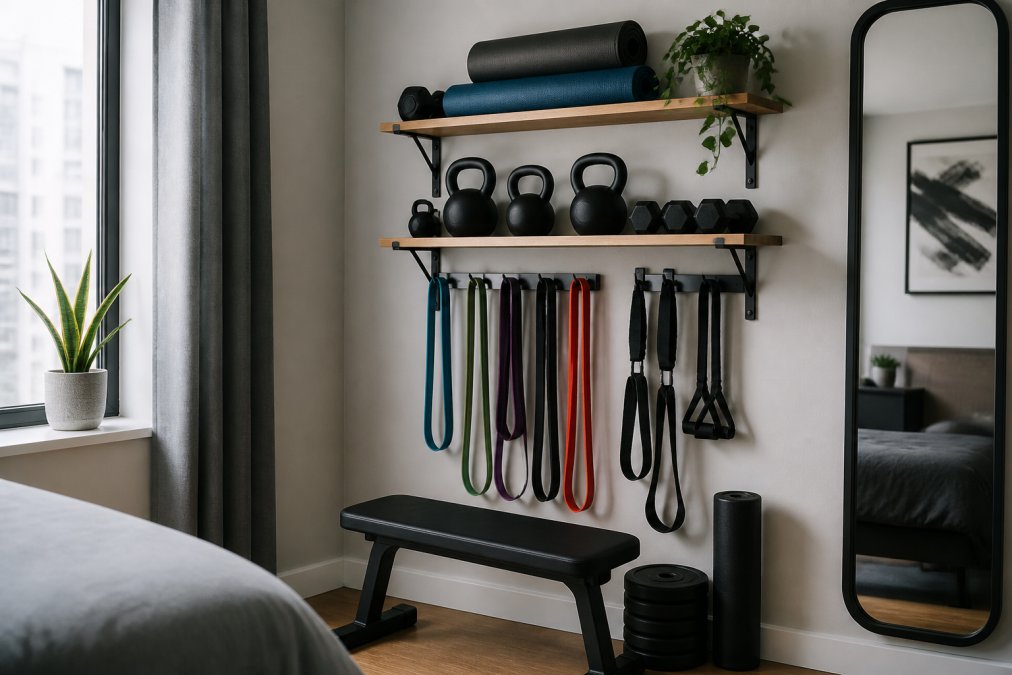
Pegboards are cheap and versatile. Mount one to a wall and hang resistance bands, jump ropes, and lighter equipment. Wall-mounted shelving holds heavier items like kettlebells and dumbbells. Tension rods hung horizontally hold resistance bands efficiently. Over-the-door organizers work for smaller items: resistance loops, jump rope, towels, and water bottles.
Lease-Friendly Modifications
Use damage-free mounting solutions. Heavy-duty adhesive strips, magnetic mounts, and tension rods require no drilling. Test any mounting solution with weight before trusting it fully. Document your modifications with photos. When you move, remove everything cleanly to keep your security deposit intact.
Set Up Your Dedicated Workout Zone
Creating a dedicated space matters psychologically and practically. Your brain recognizes the space as a workout area, making it easier to train consistently.
Lighting and Ventilation for Your Home Gym
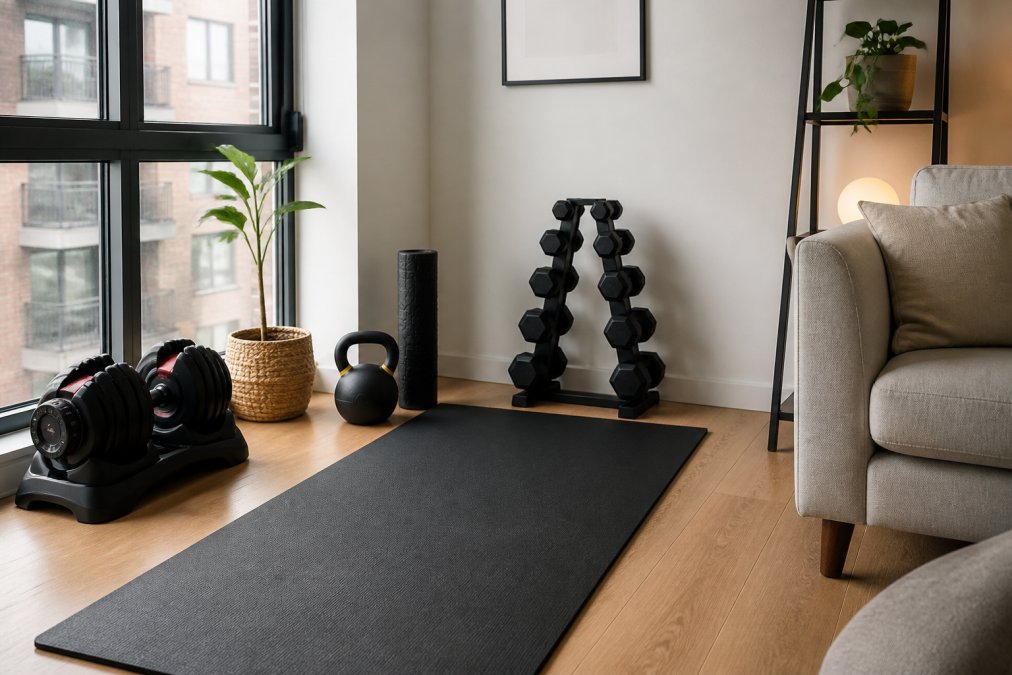
Position your workout area near a window if possible. Morning sunlight energizes workouts and improves mood. If you can't use natural light, invest in good LED lighting. Bright, cool-toned LED lights (5000K color temperature) mimic daylight and keep you alert.
Ventilation prevents your apartment from becoming a sauna. Open windows during workouts if weather permits. A small portable fan keeps air moving. A humidity monitor helps, if humidity exceeds 60 percent consistently, use a dehumidifier.
Creating a Functional Workout Space
Minimize distractions. Keep your phone, TV, and other entertainment outside your workout zone. Keep water nearby. A single mirror lets you verify movement quality on critical exercises. Aim for 65-72 degrees Fahrenheit. Adjust with fans or a space heater as needed.
Build Your Starting Equipment List and Budget
You don't need everything at once. Strategic progression prevents waste and keeps costs manageable.
Essential Gear for Beginners
Start with adjustable dumbbells covering 5-50 pounds. Add a yoga mat for floor work and stretching. Resistance bands add variety without significant cost. A pull-up bar transforms your doorframe into additional training equipment. These three categories form the foundation of effective apartment training.
Progressive Equipment Additions
Once you've trained consistently for 4-6 weeks, assess what's missing. Do you want more cardio? A compact rowing machine or jump rope adds that dimension. Do you want more strength variety? A kettlebell or adjustable bench expands options.
Bodyhackfitness offers thoughtfully selected equipment that grows with your training. Track what you actually use. Quality matters more than quantity. One solid piece of equipment you'll use for years beats five cheap pieces you'll abandon.
Setting up a home gym in a small apartment is entirely achievable with thoughtful planning and strategic equipment selection. Start with adjustable dumbbells, resistance bands, and a yoga mat, and add strategically as your training evolves. At Bodyhackfitness, we specialize in helping fitness enthusiasts like you create complete training environments in any space, with premium equipment selected specifically for effectiveness and durability. Shop now to build your apartment gym and start training with confidence.
Frequently Asked Questions
Can I really set up a functional home gym in my apartment?
Yes. A home gym in a small apartment works when you prioritize space-saving equipment like adjustable dumbbells, resistance bands, and bodyweight tools. Focus on equipment with a small footprint and high versatility. Most people see results with just 50-75 square feet of dedicated workout space. The key is choosing multi-functional gear and using vertical storage to keep your apartment livable.
What's the most important apartment-friendly workout flooring option?
Rubber tiles or interlocking foam mats are your best choice. They provide vibration dampening to reduce noise for neighbors below, protect your floors from damage, and are removable, important for renters. A 4-6mm thick rubber mat or foam tile system costs less than permanent flooring and handles most strength training and cardio without damage. Pair it with a yoga mat for added comfort during floor exercises.
How do I reduce noise when working out in my apartment?
Combine three strategies: use rubber flooring for vibration dampening, choose quiet equipment (adjustable dumbbells, resistance bands, kettlebells), and avoid dropping weights by using controlled movements. Place rubber mats under equipment, work out during reasonable hours, and let neighbors know your schedule. If impact is unavoidable, consider lower-impact exercises like resistance training and yoga, or schedule cardio when most people are awake.
How much space and budget do I actually need for a small apartment home gym?
Start with 50-75 square feet and a modest budget. Essential equipment includes adjustable dumbbells ($150-300), resistance bands ($30-60), a yoga mat ($30-80), and rubber flooring ($100-200). That's roughly $300-640 to begin. Add storage solutions ($50-150) and you're ready to train. Expand later with kettlebells, a foldable bench, or pull-up bar as your fitness grows and budget allows.
This article was written using GrandRanker