

Table of Contents
- Why Consistency Beats Intensity Every Time
- The Best Workout Frequency for Beginners (and Why Less Is More)
- How to Stay Motivated to Exercise When You'd Rather Skip
- Home Gym Setup for Consistency: Remove Every Excuse
- Track Progress Without Obsessing Over the Scale
- Common Mistakes That Break Your Routine
- How to Recover When You Fall Off
- Frequently Asked Questions
Last Updated: September 29, 2026
Why Consistency Beats Intensity Every Time
Learning how to stay consistent working out matters more than any single hard session you'll ever do. That's the core truth this guide from Bodyhackfitness is built on. Most people quit not because their workouts were too easy, but because they went too hard, too fast, and burned out.
Here's what most guides get wrong: they treat motivation as the engine. It isn't. Motivation is weather. Discipline is climate.
Think about the last time you started a new routine. You probably went all in for a week or two. Then life happened. A busy workweek, a cold, a birthday dinner. You missed one session, then another, and the whole thing fell apart.
That pattern isn't a character flaw. It's a design flaw. The CDC's physical activity guidelines recommend adults get at least 150 minutes of moderate activity per week, but hitting that number only works if your routine survives real life.
Consistency beats intensity because it compounds. Three short workouts a week for a year will always beat one heroic month followed by eleven months of nothing.
The Best Workout Frequency for Beginners (and Why Less Is More)
The best workout frequency for beginners is three days per week. This gives your body time to recover, builds the habit without overwhelming you, and leaves room for the days when life gets in the way.
How Many Days a Week Should You Actually Train?
For most beginners, three days a week is the sweet spot. Two days can work if your schedule is tight. Four is fine if you're already active.
The mistake is jumping straight to six days. A common mistake is confusing ambition with a plan. Six days sounds impressive. It also leaves zero margin for a missed session.
Building Your Weekly Training Schedule
A simple beginner schedule looks like this:
- Monday: Full-body strength, 30 minutes
- Tuesday: Rest or a short walk
- Wednesday: Full-body strength, 30 minutes
- Thursday: Rest or a short walk
- Friday: Full-body strength, 30 minutes
- Weekend: One fun activity, like hiking or a bike ride
This structure builds in recovery and flexibility. Miss Wednesday? Friday still happens. The week isn't ruined.
How to Stay Motivated to Exercise When You'd Rather Skip
You don't wait to feel motivated. You build systems that make showing up the easy choice. Motivation follows action, not the other way around.
Find Your Why and Make It Specific
"How to stay motivated to exercise" fails when your reason is vague. "I want to be healthy" won't get you off the couch. "I want to keep up with my kids on the trail" might.
Write your why down. Make it concrete. Then put it somewhere you'll see it on the days you don't feel like training.
Use Habit Stacking to Make Movement Automatic
Habit stacking means attaching a new behavior to an existing one. You already have a morning coffee routine. You already brush your teeth. You already take the dog out.
Try this:
- After I pour my morning coffee, I'll do 10 minutes of stretching.
- After I get home from work, I'll change straight into workout clothes.
- After I walk the dog, I'll do one set of resistance-band rows.
The existing habit becomes the trigger. Over time, the workout feels automatic instead of optional.
Home Gym Setup for Consistency: Remove Every Excuse
A home gym setup for consistency works by cutting friction. If your gear is ready and visible, you train. If it's buried in a closet, you don't.
Bodyhackfitness 30-Day Home Strength →
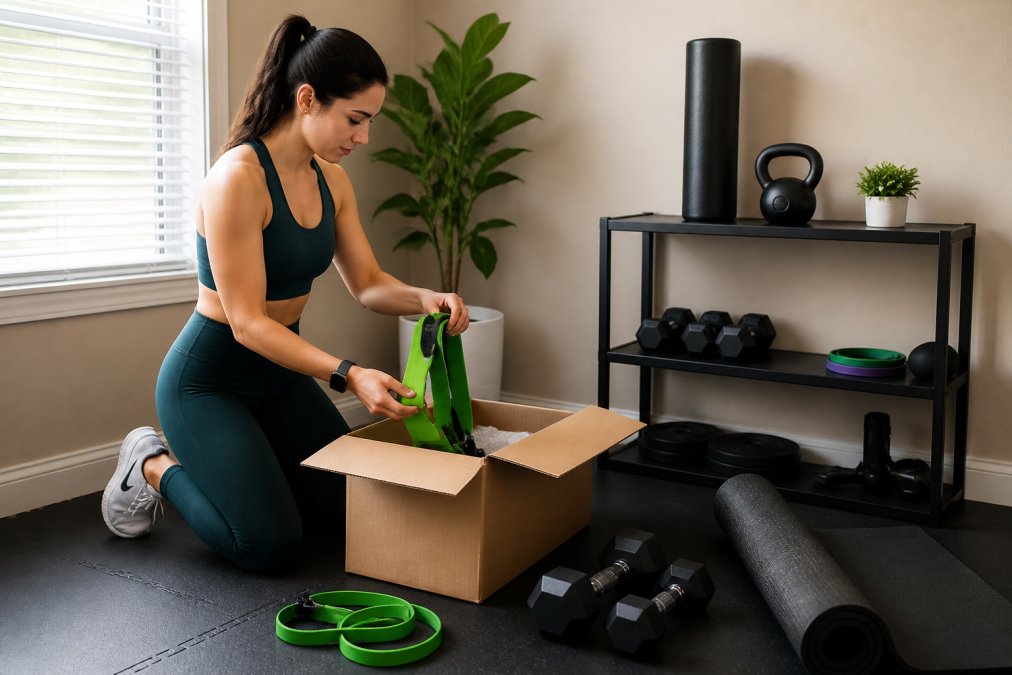
You don't need a garage full of machines. You need a corner that's ready when you are.
The Gear That Keeps You Showing Up
Start with the basics and add as you go:
- A yoga mat for floor work and stretching
- A set of resistance bands for strength without heavy weights
- One pair of adjustable dumbbells
- A fitness tracker to log sessions and see progress
The Bodyhackfitness PowerFlex Resistance Bands Set is a solid starting point. It covers upper body, lower body, core, and glutes without bulky equipment. When you want structure, the Bodyhackfitness 30-Day Home Strength Program gives you a full plan with trackers and bonus workouts for $14.99.

Track Progress Without Obsessing Over the Scale
Progress tracking keeps you honest, but the scale is a poor scoreboard. Weight fluctuates daily based on water, food, and sleep. Chasing it leads to frustration.
Track things you control instead:
- Workouts completed this week
- Minutes of activity
- How strong you feel on a given exercise
- Sleep quality and energy levels
A simple fitness tracker makes self-monitoring easy.
Common Mistakes That Break Your Routine
Most broken routines fail for the same handful of reasons. But the biggest one isn't a scheduling problem or a motivation problem. It's a thinking problem, and it has a name.
The All-or-Nothing Fallacy
The all-or-nothing fallacy is the belief that a workout only counts if it's complete, intense, and on schedule. Miss one session and the whole week feels ruined. Miss a week and the whole program feels dead.
- You plan five sessions a week.
- You miss Tuesday because of a work deadline.
- You decide the week is already blown, so you skip Thursday too.
- By Sunday, you've done one workout instead of five, and you feel like you failed.
Why Missing One Day Doesn't Matter (But Missing Two Does)
Behavioral research on habit formation from the American Psychological Association points to a consistent pattern: missing a single day has almost no effect on long-term habit strength. Missing two in a row is where routines start to slip.
The Other Mistakes That Quietly Kill Consistency
Beyond the all-or-nothing trap, these are the failure points that show up again and again:
- Going too hard too soon. Soreness and exhaustion kill motivation fast. If your first week leaves you unable to walk down stairs, you won't come back for week two.
- No recovery plan. Rest days aren't lazy. They're part of the program. Training the same muscles hard every day without recovery leads to overuse injuries that sideline you for weeks.
- Skipping the warm-up. Five minutes of dynamic movement before a session prevents the strains and tweaks that turn a two-day break into a two-month one.
- No accountability. Going it alone makes it easy to skip. A training partner, a coach, or even a public log changes the calculus.
- Chasing the scale instead of behavior. If your only scoreboard is body weight, normal daily fluctuations will convince you that your work isn't paying off.
The Recovery Mindset
The people who stay consistent for years aren't the ones who never miss a workout. They're the ones who miss a workout and treat it as a data point, not a verdict.
How to Recover When You Fall Off
Everyone falls off. The difference between people who stay consistent and people who quit is how quickly they restart.
Use this simple recovery plan:
- Skip the guilt. One missed week means nothing in a year of training.
- Shrink the next session. Do a 10-minute mini-workout instead of the full hour.
- Rebuild the trigger. Reattach the workout to your existing habit stack.
- Log it. Mark the session done so your tracker shows forward motion.
Frequently Asked Questions
How long does it actually take to build a workout habit?
Research on habit formation suggests it takes anywhere from 18 to 254 days for a behavior to feel automatic, with an average around 66 days. The key is frequency, not perfection. If you train three times a week and never miss twice in a row, most people notice the routine starts feeling normal within two to three months. Start small with mini-workouts and let the habit grow.
Is working out 3 times per week enough to see results?
Yes, for most beginners three sessions per week is enough to build strength and improve health outcomes. The best workout frequency for beginners is three to four days weekly with at least one rest day between sessions. Consistency matters more than volume. Three focused workouts you actually complete beat five you skip. Add a short walk or stretch on off days to keep momentum.
What happens to your body after 2 weeks of no gym?
Two weeks off won't erase your progress, but you may notice subtle changes. Cardiovascular fitness can dip slightly, and muscles may feel less full due to reduced glycogen and fluid. Strength typically holds for about two to three weeks. The bigger risk is mental: the all-or-nothing fallacy kicks in and one missed week becomes a month. Return with a lighter session to rebuild momentum.
How do I stay motivated to work out when I'm tired?
Lower the bar instead of skipping. Commit to a five-minute mini-workout, and if you still want to stop after that, you can. Most people keep going once they start. Prepare your gear the night before, lay out clothes, and use habit stacking by attaching your workout to an existing routine like your morning coffee. Motivation follows action, not the other way around.
Staying consistent is the hardest part of fitness, and it's the part most programs ignore. Bodyhackfitness built its catalog around that gap, with gear and digital programs designed to keep you showing up. The PowerFlex Resistance Bands Set handles strength work anywhere, the MOLED Fitness Tracker logs every session, and the 30-Day Home Strength Program gives you a plan to follow. Shop now and build the routine that finally sticks.