


Table of Contents
- Contrast Therapy and Muscle Inflammation: The Short Answer
- How Hot and Cold Exposure Affects Inflammation and Blood Flow
- What the Evidence Says About Soreness, Swelling, and Recovery
- A Practical Contrast Therapy Protocol for Sore Muscles
- How Long to Do Contrast Therapy (and How Often)
- Contrast Therapy vs. Ice Bath: Which Wins for Recovery?
- Contrast Therapy Risks and Precautions You Should Not Skip
- Verdict: Who Should Try It and What to Expect
- Frequently Asked Questions
Last Updated: October 19, 2026
Contrast Therapy and Muscle Inflammation: The Short Answer
Contrast therapy is the practice of alternating hot and cold water exposure to support recovery, and the honest answer is that it can help with soreness and swelling, but it is not a cure for inflammation.
Below, we break down what the science actually supports, where the hype outruns the evidence, and how to run a safe protocol at home.
How Hot and Cold Exposure Affects Inflammation and Blood Flow
Heat and cold push your blood vessels in opposite directions. That push-pull is the whole mechanism behind contrast therapy, and it is why the method feels so different from a plain ice bath or a hot soak.
Vasodilation is the widening of blood vessels. Heat triggers it, which increases blood flow to the area. Vasoconstriction is the narrowing of blood vessels. Cold triggers that, which pushes blood away from the surface.
Vasodilation, Vasoconstriction, and the Pump Effect
Alternating the two creates what practitioners call a pumping action. Blood floods in with heat, then gets squeezed out with cold, then floods back.
That is the theory. The evidence for a big, lasting effect on inflammation itself is thin.
- Heat: opens vessels, boosts blood flow, relaxes tight tissue
- Cold: closes vessels, numbs pain, limits swelling
- Alternating: creates a rhythmic pump that may support recovery
For a deeper look at how cold exposure is used in recovery, the Cleveland Clinic overview of cold therapy is a solid, plain-language starting point.
What the Evidence Says About Soreness, Swelling, and Recovery
Here is where we part ways with the marketing. The research on contrast therapy for muscle inflammation is not settled, and the quality of the evidence matters as much as the direction of the findings. Some studies show less soreness and better perceived recovery. Others find little difference compared with rest or active recovery. A balanced read means looking at what was measured, how big the studies were, and whether the results were consistent.
What the Data Supports Reasonably Well
- Reduced delayed-onset muscle soreness, the ache that hits a day or two after hard training
- Better self-reported recovery and readiness
- Short-term pain relief and improved joint mobility
What It Does Not Clearly Support
- A proven, lasting drop in inflammatory markers
- Faster healing of actual tissue damage
- A clear advantage over cold-only treatment or active recovery for every outcome
How to Read the Evidence
Most contrast-therapy studies are small, and many use different protocols, different temperatures, different intervals, different total durations, which makes them hard to compare directly. Outcomes are often subjective: soreness ratings, perceived recovery, and readiness scores rather than lab measures of inflammation. That does not make the findings useless, but it does mean you should treat broad claims with caution. When a study reports less soreness but no change in inflammatory markers, both can be true at once: you may feel better without measurable inflammation changing.
Conflicting Findings and What They Mean
A common pattern is that contrast therapy outperforms passive rest for soreness and perceived recovery, but looks similar to active recovery or cold-only treatment on many measures. Some trials find benefits for swelling and range of motion; others find none. The honest summary is that the effect is likely modest and most reliable for comfort and function rather than for inflammation itself.
Acute Inflammation vs. Delayed-Onset Soreness vs. Chronic Conditions
This distinction matters more than any protocol detail. Acute muscle inflammation is the body's immediate response to injury, marked by redness, heat, and swelling. Delayed-onset muscle soreness is the normal ache after unfamiliar or hard exercise. Chronic inflammatory conditions are ongoing issues like arthritis, which need medical care, not a bathtub.
Contrast therapy is a reasonable fit for soreness and general recovery. It is not a treatment for acute injury or chronic disease. If you have either, talk to a clinician first.
How It Compares With Other Recovery Methods
Contrast therapy is one option among several. Active recovery, easy movement such as walking or light cycling, has reasonable support for reducing soreness and is free. Compression garments are popular and may help with perceived recovery, though evidence is mixed. Cold-only treatment is simpler and slightly more studied, and it is a better fit when acute swelling is the main issue.
A Practical Contrast Therapy Protocol for Sore Muscles
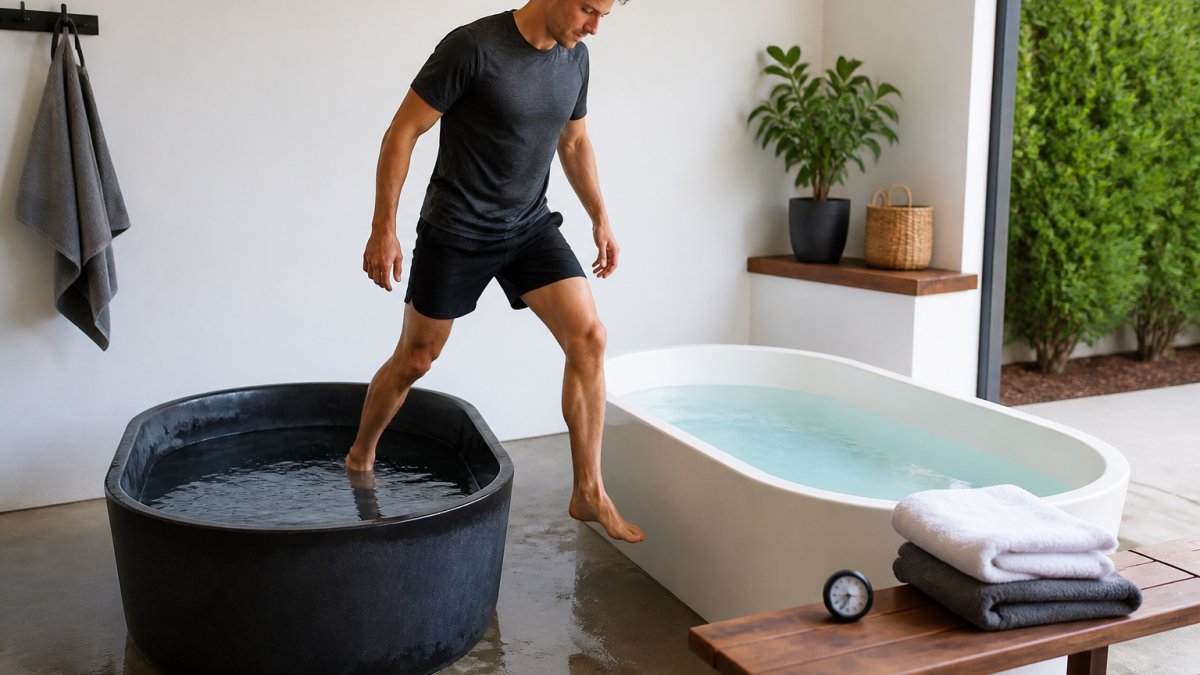
Most people overcomplicate this. A simple, repeatable routine beats an elaborate one you will not stick to. The standard approach is a contrast bath or contrast shower: alternate warm and cold water on the sore area or the whole body.
The Core Protocol
- Warm phase: water at roughly 100-104°F (38-40°C), a comfortable hot-tub temperature, not scalding.
- Cold phase: water at roughly 50-60°F (10-15°C), or as cold as you can tolerate safely without shivering uncontrollably.
- Order: start with heat, then alternate, and finish on cold.
- Intervals: 3 minutes warm, 1 minute cold.
- Rounds: repeat 3-4 times.
- Total time: about 15-20 minutes per session.
- Frequency: after hard training sessions, typically 2-4 times per week; daily use is generally fine for most healthy adults, but more is not automatically better.
Why These Numbers
The 3:1 warm-to-cold ratio is the most common pattern in recovery practice because it gives the tissue enough time to warm and relax before a short, sharp cold exposure. The short cold interval limits the numbing effect so you still get the vascular pump without over-cooling. Ending on cold is a practitioner preference: it leaves the area feeling calmer and avoids the sluggish feeling some people get after finishing warm.
Equipment and Alternatives
- Contrast bath: two tubs or basins, one warm and one cold, set side by side. Best for hands, feet, and lower legs.
- Contrast shower: alternate the shower head between warm and cold settings. Works for the whole body and needs no extra equipment.
- Bucket method: two buckets deep enough to submerge the foot or hand. Cheap and portable.
If you do not have a tub, a contrast shower works. You can also pair the routine with self-massage. Our Foam roller Roller For body Relief is a lightweight 33 cm high-density foam roller that fits easily beside a home recovery setup for easing post-workout tension.


When to Use Heat, Cold, or Neither
This is the decision most people get wrong. Use cold only in the first 48 hours after an acute sprain or strain, when swelling is the main problem, heat can increase swelling. Use contrast therapy once the acute phase has passed and the main complaint is stiffness, soreness, or sluggish circulation. Use neither, and seek medical care, if you have severe pain, cannot bear weight, or see worsening redness and warmth, which can signal infection.
A Note on Evidence for the Protocol
The specific temperatures and intervals above are practical conventions, not doses proven in large trials. Most studies of contrast therapy use water in roughly these ranges and total sessions in the 15-20 minute range, but protocols vary widely. Treat the numbers as a sensible starting point, adjust to your tolerance, and stop if you feel dizzy or faint.
Foam roller Roller For body Relief →
How Long to Do Contrast Therapy (and How Often)
A common answer to how long to do contrast therapy is roughly 15 to 20 minutes total, split into short intervals. A typical split is 3 minutes warm, 1 minute cold, repeated three to four times.
Here is a simple reference table:
| Phase | Temperature | Duration | Repeat |
|---|---|---|---|
| Warm | 100-104°F | 3 minutes | 3-4 rounds |
| Cold | 50-60°F | 1 minute | 3-4 rounds |
| Finish | Cold | 1 minute | Once |
| Total | Alternating | 15-20 minutes | Per session |
How often? Many people use it after hard training sessions, a few times a week. Daily use is generally fine for most healthy adults, but more is not automatically better.
Contrast Therapy vs. Ice Bath: Which Wins for Recovery?
Neither wins outright. Contrast therapy vs. ice bath comes down to your goal. An ice bath is simpler and delivers strong short-term pain relief and a mental boost.
| Factor | Contrast Therapy | Ice Bath Only |
|---|---|---|
| Comfort | More tolerable for most | Intense, hard to stick with |
| Best for | Stiffness, circulation, general recovery | Acute swelling, post-session numbing |
| Setup | Needs hot and cold water | Needs cold only |
| Time | 15-20 minutes | 5-10 minutes |
| Evidence | Mixed | Mixed, slightly more studied |
If you mainly want to feel less stiff and improve blood flow, contrast therapy is the better fit. If you want a quick, hard reset after a brutal session, cold alone does the job.
For building a recovery corner at home, our High-Density Foam Roller For Full Body roller is made from 100% EPP foam and supports up to 300 pounds, which pairs well with a contrast routine for post-workout tension.
Contrast Therapy Risks and Precautions You Should Not Skip
Contrast therapy is generally safe for healthy adults, but the contrast therapy risks and precautions are real and worth respecting. Temperature extremes stress the body, and not everyone should try them.
Skip contrast therapy, or check with a doctor first, if you:
- Have heart or blood pressure conditions
- Are pregnant
- Have diabetes with nerve damage or poor sensation
Verdict: Who Should Try It and What to Expect
Contrast therapy is a useful recovery tool, not a miracle. If you are a healthy adult dealing with post-workout soreness, stiffness, or just want better circulation and mobility, it is worth trying.
If you have an acute injury, a chronic inflammatory condition, or a health issue on the precautions list, get medical advice before you start. And remember: recovery is a stack.
At Bodyhackfitnesss, we build recovery gear for people who train hard and want to bounce back faster. Our High Density Foam Roller For Deep roller (Blue) is a durable EVA-foam roller that supports up to 136 kg and works well alongside a contrast routine for easing tension and improving flexibility.

Frequently Asked Questions
Does contrast therapy reduce muscle inflammation?
It can help with the soreness and stiffness that follow hard training, but the effect on inflammation itself is modest and short-lived. Alternating hot and cold water causes blood vessels to widen and narrow, which flushes fluid through the tissue and can ease swelling and aches. Research on markers of muscle damage is mixed, with some studies showing small improvements and others finding little difference versus rest. Think of contrast therapy as a comfort and circulation tool, not a treatment for chronic inflammatory conditions.
How long should you do contrast therapy after a workout?
Most protocols run about 15 to 20 minutes total. A common approach is one minute in cold water, three minutes in hot water, repeated three to four times, finishing on cold. Keep hot water around 100 to 104°F and cold water around 50 to 59°F. You can start within an hour of training or later the same day. Frequency matters less than consistency: two to four sessions per week is a reasonable starting point for most recreational athletes.
Is contrast therapy better than an ice bath for recovery?
It depends on your goal. Cold-only immersion is better studied for blunting acute swelling and numbing pain right after an injury. Contrast therapy adds heat, which can improve blood flow and joint mobility between rounds, making it a better fit for stiffness and general recovery. Some studies find alternating temperatures slightly better for perceived soreness, while others find no meaningful difference. If you dislike cold water, contrast work is often easier to stick with.
Should you use heat or ice for muscle inflammation?
Use ice in the first 24 to 48 hours after an acute injury, when swelling and sharp pain are present. Heat suits stiff, tight muscles and chronic aches where blood flow and mobility are the goal. Contrast therapy sits between the two and works best for post-training soreness rather than a fresh sprain. Never apply heat to a hot, swollen joint, and never use cold on numb skin or poor circulation.
When should you avoid contrast therapy?
Skip it if you have open wounds, a fresh fracture, or an acute injury with significant swelling. Avoid it with uncontrolled high blood pressure, heart conditions, Raynaud's phenomenon, or nerve damage that limits temperature sensation. Pregnant people and anyone with diabetes-related circulation problems should check with a doctor first. Stop immediately if you feel dizzy, faint, or notice skin that stays white or blue after cold exposure.
The hardest part of recovery is not the protocol, it is staying consistent when life gets busy. Bodyhackfitnesss makes that easier with recovery equipment designed for home use, including foam rollers that target sore muscles and support flexibility. Shop now and build a recovery setup that keeps you training hard and recovering faster.