

Table of Contents
- Kettlebell vs Dumbbell: The Quick Comparison Table
- Kettlebell vs Dumbbell for Beginners: Which One to Start With
- Exercise-by-Exercise: What Each Tool Does Better
- Kettlebell Weight Guide: Choosing Loads and Progressing Safely
- Single Kettlebell Workout at Home: A Practical Plan
- Adjustable Dumbbells for Home Gym: Cost, Space, and Long-Term Value
- Which One Should You Buy First?
- Frequently Asked Questions
Last Updated: October 4, 2026
Kettlebell vs Dumbbell: The Quick Comparison Table
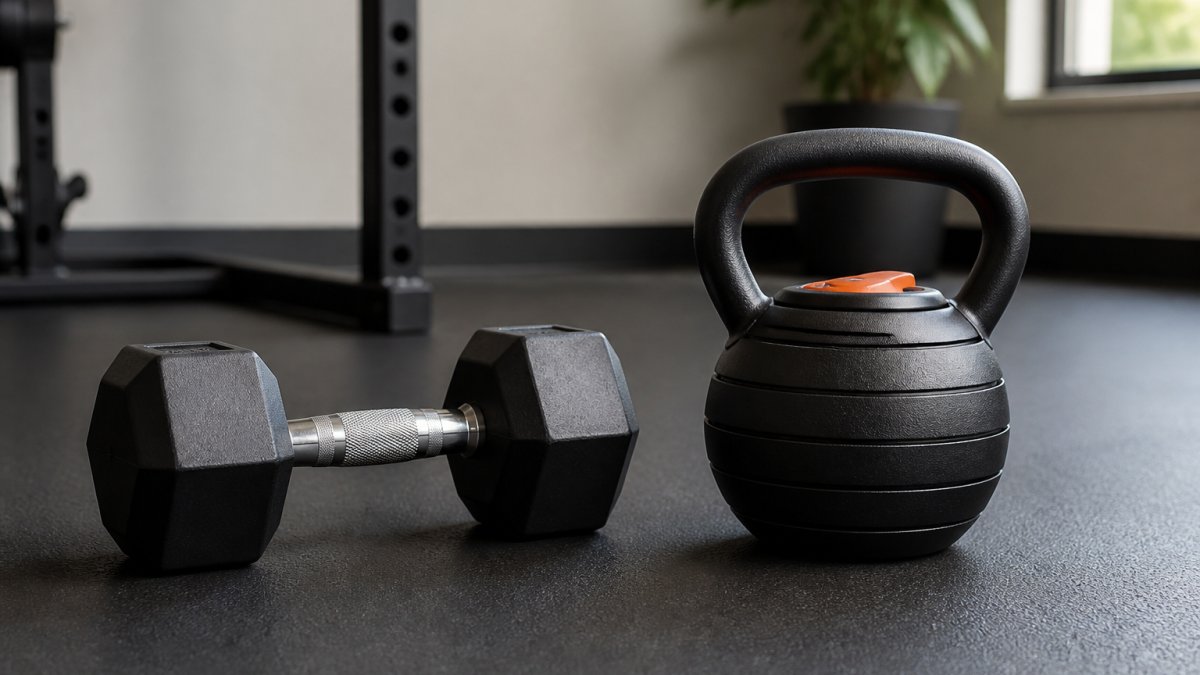
The kettlebell vs dumbbell decision comes down to one question: controlled strength work or dynamic, full-body power? At Bodyhackfitnesss, most customers building a first home gym eventually want both.
| Factor | Dumbbell | Kettlebell |
|---|---|---|
| Weight distribution | Balanced, centered in the palm | Offset load, sits behind the wrist |
| Best for | Isolation, hypertrophy, controlled reps | Swings, cleans, full-body power |
| Learning curve | Beginner-friendly | Steeper, needs technique work |
| Weight increments | Fine, often 5 lb jumps | Coarser, especially fixed models |
| Space and storage | Hex heads store flat | Flat bottom stores upright |
| Grip demand | Moderate | High, especially in swings |
| Cost to start | Lower per pound | Higher per pound |
| Movement variety | Press, row, curl, squat, hinge | Swing, clean, press, goblet squat, carry |
Weight distribution is the whole story. A dumbbell keeps its mass under your hand, so your wrist stays neutral and your muscles do the work.
Kettlebell vs Dumbbell for Beginners: Which One to Start With
Dumbbells are the better starting point for most beginners. The balanced load and fine increments let you learn squat, hinge, press, and row patterns without fighting the equipment. Kettlebell training adds a technique layer on top of those patterns, and that layer is where beginners get hurt.
Form and Learning Curve
A dumbbell press or row is forgiving: if your wrist drifts a few degrees, nothing dramatic happens. A kettlebell swing is not.
The learning curve is real but not steep. Most people learn a clean swing in a few sessions with good instruction, but bad swing habits feel productive, so they stick.
Weight Increments and Starting Loads
This is where beginners get stuck with kettlebells. Fixed bells often jump in 8 to 10 lb increments, a big leap for an overhead press.
A common approach: start with lighter dumbbells for pressing and rowing, then add one moderate kettlebell for swings and goblet squats. That covers nearly every beginner movement pattern without buying four kettlebells in month one.
Exercise-by-Exercise: What Each Tool Does Better
The tool should follow the movement, not the other way around. Here is a breakdown of the exercises you will actually do at home, with the mechanical reason each implement wins and the trade-offs to expect.
Pressing Patterns
Dumbbell floor press or bench press: The balanced load sits over the forearm, keeping the wrist stacked and the pressing arc natural.
Kettlebell overhead press: The bell sits behind the wrist in a "racked" position, forcing the forearm vertical and the shoulder packed.
Verdict: Dumbbells win for pressing volume and shoulder-friendly loading. Kettlebells win for teaching shoulder stability and the vertical forearm path.
Pulling Patterns
Single-arm dumbbell row: The balanced load pulls straight back with no forward swing, so you can chase a rep range and squeeze the mid-back at the top.
Kettlebell row: The offset load swings forward at the bottom, so you brace the core and grip harder to keep the path clean.
Verdict: Dumbbells win for rowing volume and back-building. Kettlebells add a grip and core challenge but are less efficient for pure hypertrophy.
Squat Patterns
Dumbbell goblet squat: Holding one dumbbell vertically at chest height keeps the torso upright and the load centered. It is the easiest way to learn a squat pattern, with small progression increments.
Kettlebell goblet squat: The bell hangs slightly forward of the chest, reinforcing an upright torso and adding core-stability demand.
Verdict: Both work well. Dumbbells are easier to progress; kettlebells reinforce posture and bracing.
Hinge Patterns
Dumbbell Romanian deadlift: Two balanced loads let you load the hinge heavy and symmetrically, ideal for hamstring and glute strength, and make the hamstring stretch easier to feel.
Kettlebell swing: The ballistic hinge is where kettlebells are unmatched.
Verdict: Dumbbells win for heavy, controlled hinge strength. Kettlebells win for explosive power and conditioning.
Carries and Loaded Walks
Dumbbell farmer carry: Two balanced loads let you walk heavy with a neutral grip, taxing grip, traps, and posture while keeping the shoulders level.
Kettlebell farmer carry: The offset load forces grip and core to work harder to stop the bell rotating, so you use less weight for the same systemic demand.
Verdict: Dumbbells win for heavy carries. Kettlebells win for grip and anti-rotation demand at lighter loads.
Ballistic and Full-Body Movements
Kettlebell clean, snatch, and Turkish get-up: No dumbbell replicates these cleanly. The clean teaches the bell to rack softly against the forearm; the snatch builds power and overhead stability; the get-up exposes every weak link from floor to standing.
Verdict: Kettlebells own ballistic and full-body work. Dumbbells cannot match the movement quality here.
Isolation and Targeted Work
Dumbbell curl, tricep extension, lateral raise, and rear delt fly: The balanced load keeps tension on the target muscle through the full range of motion, and fine increments let you chase a rep range. A kettlebell's offset load makes lateral raises and rear delt flies awkward and grinds the wrist.
Versatile Adjustable Kettlebell: 7 Weight Levels for Enhanced Strength Training →
Verdict: Dumbbells win every isolation movement. Kettlebells are not built for it.
Kettlebell Weight Guide: Choosing Loads and Progressing Safely
Choose your kettlebell weight by your weakest relevant lift, not your strongest. For most beginners, a single 15 to 25 lb bell handles swings, goblet squats, and cleans, while presses need something lighter.
Use this as a starting framework:
- Swings and goblet squats: pick a load you can move for 3 sets of 10 with clean technique and no lower back rounding.
- Cleans and presses: if you cannot press the bell overhead for 5 clean reps per side, it is too heavy for pressing. Use it only for swings.
- Farmer carries: load until your grip fails before your posture does, then back off one step.
An adjustable kettlebell makes this easier, shifting between seven weight levels in seconds. That matters because a press day and a swing day often need different loads from the same bell.

Single Kettlebell Workout at Home: A Practical Plan
A single kettlebell workout at home can cover a full training week if you structure it around movement patterns rather than muscles. Here is a three-day plan that fits a small space and takes about 25 minutes per session.
Day 1, Hinge and Power
- Kettlebell swings: 5 sets of 15, 45 seconds rest
- Goblet squats: 3 sets of 10
- Single-arm kettlebell rows: 3 sets of 10 per side
Day 2, Press and Carry
- Single-arm overhead press: 4 sets of 6 per side
- Kettlebell cleans: 3 sets of 8 per side
- Farmer carries: 4 rounds of 40 steps
Day 3, Full Body and Core
- Turkish get-ups: 3 sets of 3 per side, light load
- Reverse lunges holding the bell at chest height: 3 sets of 8 per side
- Halo and around-the-body drills: 2 sets each direction
Rest at least one day between sessions. If your grip is the limiting factor, that is normal and it improves quickly.
Adjustable Dumbbells for Home Gym: Cost, Space, and Long-Term Value
Most comparisons stop at "adjustable saves space." The real question is cost per usable pound over the life of your home gym, and that is where adjustable equipment separates itself from fixed weights.
The Fixed-Weight Trap
Fixed dumbbells and kettlebells are sold in pairs or singles at set weights. To cover a beginner-to-intermediate range, most home lifters need roughly 5 to 50 lb per hand in dumbbells and 10 to 35 lb in kettlebells. Buying that fixed means:
- 10 pairs of dumbbells at 5 lb increments from 5 to 50 lb
- 3 to 4 kettlebells from 10 to 35 lb
- A rack or storage solution for all of it
That is a large upfront cost, a large footprint, and a purchase cycle that never ends. Fixed weights also lock your money into a single load, so a 25 lb pair you outgrow becomes dead storage.
The Adjustable Math
Adjustable equipment front-loads the cost and then stops charging you. One adjustable dumbbell pair typically replaces 10 or more fixed pairs, and an adjustable kettlebell replaces 3 to 7 fixed bells.
Our Premium 20LB Rubber Coated Cast Iron Dumbbell with Ergonomic Chrome Handle is $59.70, and the 8LB Rubber Coated Dumbbells are $49.50.

Space and Storage
A fixed dumbbell rack for 5 to 50 lb takes roughly the footprint of a small bookshelf and needs space you may not have in an apartment, spare room, or garage. An adjustable pair and one adjustable kettlebell fit in under two square feet and tuck under a bed or into a closet.
Long-Term Value
The break-even point for adjustable equipment usually arrives within the first year. After that, every strength gain is free: turn a dial or pull a pin instead of buying a new pair. Fixed weights keep charging you for progress and hold less resale value per pound used. Adjustable equipment also travels and stores better if you move or reconfigure your space.
Where Adjustable Falls Short
Adjustable dumbbells are bulkier than fixed pairs at the same weight, so some movements feel cramped. The adjustment mechanism adds a small time cost between sets, and dropping them is not an option. Adjustable kettlebells can feel slightly different from a competition bell in the rack position. None are dealbreakers for home training, but they are real trade-offs.
General guidance on safe strength-training progression for beginners
Which One Should You Buy First?
Buy dumbbells first if your goal is muscle building, you are new to strength training, or you want the widest exercise variety with the least technique risk.
For most home gyms, start with a pair of dumbbells and add a single adjustable kettlebell within the first few months.
The one scenario where a kettlebell alone makes sense: you have limited space, you want one tool, and you are willing to invest a few weeks in learning the swing properly.
Frequently Asked Questions
Is a kettlebell or dumbbell better for building strength at home?
It depends on the movement. Dumbbells let you load small increments and isolate a muscle, which suits controlled strength work like presses, rows, and curls. Kettlebells suit ballistic movements such as swings and cleans, where the offset load builds grip, core stability, and power. Most home lifters get further with one adjustable kettlebell for dynamic work plus a pair of dumbbells for progressive overload, rather than choosing only one.
Can you do the same exercises with kettlebells and dumbbells?
Many movement patterns overlap: squats, presses, rows, and carries work with either tool. The goblet squat and farmer carry are near-identical. The split appears with speed. Kettlebell swings, cleans, and snatches rely on the offset load and a smooth handle for grip transitions, while dumbbells handle slower, heavier isolation work better. Treat them as complementary, not interchangeable.
Which takes up less space in a home gym: kettlebells or dumbbells?
One adjustable kettlebell with seven weight levels replaces a rack of fixed bells, and a single adjustable dumbbell pair replaces a full dumbbell set. Fixed cast iron dumbbells with rubber-coated hexagon heads resist rolling and store neatly under a bench, but a full range still takes floor space. For a small apartment or garage corner, adjustable options win on footprint.
Are dumbbells or kettlebells better for beginners?
Dumbbells are easier to learn first. The balanced load and controlled tempo make it simpler to feel the target muscle and correct your form without momentum. Kettlebells demand more technique because the bell moves around your wrist on swings and cleans. A reasonable path is a few weeks of dumbbell work to build base strength, then add a kettlebell for conditioning and grip.
Can you build muscle with just one kettlebell?
Yes, within limits. One kettlebell supports goblet squats, single-arm presses, rows, and swings, which cover squat, hinge, press, and pull patterns. The constraint is load: once your reps climb past roughly 15 to 20 with no heavier bell available, muscle growth stalls because you cannot apply progressive overload. An adjustable kettlebell with seven weight levels solves this by letting you add load as you get stronger.
Building a home gym that you actually use comes down to buying equipment that fits your space, your goals, and your experience level. At Bodyhackfitnesss, we stock adjustable kettlebells with seven weight levels, rubber-coated cast iron dumbbells that protect your floors, and the recovery gear that keeps you training week after week. Shop now and build a setup that grows with you instead of collecting dust in the garage.