

Table of Contents
- What Makes an Online Fitness Platform Worth Your Investment
- Best Workout Apps for Home: Features That Actually Matter
- Virtual Personal Training Cost: What You'll Actually Spend
- How to Build a Workout Routine Online: A Practical Framework
- Equipment Requirements and Home Setup for Online Fitness Platforms
- Sustainability and Habit Formation: Why Most People Quit (and How to Stay Consistent)
- Frequently Asked Questions
Last Updated: September 3, 2026
What Makes an Online Fitness Platform Worth Your Investment
An online fitness platform delivers workout classes, training programs, and coaching via streaming video, mobile apps, or web interfaces. It combines convenience with structured programming, letting you train from home or anywhere with internet.
The fitness landscape has shifted. What once meant a $50-100 monthly gym membership now splits into dozens of specialized options: live classes, pre-recorded routines, or personalized coaching. The decision isn't about price, it's about whether you'll stick with it.
Most people quit within the first month because consistency breaks down when motivation fades (peer-reviewed research). An online platform works only if it fits your life, matches your fitness level, and keeps you engaged past initial enthusiasm.
At Bodyhackfitness, we empower fitness enthusiasts to train harder and recover faster by offering a seamless, customer-focused shopping experience for both training and recovery equipment, enabling you to create a more complete training environment at home. Our commitment to quality and a comprehensive approach to fitness ensures you have the resources needed at every stage of your journey.
Below, we'll walk through the features that separate mediocre platforms from ones worth your money, the real costs you'll face, and the specific strategies that keep people consistent long-term.
Best Workout Apps for Home: Features That Actually Matter
When evaluating a platform, most reviews focus on flashy features like social feeds and badges. What matters is on-demand classes you'll use, customized plans that progress, and enough variety to prevent boredom.
The best platforms offer multiple modalities (cardio, strength, yoga, HIIT, mobility), let you filter by time commitment, and include progress tracking.
Platforms specialize in live group classes (accountability and community) or on-demand libraries (flexibility). The best offer both.
Expert-led programming prevents injury and builds sustainable strength. Look for platforms that list instructor credentials and training philosophy, not just follower count.
Customized plans transform an app from entertainment into a training tool. Input your fitness level, goals, and equipment to receive a structured program that progresses weekly.
Mobile compatibility is essential. Your phone should sync seamlessly across devices (tablet, TV) while tracking progress on iOS, Android, or web.
Community engagement keeps you consistent, whether through knowing others are doing the same workout, accessing a responsive coach, or seeing real user results. Connection sustains consistency.
Virtual Personal Training Cost: What You'll Actually Spend
Most platforms charge $10-30 monthly for on-demand classes, $20-50 for live classes, and $50-150 per session for one-on-one coaching (the FTC).
Equipment costs add up. A $15 platform requires dumbbells, mat, bands, and bench for proper workouts, an upfront investment of $200-500.
Bodyhackfitness offers these exact pieces at transparent pricing, the Walking Pad Treadmill at $99.30, the Folding Exercise Bike at $160.72, the Versatile Adjustable Kettlebell at $117.02, and the Multi-Functional Adjustable Weight Bench at $121.91. When you pair a platform subscription with quality equipment, you're building a complete home gym, not just renting access to videos.

A gym membership costs $50-100 monthly plus commute time (bls.gov). An online platform costs $15-30 monthly with $200-500 upfront equipment investment. Break-even is 3-6 months.
Coaching adds $50-150 monthly for form feedback and programming adjustments, worth it for serious strength training, overkill for beginner bodyweight work.
Hidden costs include wearable integration, premium music licensing, and advanced analytics features.
Cheapest platforms often have weak libraries or poor instruction. Cost per workout matters more than monthly fee.
How to Build a Workout Routine Online: A Practical Framework
Start with your honest fitness level. Many beginners skip to intermediate and burn out in week two. Starting too hard kills consistency.
A practical framework for building routine:
| Phase | Duration | Focus | Frequency |
|---|---|---|---|
| Foundation | Weeks 1-4 | Consistency over intensity | 3-4 days per week |
| Progression | Weeks 5-12 | Gradual difficulty increase | 4-5 days per week |
| Specialization | Week 13+ | Goal-specific training | 5-6 days per week |
The foundation phase (weeks 1-4) establishes habit, not fitness. Three to four workouts weekly at the same time, 30-45 minutes each, should feel moderately challenging but not exhausting.
Many platforms adjust difficulty automatically based on feedback. If yours doesn't, manually increase weight, reps, or intensity every 2-3 weeks.
Thirty minutes of focused training beats 90 minutes of random exercises. Most effective programs are 30-50 minutes.
Recovery matters as much as training. Include one mobility or yoga session weekly and one full rest day. The Tri-Fold Fitness Mat ($273.71) supports stretching and recovery work.
Tracking progress keeps you motivated. Whether it's logging workouts in the app, writing them down, or taking progress photos, you need visible evidence that you're improving. Most online platforms include basic tracking (reps, weight, duration), but you have to actually use it.
Equipment Requirements and Home Setup for Online Fitness Platforms
You need a smartphone or tablet, internet, and space the size of a yoga mat to start.
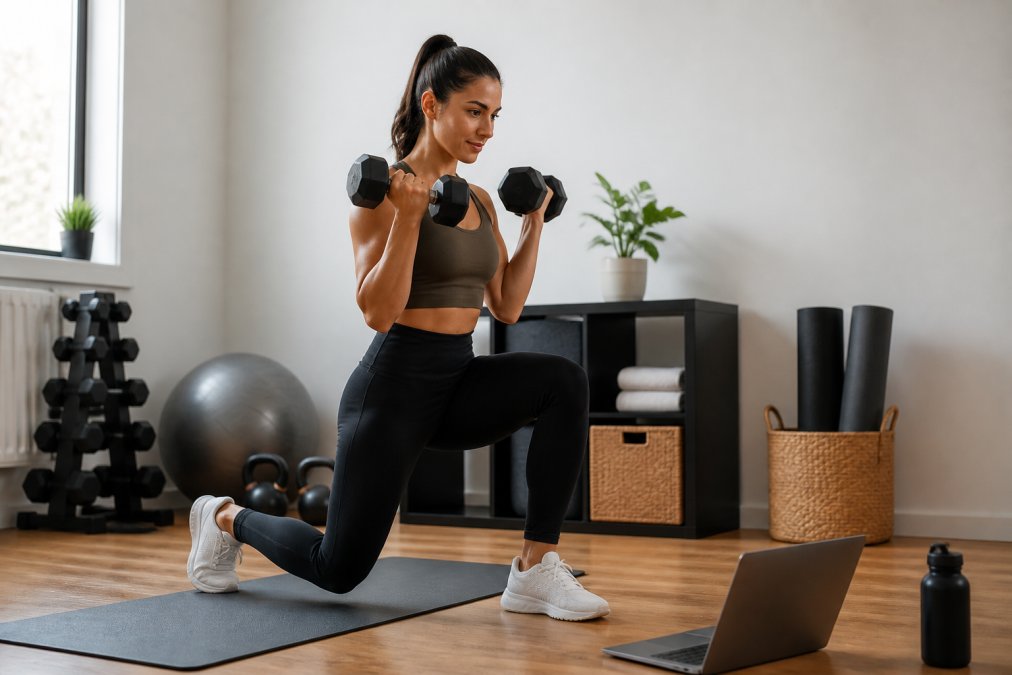
Most programs assume basic equipment. Starting with zero limits you to bodyweight classes, which gets repetitive fast.
A realistic starter setup includes:
- Adjustable dumbbells or kettlebell (replaces buying 5+ individual weights)
- Yoga mat or padded surface for floor work
- Resistance bands (cheap, versatile, space-saving)
- Optional: adjustable bench for pressing movements
The Bodyhackfitness equipment line covers these bases. The Adjustable 15lbs Rubber Hex Dumbbell Set at $46.56 gives you a starting point for strength work. The Tri-Fold Fitness Mat at $273.71 provides cushioning for yoga, stretching, and floor exercises. The Versatile Adjustable Kettlebell at $117.02 handles full-body movements.
For cardio, many platforms include bodyweight options (jumping jacks, burpees, high knees). But if you want low-impact cardio or the option to work while taking calls, a treadmill or exercise bike changes everything. The Walking Pad Treadmill at $99.30 lets you walk during video calls or while watching classes. The Folding Exercise Bike at $160.72 gives you stationary cardio without taking up permanent space.

Choose equipment that serves multiple purposes and stores compactly. A folding bench, adjustable dumbbells, and mat fit in a closet.
Hard floors are tough on joints and loud during plyometrics. A proper mat absorbs impact and mutes noise.
A larger screen improves form feedback. Prop your phone or tablet on a stand so you can see the instructor while working out.
Sustainability and Habit Formation: Why Most People Quit (and How to Stay Consistent)
80% of people quit within the first month because motivation is a terrible strategy for building habits.
Motivation fades by week three. Habit formation, consistency, not intensity, keeps you going after motivation dies.
Setting the bar too high (6 days, 60 minutes) fails when life happens. Sustainable routines are 3-4 workouts weekly, 30-45 minutes, at the same time.
Environmental design matters more than willpower. Keep equipment visible, leave the mat out, and have the app open on your phone.
Social accountability keeps you consistent, tell a friend, join a community, or hire a coach. High-retention platforms have some form of accountability.
Progress tracking prevents the "am I getting better?" question. Log workouts, note how you felt, and take monthly photos. Evidence sustains effort when motivation fades.
Recovery is part of consistency. One full rest day weekly, one mobility session, and proper sleep matter as much as workouts. The Tri-Fold Fitness Mat supports stretching and mobility work.
Winning platforms build community, track progress, adjust difficulty, and create routines that fit real life. They acknowledge that consistency beats perfection.
Frequently Asked Questions
What is the best online fitness platform for beginners?
The best platform depends on your goals and preferred workout style. Look for one offering beginner-friendly classes, clear form instruction, and progressive difficulty levels. Platforms with trial periods let you test before committing. Consider whether you want live classes, on-demand videos, or personalized coaching, each serves different learning styles and schedules.
How much does virtual personal training cost?
Virtual personal training ranges from $50-$300+ per session depending on the trainer's credentials and specialization. Monthly coaching packages typically cost $200-$500. Many online fitness platforms offer built-in coaching features starting at $15-$30 monthly, making structured guidance more affordable than one-on-one sessions while still providing form feedback and progression.
Can you get a full-body workout using only an online fitness platform?
Yes. Quality platforms offer strength training, cardio, flexibility, and core work, everything needed for balanced fitness. The key is choosing one with diverse class types: HIIT for cardio, weight training for strength, yoga for flexibility. Consistency matters more than equipment; many effective routines use only bodyweight or minimal gear like dumbbells or resistance bands.
What equipment do I need to get started with an online fitness platform?
You can start with nothing, bodyweight exercises work. A yoga mat ($50-$275) adds comfort for floor work. Dumbbells ($46-$120 for a pair), resistance bands, and a sturdy bench ($121-$300+) expand your options. Cardio equipment like a walking pad ($99) or exercise bike ($113-$160) pairs well with platform workouts. Start minimal and add as your routine evolves.
Starting an online fitness platform isn't complicated. The hard part is staying consistent past the first month. Bodyhackfitness supports this by pairing quality equipment with structured guidance. The Walking Pad Treadmill, adjustable kettlebells, and weight benches give you the tools to follow any program. The real investment is showing up, not to a gym, but to your home, at the same time, week after week. That's where transformation happens.
This article was written using GrandRanker