


Last Updated: November 4, 2026
Quick Summary
To optimize your home gym for muscle gain, train each major muscle group twice weekly with 10 to 20 hard sets per muscle group per week, using adjustable free weights, a solid bench, and a rack with safeties. Hit 3 to 5 sets of 6 to 12 reps per lift and add load when you reach the top of your rep range.
- Adjustable dumbbells, kettlebells, and benches replace multiple machines in a compact setup.
- Beginners should run three full-body sessions per week rather than a six-day plan.
- When you cannot add load, add a rep, a set, or slow the lowering phase to 3 seconds.
- Every fourth week, cut volume by about 40% while keeping intensity the same.
- Store dumbbells on a low rack at hip height and keep heavy loads below chest height.
Table of Contents
- Why Most Home Gyms Fail to Build Muscle
- The Best Home Gym Equipment for Muscle Gain
- How to Build Muscle at Home for Beginners
- Your Home Gym Workout Plan for Muscle Growth
- Progressive Overload at Home When Equipment Is Limited
- Layout, Storage, and Workout Flow for Small Spaces
- Tracking Progress and Adjusting Your Program
- Start Your Muscle-Building Setup Today
- Frequently Asked Questions
Why Most Home Gyms Fail to Build Muscle
Most home gyms fail to build muscle because they are collections of equipment, not training systems. A rack full of gear means nothing without a plan for progressive overload, enough protein, and enough weekly volume.
Yet plenty of home gym gear sits idle.
Here's the gap. Muscle growth needs three things: hard sets, enough food, and consistency over months. Equipment only supports that.
Below, we'll show you exactly how to optimize home gym for muscle gain, from equipment picks to weekly programming. But first, here's what most guides get wrong: they treat buying gear as the finish line. It's the starting line.
The Best Home Gym Equipment for Muscle Gain
The best home gym equipment for muscle gain is adjustable free weights, a solid bench, and a rack with safeties. These three cover nearly every compound lift you need.
Adjustable gear beats single-use machines. Experts at PowerBlock and Cleveland Clinic equipment guidance recommend adjustable dumbbells, kettlebells, and benches to replace multiple machines. That's the smartest way to build a compact setup.
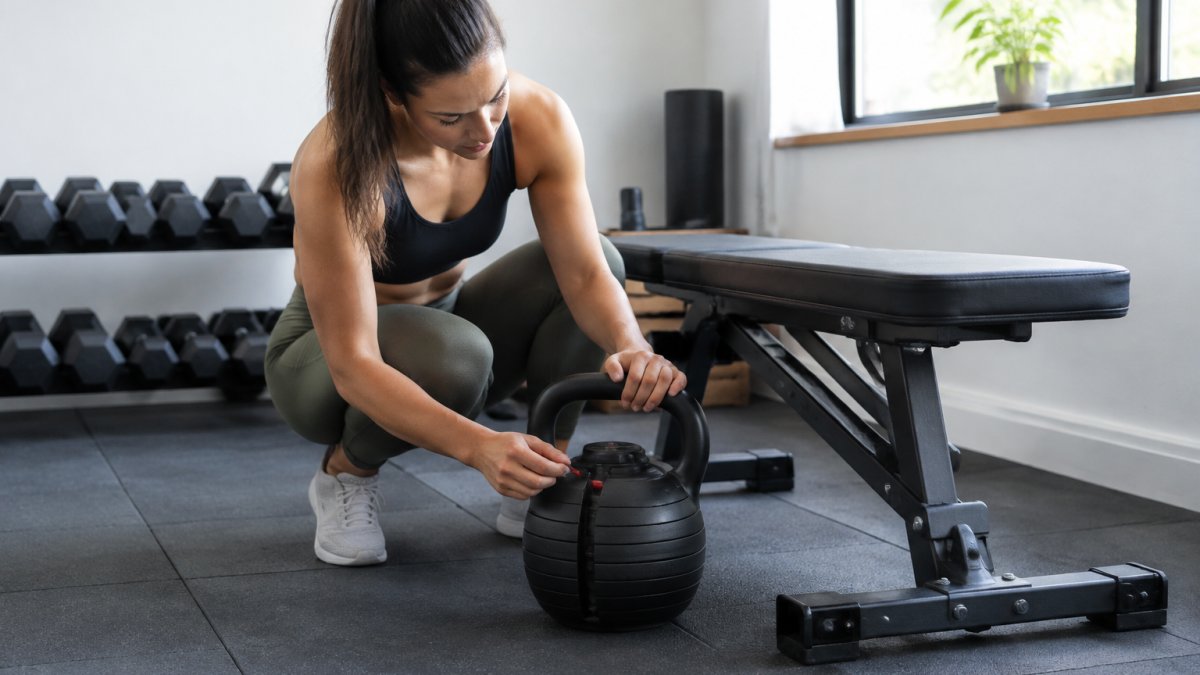
Free Weights: Dumbbells, Barbells, and Plates
Free weights are the core of any muscle-building setup. They let you load heavy, track progress, and train every major muscle group.
A common mistake is buying a fixed set of light dumbbells. You outgrow them fast. Instead, start with adjustable options and add load as you get stronger.
Our free weights collection covers dumbbells, kettlebells, and adjustable weights so you can grow into your setup. A single 20 lb rubber-coated cast iron dumbbell runs $59.70, or you can get the adjustable kettlebell with 7 weight levels for $117.02.
Racks, Benches, and Safety Gear for Solo Lifting
Solo lifting is where safety matters most. A power rack with spotter arms lets you squat and bench heavy without a training partner.
Pair it with a bench rated for serious load. Our foldable weight bench handles up to 1000 lbs, needs no assembly, and folds into a corner. For squats and presses, the power rack gives you a steel cage with inside dimensions of 41.3 in by 39.7 in.

How to Build Muscle at Home for Beginners
Beginners build muscle at home by training each major muscle group twice a week with compound lifts. Keep it simple, add weight slowly, and eat enough protein.
The U.S. Department of Health and Human Services physical activity guidelines recommend strength training for all major muscle groups at least two times a week. That's your baseline.
Start with these movements:
- Goblet squats with a kettlebell
- Dumbbell bench press or floor press
- Bent-over rows or pull-ups
- Romanian deadlifts
- Overhead presses
- Planks and carries
Beginners don't need fancy splits. Three full-body sessions per week beat a six-day plan you can't sustain. A common mistake is chasing soreness instead of adding reps or weight.
Your Home Gym Workout Plan for Muscle Growth
A home gym workout plan for muscle growth should hit each major muscle group twice weekly with 10 to 20 hard sets per muscle group per week. That range covers the volume most people need to grow, and it fits a three- or four-day schedule that leaves room for recovery.
Here is a concrete three-day full-body structure that works with adjustable dumbbells, a bench, and a rack:
| Day | Focus | Key Lifts | Sets x Reps |
|---|---|---|---|
| Day 1 | Full body | Goblet squat, dumbbell bench press, bent-over row | 3 x 8-12 each |
| Day 2 | Full body | Romanian deadlift, overhead press, pull-up or lat pulldown | 3 x 8-12 each |
| Day 3 | Full body | Walking lunge, incline press, farmer carry | 3 x 10-12 each |
Rest at least one day between sessions. If you prefer four days, run an upper/lower split twice weekly: upper on Monday and Thursday, lower on Tuesday and Friday. The twice-weekly frequency per muscle group is the non-negotiable part; the split is just packaging.
Sets, Reps, and Training Frequency
Aim for 3 to 5 sets of 6 to 12 reps per lift. This rep range builds muscle with moderate to heavy weights and manageable fatigue. For isolation work like lateral raises or curls, 2 to 3 sets of 12 to 15 reps is enough.
Training frequency matters more than any single session. Hitting a muscle twice a week gives better growth than once, because you get more total hard sets across the week without burying yourself in one session. A common pattern is to start at the low end of the volume range (10 sets per muscle group weekly) and add one set per week until you reach 20, then hold there and focus on load progression.
Heavy-Duty Foldable Weight Bench for Home Gym Workouts - Multi-Purpose Flat →
Progression rule: when you hit the top of your rep range on every set with clean form, add the smallest available load increment (often 5 lb on dumbbells or 2.5 lb per side on a barbell) and drop back to the bottom of the range. If you cannot add load, add a rep or a set instead.
Protein intake supports all of it. Protein intake supports muscle growth, and many lifters aim for a daily target that fits their body weight and goals.
Watch out: adding sets every week without deloading eventually outruns recovery. Every fourth week, cut volume by about 40% while keeping intensity the same, then resume.
Progressive Overload at Home When Equipment Is Limited
Progressive overload at home works by increasing reps, sets, tempo, or range of motion when you can't add weight. Your body only grows when the demand rises.
Limited gear is no excuse. Use these levers:
- Add reps until you hit the top of your range
- Slow the lowering phase to 3 seconds
- Add a pause at the bottom
- Increase range of motion with a deficit
- Shorten rest between sets
- Add a set per week
Research cited by the Athletic Aging Blog shows resistance bands produce lower muscle activation than free weights. For long-term growth, heavier dumbbells and kettlebells matter.
Layout, Storage, and Workout Flow for Small Spaces
A small home gym works when equipment moves and stores fast, and when the layout supports the lifts you actually do. Most guides stop at "use foldable gear." The practical optimization is a three-zone layout that cuts setup time and keeps your training consistent.
Zone 1: the lifting platform. Reserve a clear rectangle at least 8 ft by 6 ft for squats, deadlifts, and presses. Put the rack or bench against a wall so the open floor faces the room, not a corner. Mark the zone with rubber flooring tiles (typically 3/8 to 1/2 inch thick) to protect the floor, cut noise, and give you a consistent footing for heavy lifts.
Zone 2: the storage wall. Store dumbbells on a low rack at hip height so you can grab and re-rack without bending or reaching overhead. Keep the weights you use most at the ends of the rack, not the middle. Foldable benches and adjustable dumbbells go against the wall when not in use, leaving the platform clear.
Zone 3: the support corner. Put a fan, a water bottle, a towel, and your logbook within arm's reach of the platform. This sounds trivial, but a common pattern is that people skip sets because the fan is across the room or the logbook is in another room. Reducing friction on small tasks is how you keep sessions moving.
Space-efficient setup rules:
- Put the rack or bench against a wall, with the open side facing the room
- Store dumbbells on a low rack at hip height
- Keep a clear 6-foot lifting zone in every direction from the bar
- Use foldable gear for tight rooms, but only if you will actually fold it
- Add rubber flooring to protect the floor and cut noise
- Position a fan so airflow crosses the lifting zone, not just the room
Our picks for space-saving home gym equipment cover compact options that still train hard. Good airflow and a fan keep long sessions comfortable, and a simple layout means you spend your energy on sets, not on moving furniture.
Watch out: stacking plates or dumbbells on a shelf above shoulder height saves floor space but adds a fall risk during solo sessions. Keep heavy loads below chest height.
Tracking Progress and Adjusting Your Program
Track every lift, every set, every week.
Keep it simple: log the exercise, weight, reps, and date. Review it every four weeks. If a lift stalls twice, change one variable, like adding a set or swapping the exercise.
A 2017 study in F1000Research via Harvard Health Publishing found older adults in an unsupervised home program improved physical function in four weeks. Consistency, tracked, is what drives results.
Start Your Muscle-Building Setup Today
Building muscle at home comes down to three things: the right gear, a plan you can repeat, and progress you can measure. Skip any one of them and the garage collects dust.
Bodyhackfitness offers free weights, benches, and related equipment, along with digital fitness programs, to help you build a home setup you can grow with.
Ready to train harder and recover faster? Get started with Bodyhackfitness and build the home gym that actually builds muscle.
Frequently Asked Questions
Can you build muscle with a home gym?
Yes. A home gym with free weights, a bench, and a pull-up bar covers the compound lifts that drive muscle growth. Strength training all major muscle groups at least twice a week is a commonly cited standard, and it applies whether you train at a commercial gym or at home. The key is progressive overload: adding weight, reps, or sets over time. With adjustable equipment like dumbbells and kettlebells, you can keep increasing the challenge without filling a room with machines.
What equipment do you need to build muscle at home?
Start with adjustable dumbbells or a set of fixed dumbbells, a sturdy flat or adjustable bench, and a pull-up bar. Add a squat rack or power rack with spotter arms if you plan to lift heavy alone. Resistance bands can help with warm-ups and accessory work, and free weights are generally the better choice for building muscle. A foldable bench like the Heavy-Duty Foldable Weight Bench ($66.14) saves space while supporting up to 1000 lbs.
How do you apply progressive overload with home gym equipment?
Progressive overload at home works through four levers: adding weight, adding reps, adding sets, or slowing the tempo. If you own adjustable equipment, move up a weight level when you hit the top of your rep range with clean form. Without heavier weights, add a rep or set each week, or switch to a harder variation such as elevating your feet during push-ups. Track every session so you know when to push and when to repeat a week.
How much space do you need for a home gym?
A functional muscle-building setup fits in roughly 6 by 8 feet, enough room for a bench, a rack, and floor space to lie down. Foldable benches and adjustable kettlebells collapse or stack into a corner, which matters in apartments and garages. Leave clearance around the rack for loading plates and at least two feet in front of the bench for pressing. Rubber flooring protects the subfloor and cuts noise, and good ventilation keeps sessions comfortable.
