

Table of Contents
- Understanding Progressive Overload for Beginners
- How to Increase Reps vs Weight in Your Training
- Signs You Are Ready for Heavier Dumbbells
- Strategies for Progressing From 15 lb Dumbbells
- Tracking Progress and Avoiding Plateaus
- Form, Recovery, and Psychological Barriers
- Frequently Asked Questions
Last Updated: September 2, 2026
Understanding Progressive Overload for Beginners
Progressive overload is the foundational principle behind any successful strength training program. It means gradually increasing the demands placed on your muscles during exercise, forcing them to adapt and grow stronger over time. Without progressive overload, your muscles have no reason to change, they'll maintain their current capacity indefinitely.
The challenge most beginners face is knowing how to apply progressive overload effectively. You're not just randomly adding weight; you're strategically increasing intensity in ways that match your current fitness level and recovery capacity. This is especially true when you're working with 15 lb dumbbells and looking to progress heavier dumbbells.
At Bodyhackfitness, we understand that progression isn't linear. Some weeks you'll add weight. Other weeks you'll add reps, adjust your tempo, or increase training frequency. The key is understanding which progression method works best for your current situation.
Progressive overload works through several mechanisms: mechanical tension (the force your muscles produce), metabolic stress (the burn you feel during high-rep sets), and muscle damage (the microscopic tears that trigger growth). By varying how you apply these principles, you keep your body adapting and avoid plateaus that derail beginners.
How to Increase Reps vs Weight in Your Training
The decision between adding reps and adding weight depends on where you are in your current rep range and your training goals. This is where many lifters get confused, they think they should always chase heavier weight, but that's not how progression works.
Start by establishing a target rep range for each exercise. Most hypertrophy-focused training uses 6-12 reps per set, though beginners often benefit from starting at 8-12 reps. Once you choose your range, the progression becomes clear: increase reps first, then increase weight.
Here's the practical approach: if you're doing 3 sets of 8 reps with 15 lb dumbbells, your goal is to hit 3 sets of 12 reps with those same dumbbells. Only after you've achieved 12 reps for all sets do you increase the weight. This approach builds volume (total reps × weight) gradually, which is crucial for strength gains and muscle growth.
The benefit of this method is that it gives you a clear target. You know exactly when to progress, when you hit your upper rep range limit. It also reduces injury risk because you're not jumping weight too quickly. Your connective tissues, stabilizer muscles, and central nervous system all adapt better to gradual increases.
Once you progress heavier dumbbells, say from 15 lbs to 20 lbs, you'll typically drop back to the lower end of your rep range (around 8 reps). Then you repeat the process: build back up to 12 reps, then increase weight again. This cycle is the foundation of sustainable strength development.
Signs You Are Ready for Heavier Dumbbells
Knowing when you're genuinely ready to progress heavier dumbbells prevents both premature jumps that compromise form and unnecessary delays that limit progress. Several clear signals indicate readiness.
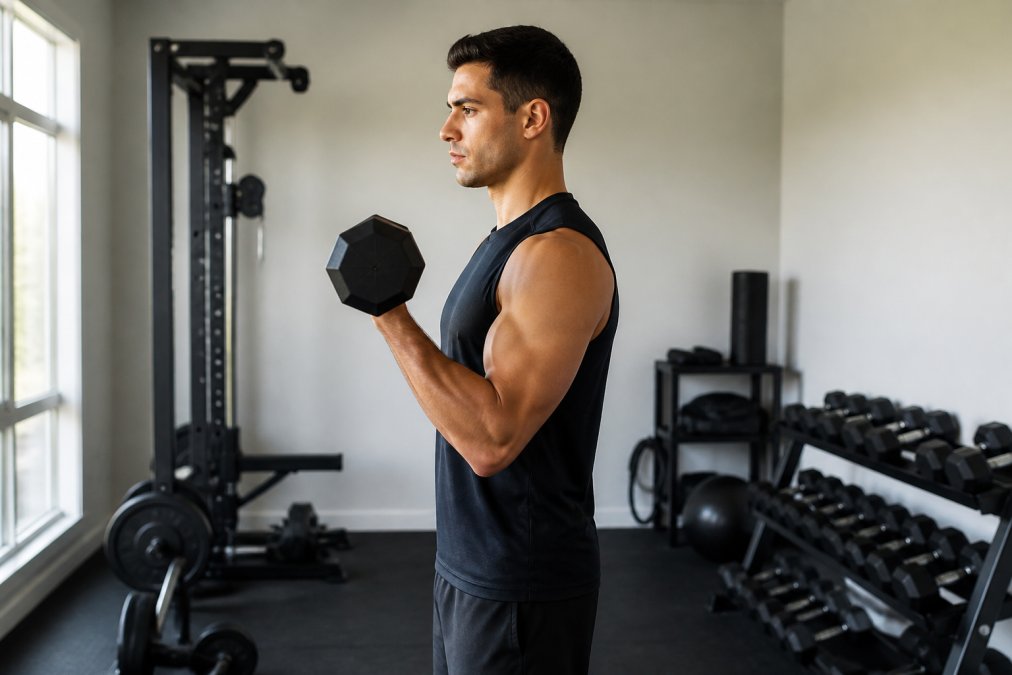
The most obvious sign is hitting your rep range target consistently. If you've completed 3 sets of 12 reps with good form on your last three workouts, you're ready. Consistency matters, one good set doesn't mean progression is appropriate. You need to demonstrate that you can handle the current weight reliably.
Form breakdown is the critical checkpoint. If your last few reps require excessive momentum, jerking, or compensation patterns, you're not ready for heavier weight. Form should remain relatively stable throughout all sets. The final reps should feel challenging, but your body position shouldn't change significantly. Watch yourself in a mirror or video to catch subtle form degradation you might not feel.
Recovery capacity is another indicator. Are you recovering adequately between workouts? If you're still sore three days after training, or if you feel fatigued during your next session, your body may not be ready for increased demands. Progression should feel sustainable, not exhausting.
Time under tension is a practical metric. Each rep should take approximately 2-3 seconds on the concentric phase (lifting) and 2-3 seconds on the eccentric phase (lowering). If you're rushing reps to hit your target number, the weight is likely too light in terms of stimulus, but that's different from being unready to progress. The signal here is whether you're maintaining control throughout the range of motion.
Strategies for Progressing From 15 lb Dumbbells
Multiple strategies exist for progressing heavier dumbbells beyond simply jumping to the next weight increment. The most effective approach combines several methods based on your specific situation.
Micro-Loading and Fractional Plates
Micro-loading is one of the most underutilized progression tools available to home gym users. Instead of jumping from 15 lbs to 20 lbs (a 33% increase), you add small increments, 2.5 lbs or even 1.25 lbs per dumbbell. This creates a much smoother progression curve that your body can adapt to more easily.
The challenge with standard dumbbells is that the weight jumps are often too large. Going from 15 lbs to 20 lbs is a significant jump. Your nervous system, stabilizer muscles, and connective tissues all need time to adapt to the increased load. Micro-loading bridges that gap.
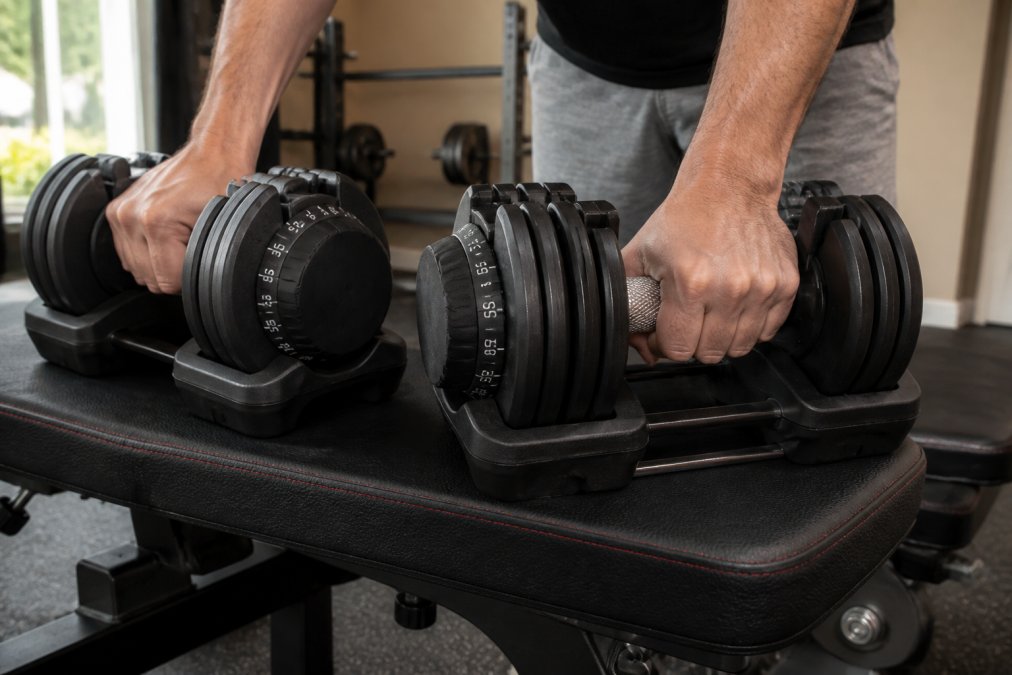
Fractional plates are the tool for this. These are small weight plates (typically 1.25 lbs, 2.5 lbs, or 5 lbs) that you can add to adjustable dumbbells. If you're using adjustable dumbbells like the Premium Adjustable Dumbbell Set - 44lbs Cast Iron Barbell Kit, you can add fractional plates to increase weight in small increments.

The progression becomes: 15 lbs → 16.25 lbs → 17.5 lbs → 18.75 lbs → 20 lbs. Each step feels manageable. Your body adapts to each increment before facing the next challenge. Over several weeks, you've added 5 lbs without any single jump feeling overwhelming.
This approach is particularly valuable when you're building strength in compound movements like dumbbell bench press or dumbbell rows. The nervous system needs time to coordinate the increased load, and micro-loading respects that biological reality.

Tempo Training and Time Under Tension
Tempo training changes how long your muscles work during each rep, increasing metabolic stress without necessarily adding weight. This is a legitimate progression strategy that many beginners overlook.
Standard tempo is roughly 1-1 (one second up, one second down). Slower tempos increase time under tension. A 3-2 tempo means three seconds on the concentric phase and two seconds on the eccentric phase. This dramatically increases the work your muscles perform without adding any weight.
The benefit is significant. A set of 10 reps at standard tempo takes roughly 20 seconds of work. The same set at 3-2 tempo takes 50 seconds. Your muscles experience far more metabolic stress, which triggers growth adaptations. Many lifters find that slowing tempo allows them to progress heavier dumbbells more effectively because they've built more muscular endurance and work capacity.
Practically, you can use tempo training as a bridge between weight increments. When you hit 12 reps with 15 lbs, instead of immediately jumping to 20 lbs, spend one week doing 3-2 tempo with 15 lbs. This increases difficulty without adding weight. Then progress to 20 lbs at standard tempo. The adaptation is smoother.
The eccentric phase (lowering) is particularly important. Taking 2-3 seconds to lower the weight creates significant mechanical tension and muscle damage, two of the three mechanisms driving growth. Many beginners rush the lowering phase, missing out on this stimulus.
Unilateral Movements and Single-Arm Work
Unilateral training, working one limb at a time, is a powerful progression tool that increases demand on stabilizer muscles and core engagement. Single-arm dumbbell exercises are harder than their bilateral counterparts, even with the same weight.
When you do a dumbbell bench press with both arms simultaneously, your body can distribute the load evenly. Your core doesn't need to work as hard to prevent rotation. Your stabilizer muscles can rely on symmetrical support. With single-arm work, all of that changes.
Single-arm dumbbell rows, for example, require significant core stability to prevent rotation. Your back muscles work harder to stabilize the load. The same 15 lb dumbbell feels noticeably more challenging when held in one hand versus two. This increased difficulty is real, it's not just perception.
The progression strategy is straightforward: alternate between bilateral and unilateral variations. One week you might do dumbbell bench press (both arms). The next week, single-arm dumbbell bench press. You're using the same weight, but the difficulty has increased. This allows your stabilizer muscles and core to adapt before you add actual weight.
Unilateral work also addresses muscular imbalances. If one arm is stronger than the other, bilateral work masks this. Single-arm training forces each side to work independently, preventing the stronger arm from compensating. Over time, this creates more balanced strength development.
Tracking Progress and Avoiding Plateaus
Tracking your workouts is non-negotiable if you want to progress heavier dumbbells consistently. Without a training log, you're guessing about whether you've actually made progress. Memory is unreliable, you'll forget what weight you used last week or how many reps you completed.
A simple training log contains: the exercise, the weight used, the number of sets and reps, and any notes about how the workout felt. You don't need an expensive app, a notebook works perfectly fine. The critical information is whether you've added reps, weight, or volume since your last workout.
Volume is the total amount of work: sets × reps × weight. If you did 3 sets of 10 reps with 15 lbs, your volume is 450 reps × 15 lbs = 6,750 pounds of total volume. The next week, if you do 3 sets of 11 reps with 15 lbs, your volume is 7,425 pounds. You've increased volume without adding weight, that's measurable progress.
Plateaus happen when volume stops increasing. You're doing the same weight, reps, and sets week after week. Your body has no stimulus to adapt. This is where many beginners get stuck, thinking they need to jump to significantly heavier weight. Often, they just need to add one more rep, adjust tempo, or switch to unilateral work.
The solution is systematic progression. Set a specific target, hitting 12 reps with current weight, for example. Once you hit that target, make a small change: add weight, adjust tempo, switch to unilateral work, or increase frequency. Something must change to continue progress. Small, consistent changes beat dramatic jumps.
Form, Recovery, and Psychological Barriers
Form degradation is the most common reason lifters plateau or get injured. As weight increases, maintaining perfect form becomes harder. Your ego wants to lift heavier, but your body needs good positioning to do so safely.
The eccentric phase is where form usually breaks down first. As fatigue accumulates, the lowering phase gets faster and less controlled. This is exactly when you need to slow down and focus on control. If you can't lower the weight with control, you can't safely lift it. Period.
Recovery is the often-overlooked piece of progression. Your muscles don't grow in the gym, they grow during rest. Progressive overload only works if you're recovering adequately. This means adequate sleep (7-9 hours), proper nutrition (especially protein), and appropriate training frequency.
Training frequency matters. If you're training the same muscle groups too frequently without adequate recovery, you'll plateau or regress. Most beginners benefit from training each muscle group 2-3 times per week with at least one rest day between sessions. This allows adaptation while maintaining frequency.
Psychological barriers are real. There's a mental block many lifters hit when they're about to progress to a weight that feels "heavy." The 20 lb dumbbell feels significantly heavier than 15 lbs, even though it's only a 33% increase. This is partly real, the load has genuinely increased, but partly psychological.
The solution is confidence built through progressive adaptation. When you've gradually increased through micro-loading or tempo training, the jump feels smaller. Your nervous system has already adapted to increasing loads. The psychological barrier is lower because the progression feels earned rather than sudden.
Progressing from 15 lb dumbbells to heavier weights isn't about finding a secret hack. It's about understanding the principles of progressive overload and applying them systematically. At Bodyhackfitness, we've designed our equipment and programs to support this progression journey. Whether you're using adjustable dumbbells like our Premium Adjustable Dumbbell Set or standard fixed weights like our Premium 20LB Rubber Coated Cast Iron Dumbbell, the principles remain constant. Start with small, consistent increases. Track your progress. Adjust when you plateau. Over months, you'll be lifting weights you never thought possible, because you built the strength gradually and sustainably.

Frequently Asked Questions
When should I switch to heavier dumbbells?
Switch when you can complete all sets and reps with good form and still have energy left. Once your last rep feels easy, it's time to progress. Most lifters find this happens after 2-3 weeks of consistent training at the same weight. Signs include completing reps without fatigue, no muscle soreness, and feeling you could do more. Aim to reach a point where your final rep is challenging but achievable, that's your signal to increase weight.
How does progressive overload for beginners differ from advanced training?
Beginners should focus on mastering movement patterns and building a foundation before chasing heavy weights. Progressive overload for beginners means gradually increasing reps first, then weight. Beginners typically progress faster because their bodies adapt quickly to new stimulus. Advanced lifters often use micro-loading, tempo changes, and volume manipulation instead of big weight jumps. Start with consistent rep increases, nail your form, then add weight in 5-10 lb increments. This approach builds strength safely and creates sustainable habits.
Should I increase reps or weight first?
Increase reps first. Start with 3 sets of 8-12 reps at 15 lbs. Once you hit 3 sets of 12 reps comfortably, move to the next weight increment. This approach builds muscular endurance and volume before adding intensity. For example, progress from 15 lbs × 12 reps to 20 lbs × 8 reps, then climb back to 20 lbs × 12 reps. This rep-first strategy reduces injury risk, improves form consistency, and creates a clear progression pathway. Only jump weight when you've maxed out your rep range at the current weight.
Can I build muscle with 15 lb dumbbells?
Yes, 15 lb dumbbells can build muscle, especially for beginners or lighter exercises. Muscle growth depends on progressive overload, volume, and consistency, not just absolute weight. Higher rep ranges (12-15 reps) with 15 lbs creates metabolic stress and hypertrophy. However, progression matters: you'll eventually need heavier weight to continue building muscle. Use 15 lbs to establish movement patterns and build a foundation, then progress to heavier weights like the Premium 20LB Rubber Coated Cast Iron Dumbbell to continue driving muscle growth.
This article was written using GrandRanker