

Table of Contents
- Why Hip Flexor Tightness and Weakness Get Confused
- Signs of Tight Hip Flexors
- Signs of Weak Hip Flexors
- How to Test for Tight Hip Flexors at Home
- Hip Flexor Strengthening Exercises That Rebuild Control
- Hip Flexor Recovery Tools for Tight and Weak Muscles
- Frequently Asked Questions
Last Updated: September 16, 2026
Why Hip Flexor Tightness and Weakness Get Confused
The reason signs of weak hip flexors vs tight are so hard to separate is that both conditions produce nearly identical sensations: a pulling feeling at the front of the hip, stiffness when you stand up, and an ache that lingers after sitting. This guide from Bodyhackfitness breaks down how to tell them apart, because the two problems need opposite treatments.
The Tight-Weak Paradox, Explained
Most people assume a muscle that feels tight must be short. That assumption is wrong more often than it is right. A muscle can feel tight for two opposite reasons:
- It is genuinely shortened. The tissue has adapted to a position it holds all day, such as sitting with the hips flexed. Length is the problem.
- It is chronically overstretched and weak. The muscle sits in a lengthened position for hours, and its spindle cells, the sensory receptors that report length and tension, fire constantly. The brain reads that constant signal as tightness, even though the tissue is not short. Control is the problem.
Why the Two States Need Opposite Treatments
Stretch a weak muscle and you make the problem worse. Strengthen a genuinely tight one without addressing the tension first, and you can irritate it further. That single distinction explains why so many generic hip routines fail.
| What You Feel | What Is Likely Happening | What Helps | What Hurts |
|---|---|---|---|
| Hard stop at end range, pulling in groin | Shortened, overactive tissue | Lengthening drills, controlled stretching | Heavy loading before mobility work |
| Constant tightness, no hard stop | Overstretched, underactive tissue | Isometric activation, strength work | Aggressive static stretching |
| Tightness that shifts side to side | Asymmetrical compensation | Single-leg control work | Symmetrical stretching routines |
| Tightness worse after rest, better with movement | Circulation and neural tone issue | Movement snacks, walking breaks | Prolonged static holds |
Signs of Tight Hip Flexors
Tight hip flexors show up as a hard stop at the front of the hip when you try to extend your leg behind you. The muscle resists lengthening, and you feel it immediately.
Common signs include:
- A pulling sensation in the groin when you step into a long stride
- Difficulty lying flat on your back with legs extended comfortably
- Anterior pelvic tilt, where the front of the pelvis drops and the lower back arches
- Lower back pain that worsens after prolonged sitting
- A feeling of "blocked" hip extension during walking or running
Postural Clues: Anterior Pelvic Tilt and Lower Back Pain
Anterior pelvic tilt is often the first visible clue. When the hip flexors stay shortened, they pull the front of the pelvic bowl downward, which tips the pelvis forward and increases the curve of the lower back. Over time this postural dysfunction loads the lumbar spine and produces the lower back pain many people attribute to a "bad back" rather than a hip issue.
Signs of Weak Hip Flexors
Weak hip flexors are harder to spot because the muscle still feels tight. The tell is performance, not sensation: you cannot actively lift your knee against resistance, and your hip extension feels passive rather than controlled.
Watch for these patterns:
- Your knee drops or your torso leans back when you march in place
- You struggle to lift your leg to step onto a high surface
- Your lower back arches to help you stand from a chair
- One hip fatigues faster than the other during walking
- Your stride feels short and shuffling rather than driven
Compensatory Patterns and Gluteal Amnesia
When the hip flexors cannot generate force, the body recruits other muscles to do the job. The lower back and the rectus femoris take over, creating compensatory patterns that lead to overuse and strain. Meanwhile, the glutes can become underactive, a pattern often called gluteal amnesia, where the large hip extensors stop firing efficiently. The result is a muscle imbalance that affects the whole lower body.
How to Test for Tight Hip Flexors at Home
Learning how to test for tight hip flexors takes about two minutes and no equipment beyond a firm surface. The most reliable screen is the Thomas test, but a single test cannot separate tightness from weakness. Run all three screens below in order, then use the decision tree to interpret what you find.
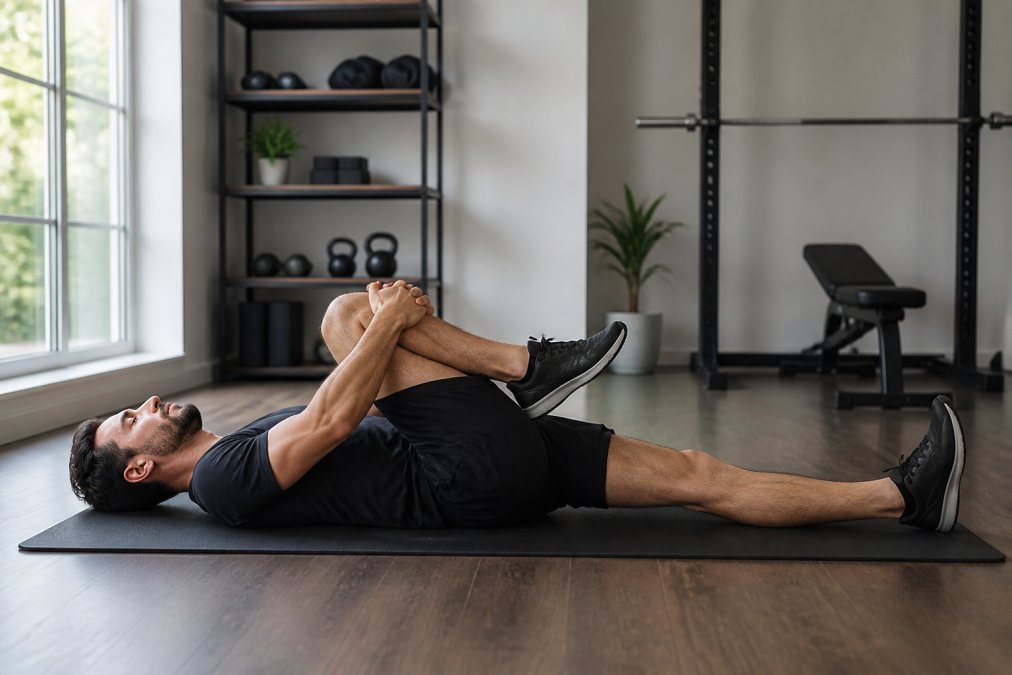
Test 1: The Thomas Test (Tightness)
The Thomas test: Lie on your back at the edge of a firm bed or bench. Hug one knee to your chest and let the other leg hang relaxed. If the hanging thigh lifts off the surface, or the knee cannot straighten, the hip flexors on that side are tight.
Test 2: Seated Knee Lift Against Resistance (Strength)
Sit tall on a chair with both feet flat. Place your hand on your thigh just above the knee and try to lift the knee toward your chest while your hand resists. A strong hip flexor lifts smoothly and holds against moderate resistance without your torso moving. If your torso leans back, your lower back arches, or the knee drops when you add resistance, the hip flexors lack strength and control.
Test 3: The March-and-Hold Screen (Control)
Stand with feet hip-width apart. Slowly lift one knee to hip height and hold for five seconds. Watch for three failure signs: your torso leans back, your standing hip shifts out to the side, or your lifted knee drops before the five seconds are up. Any of these points to a control problem rather than a length problem.
The Diagnostic Decision Tree
Use your results in this order:
- Thomas test positive AND seated knee lift strong: True tightness. Prioritize lengthening drills and mobility work.
- Thomas test positive AND seated knee lift weak: Tight-weak pattern. Start with activation and isometric strength work, then add mobility once control improves.
- Thomas test negative AND seated knee lift weak: Pure weakness. Skip stretching entirely and go straight to strengthening.
- Thomas test negative AND seated knee lift strong but march-and-hold fails: Control or coordination issue. Focus on single-leg stability and slow tempo work.
- All three tests negative but you still feel tight: The sensation is likely coming from the lower back, the glutes, or the joint capsule rather than the hip flexors themselves. Screen the lumbar spine and glutes next.
| Test | What You Do | Tight Result | Weak Result |
|---|---|---|---|
| Thomas test | Lie flat, hug one knee, let the other leg hang | Thigh lifts off the surface | Thigh stays down, no lift |
| Seated knee lift | Lift one knee against hand resistance | Easy lift, feels restricted at end range | Cannot hold, torso leans back |
| March in place | Lift knees to hip height slowly | Pulling at front of hip | Knee drops, poor control |
Hip Flexor Strengthening Exercises That Rebuild Control
Hip flexor strengthening exercises work best when they emphasize control over range, not maximum load. Start with isometric contractions, then progress to eccentric loading.
- Seated knee lift hold: Sit tall, lift one knee to hip height, and hold for 20-30 seconds. Keep the lower back still.
- Standing march: Lift each knee slowly to hip height without leaning back. Ten reps per side.
- Slow leg lower: Lie on your back, lift one leg to 90 degrees, then lower it slowly over five seconds.
- Step-up with control: Step onto a low platform, driving the knee up rather than pushing off the back foot.
Hip Flexor Recovery Tools for Tight and Weak Muscles
Hip flexor recovery tools help you manage tension before and after training, but they do not replace strengthening. Use them to calm overactive tissue, then train the muscle to control movement.
- The Foam roller Roller For body Relief uses high-density foam to ease tension and support flexibility and range of motion before a session. Its 33 cm length travels easily between home and gym.
- The Foam Massage Roller for Muscle Relief targets specific muscle points to relieve soreness and improve circulation after training.
- The NNEDSZ Green Massage Gun offers six speed levels and four heads for deep tissue work on the hip and thigh.
- The NNETM Portable Mini Massage Gun is pocket-sized and quiet, with a brushless motor and four interchangeable heads for on-the-go relief.
- The Rechargeable Vibration Massage Ball delivers five intensity settings and up to 180 minutes per charge for trigger point and fascia release.
Frequently Asked Questions
What are the primary symptoms of weak hip flexors?
Weak hip flexors typically show up as difficulty lifting your knee above hip height, a feeling of instability when standing on one leg, and lower back pain during walking or running. You may also notice your pelvis tilting forward or your lower back arching when you stand, which are compensatory patterns from underactive muscles. Unlike tightness, weakness does not produce a sharp stretch sensation. Instead, you feel a lack of control and rely on your lower back or glutes to do the work your hip flexors should handle.
How can you distinguish between tight and weak hip flexors?
The Thomas test identifies tightness: lie on your back, pull one knee to your chest, and if the other thigh rises off the table, your hip flexors are tight. Weakness shows up differently. Try lying on your back and lifting one straight leg toward your chest. If you cannot hold it there without your lower back arching or your pelvis shifting, the muscle is weak. Tightness limits range of motion. Weakness limits control through that range. Many people have both at once, which is the tight-weak paradox.
Can over-stretching weak hip flexors make the pain worse?
Yes. If your hip flexors are weak, aggressive static stretching can over-lengthen an already underactive muscle, making it harder to generate tension. This can worsen anterior pelvic tilt and increase lower back pain because the muscle loses what little neuromuscular control it had. Instead of stretching, focus on isometric contractions and eccentric loading to rebuild strength. Recovery tools like a vibrating massage ball, available for $49.14, can help reduce tenderness without lengthening the muscle.
What exercises should you avoid if your hip flexors are weak?
Skip prolonged static lunges and deep hip flexor stretches that hold the muscle in a lengthened position for more than 30 seconds. Avoid sit-ups and leg raises that rely on the hip flexors without core stability, as these reinforce compensatory patterns. Also avoid high-volume running or cycling without addressing the imbalance first. Instead, start with isometric holds like a standing knee lift held for 10 to 20 seconds, then progress to eccentric step-downs. These build muscle activation without over-stretching.
Distinguishing tight from weak hip flexors is the step most people skip, and it is the one that decides whether your routine helps or hurts. Bodyhackfitness stocks the recovery tools and digital programs to support both sides of that work, from high-density foam rollers to portable massage guns and guided strengthening plans you can follow at home. Shop now at Bodyhackfitness and build a hip routine that matches what your body actually needs.