

Table of Contents
- Why Lower Back and Hip Pain Often Occur Together
- Essential Stretches for Lower Back and Hip Pain Relief
- How Long to Hold Stretches for Lower Back Pain
- Best Recovery Tools for Hip Mobility
- Exercises to Avoid With Lower Back Pain
- Safety Precautions and When to See a Doctor
- Building a Sustainable Stretching Routine
- Frequently Asked Questions
Last Updated: September 19, 2026
Lower back and hip pain often occur together because they're connected by muscles, nerves, and movement patterns. Stretches for lower back and hip pain restore mobility and reduce tension. This guide shows you which stretches work best, how long to hold them, and when to seek professional help.
Why Lower Back and Hip Pain Often Occur Together
Your hip flexors, glutes, and lower back muscles work as a team. Sitting shortens hip flexors, weakens glutes, and forces your lower back to compensate by tightening. Restoring flexibility and mobility in your hips reduces strain on your lower back, which is why stretches for lower back and hip pain address both areas at once.
Essential Stretches for Lower Back and Hip Pain Relief
These five stretches target the muscles that cause most lower back and hip pain. Do them in order, holding each stretch for the time listed below.
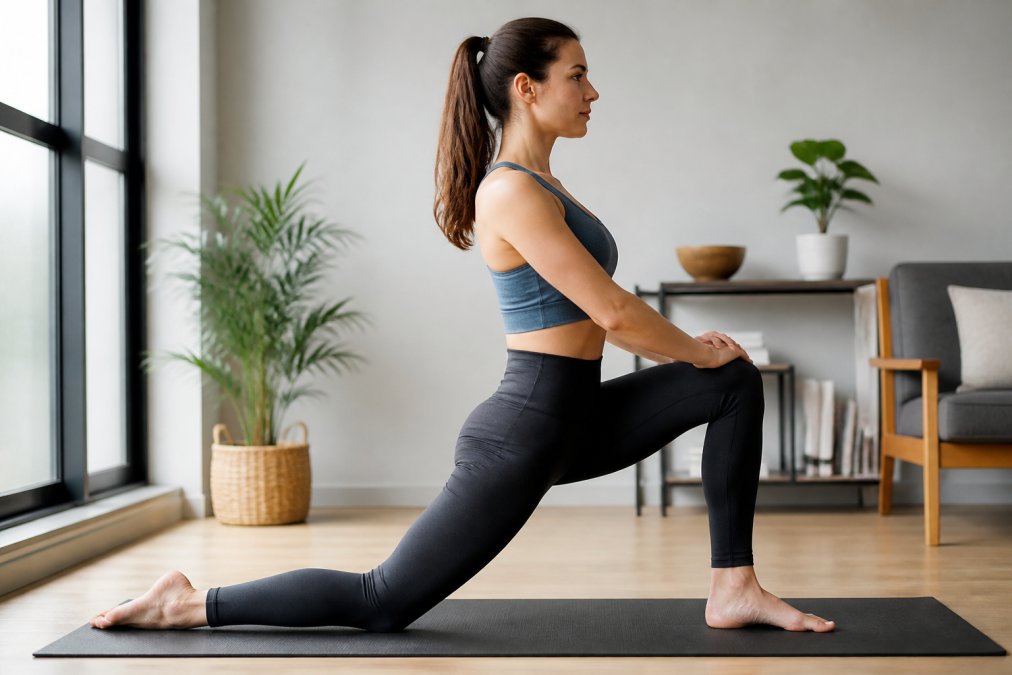
Hip Flexor Stretches
Tight hip flexors pull your pelvis forward and arch your lower back, making them a primary target for relief.
The standing hip flexor stretch:
- Step one foot forward into a lunge position
- Keep your back knee on the ground or hovering just above it
- Tilt your pelvis backward slightly to deepen the stretch
- Breathe steadily and relax into the position
Knee-to-Chest Exercises
How to perform it:
- Lie on your back on a mat
- Pull one knee toward your chest with both hands
- Gently draw your knee closer until you feel a stretch in your lower back and glute
- Avoid pulling so hard that you lift your lower back off the ground
Hold for 30 seconds. Switch legs and repeat 2-3 times per side.
Pelvic Tilts
Pelvic tilts teach your core to stabilize and reduce lower back strain.
The movement:
- Lie on your back with knees bent and feet flat on the floor
- Tighten your core as if bracing for a punch
- Tilt your pelvis so your lower back flattens against the floor
- Hold for 2 seconds, then relax
Piriformis Stretches
Your piriformis muscle sits deep in your glute and can pinch your sciatic nerve when tight, causing shooting leg pain.
The figure-4 stretch:
- Lie on your back with both knees bent
- Cross one ankle over the opposite knee (making a "4" shape)
- Grab the thigh of the leg on the ground and pull it toward your chest
- Keep your head and shoulders relaxed on the ground
Child's Pose Variations
Child's pose stretches your entire back, hips, and shoulders at once.
Standard child's pose:
- Kneel on a mat with big toes touching and knees wide apart
- Fold forward, letting your chest sink toward the floor
- Extend your arms forward or rest them by your sides
- Relax your neck and let your forehead rest on the mat
Hold for 60 seconds.
Child's pose with a twist:
- Start in child's pose
- Reach your right arm across your body toward the left side
- Feel the stretch along your right side and lower back
- Switch sides and repeat
Hold each side for 30 seconds.
How Long to Hold Stretches for Lower Back Pain
Hold duration depends on your flexibility level and pain condition.
General hold-time guidelines:
- Beginner flexibility: Start with 20-30 seconds and gradually increase by 5-10 seconds each week
- Intermediate flexibility: 45-60 seconds per stretch
- Advanced flexibility: 60-90 seconds is safe and effective
- Frequency: Stretch 5-7 days per week for improvement; 3-4 days per week maintains gains
Modify hold times by pain condition:
Progressive stretching protocol:
Best Recovery Tools for Hip Mobility
Stretching alone isn't enough. Recovery tools speed up healing and reduce soreness between stretches.
Exercises to Avoid With Lower Back Pain
High-risk exercises:
- Sit-ups and crunches (they compress your spine)
- Heavy deadlifts with poor form (they overload your lower back)
- Toe touches with straight legs (they overstretch your hamstrings and pull on your lower back)
- Twisting movements under load (they strain your spinal discs)
- Heavy squats without proper form (they transfer load to your lower back instead of your legs)
Instead, focus on:
- Planks (they build core stability without spinal compression)
- Bird dogs (they strengthen your back safely)
- Glute bridges (they activate weak glutes and reduce lower back strain)
- Quadruped movements (they build stability without heavy loading)
Start with bodyweight exercises. Add resistance only when you can move pain-free.
Safety Precautions and When to See a Doctor
See a doctor if:
- Pain lasts more than 6 weeks without improvement
- Pain radiates down your leg or into your foot (this suggests nerve involvement)
- You have numbness or tingling in your legs or feet
- Pain follows a fall, accident, or sudden injury
- You experience loss of bowel or bladder control (this is an emergency)
- Pain is severe enough to limit daily activities
Stretching safety rules:
Foam roller Roller For body Relief →
- Never bounce or force a stretch
- Stretch only to mild discomfort, never pain
- Warm up for 5-10 minutes before stretching
- Stop if you feel sharp or shooting pain
If you're recovering from surgery or have a diagnosed spinal condition, ask your doctor before starting a stretching routine.
Building a Sustainable Stretching Routine
Ergonomic fixes for desk workers:
Fix your sitting posture:
-
Adjust your chair height: Your feet should rest flat on the floor with knees at 90 degrees. Your hips should be slightly higher than your knees (use a lumbar support pillow if needed). This prevents your pelvis from tilting forward.
-
Position your monitor at eye level: The top of your screen should be at or slightly below eye level to prevent hunching.
-
Keep your keyboard and mouse close: Your elbows should be at 90 degrees with your keyboard directly in front of you to prevent shoulder rounding and spinal misalignment.
-
Use a lumbar support pillow: A small pillow in the curve of your lower back maintains the natural arch of your spine and prevents anterior pelvic tilt.
-
Avoid crossing your legs: Crossing your legs rotates your pelvis and increases hip and lower back strain. Keep both feet flat on the floor.
Movement breaks prevent pain better than stretching alone:
- Every 30 minutes: Stand and walk for 2-3 minutes to reset hip flexor length and activate glutes.
- Every 60 minutes: Do 5 minutes of light movement, stairs, squats, or a quick desk stretch.
- At lunch: Take a 10-15 minute walk, the single most effective habit for preventing lower back pain in desk workers.
Your 4-week progressive routine:
Week 1-2: Foundation (5 minutes, 5 days per week)
-
Hip flexor stretch: 30 seconds each side, 2 reps
-
Pelvic tilts: 15 reps
-
Child's pose: 60 seconds, 1 rep
-
Hip flexor stretch: 45 seconds each side, 2 reps
-
Knee-to-chest exercise: 30 seconds each side, 2 reps
-
Pelvic tilts: 20 reps
-
Piriformis stretch (figure-4): 45 seconds each side, 1 rep
-
Child's pose: 60 seconds, 1 rep
Add foam rolling 1-2 times per week.
- Hip flexor stretch: 60 seconds each side, 2 reps
- Knee-to-chest exercise: 45 seconds each side, 2 reps
- Pelvic tilts: 20 reps
- Piriformis stretch (figure-4): 60 seconds each side, 2 reps
- Child's pose with twist: 45 seconds each side, 1 rep
The desk worker's daily checklist:
- ✓ Morning stretching routine (5-15 minutes, depending on week)
- ✓ Lumbar support pillow in place
- ✓ Monitor at eye level
- ✓ Movement break every 60 minutes (2-3 minute walk)
- ✓ Lunch walk (10-15 minutes)
- ✓ Foam rolling or massage ball 2-3 times per week
Recovery tools like foam rollers accelerate progress. Bodyhackfitness offers foam rollers and massage tools to support your routine and help you maintain mobility gains through consistent stretching and postural awareness.
Frequently Asked Questions
What are the best stretches for lower back and hip pain?
The most effective stretches target the hip flexors, piriformis muscle, and lumbar spine. Hip flexor stretches, knee-to-chest exercises, pelvic tilts, piriformis stretches, and child's pose variations address the root causes of tightness and tension. Each stretch targets different muscle groups that contribute to lower back and hip pain, so combining several stretches into a routine provides comprehensive relief and improves overall flexibility and range of motion.
How long should you hold stretches for lower back pain?
Hold each stretch for 20 to 30 seconds, repeating 2 to 3 times per muscle group. This duration allows your muscles to relax without triggering a defensive response. For deeper flexibility work, experienced practitioners may hold stretches for up to 60 seconds. Consistency matters more than duration, performing stretches daily with proper form yields better results than occasional longer holds. Breathing steadily throughout helps reduce tension and improve alignment.
When should you see a doctor for hip and lower back pain?
Seek medical attention if pain persists beyond two weeks despite stretching and rest, if you experience sharp or shooting pain down your leg, or if pain follows a sudden injury or fall. Numbness, tingling, or weakness in your legs, loss of bladder or bowel control, or pain accompanied by fever also require immediate evaluation. A healthcare provider can rule out conditions affecting the sciatic nerve, vertebrae, or other structures that stretching alone cannot address. Early diagnosis prevents complications and ensures appropriate treatment.
What causes tight hips and lower back pain?
Prolonged sitting, poor posture, and weak core stability are common culprits. Desk work tightens hip flexors while weakening gluteal muscles, creating an imbalance that strains the lumbar spine. Muscle tightness in the piriformis or hip flexors restricts range of motion, forcing the lower back to compensate. Lack of stretching and mobility work compounds the issue. Stress and tension also cause muscles to tighten involuntarily. Understanding your specific trigger, whether it's ergonomics, activity level, or posture, helps you address the root cause rather than just symptoms.