


Quick Summary
The best under desk treadmills for home offices are compact walking pads that are quiet enough for calls, fold away easily, and offer remote or display controls. In this catalog, the 2.5HP silver model at $101.10 suits quiet shared spaces, while the Walking Pad with 8° Incline at $105.53 adds a remote and display.
- The 2.5HP silver model is described as whisper-quiet with a brushless drive.
- Test call noise with a phone recording at each speed you plan to use.
- A walking pad's deck height and belt length decide whether it fits under your desk.
- Raise your desk about the deck height plus shoe when walking, and save a separate preset.
- Standing desk cables must route down the back leg with enough slack for full height range.
Table of Contents
- How We Evaluated Under Desk Treadmills for Home Offices
- Quick Comparison: Under Desk Treadmills at a Glance
- Quiet Under Desk Treadmill for Home Office Calls
- Under Desk Treadmill Weight Capacity and Build Quality
- Under Desk Treadmill with Remote Control and Display Features
- Walking Pad for Standing Desk Setups and Small Spaces
- Choosing Your Under Desk Treadmill and Starting Your Walking Routine
- Frequently Asked Questions
How We Evaluated Under Desk Treadmills for Home Offices
Last Updated: November 18, 2026
Choosing an under desk treadmill for a home office means balancing four things: how quiet it runs during calls, how much weight it holds, how easily it folds away, and how well the controls work from a seated position. At Bodyhackfitness, we built this guide around those practical questions, using the specifications and pricing from our own under desk walking pad catalog and the product data we researched.
The Scisco et al. 2023 study on treadmill workstations under real working conditions among female office workers examined what helps and what gets in the way when office workers try treadmill workstations. Its findings point to real-world barriers such as fitting the equipment into a workday, which shaped the criteria below.
Our evaluation focused on these criteria:
- Noise during calls: We looked at whether each model is described as quiet enough for shared spaces or video meetings.
- Weight capacity and build: We compared stated load limits and frame construction.
- Folding and storage: Compact footprints matter in small apartments and shared offices.
Quick Comparison: Under Desk Treadmills at a Glance
Here is how the five models in our catalog stack up on the details that matter most for a home office.
| Model | Starting Price | Speed Range | Incline | Capacity | Best For |
|---|---|---|---|---|---|
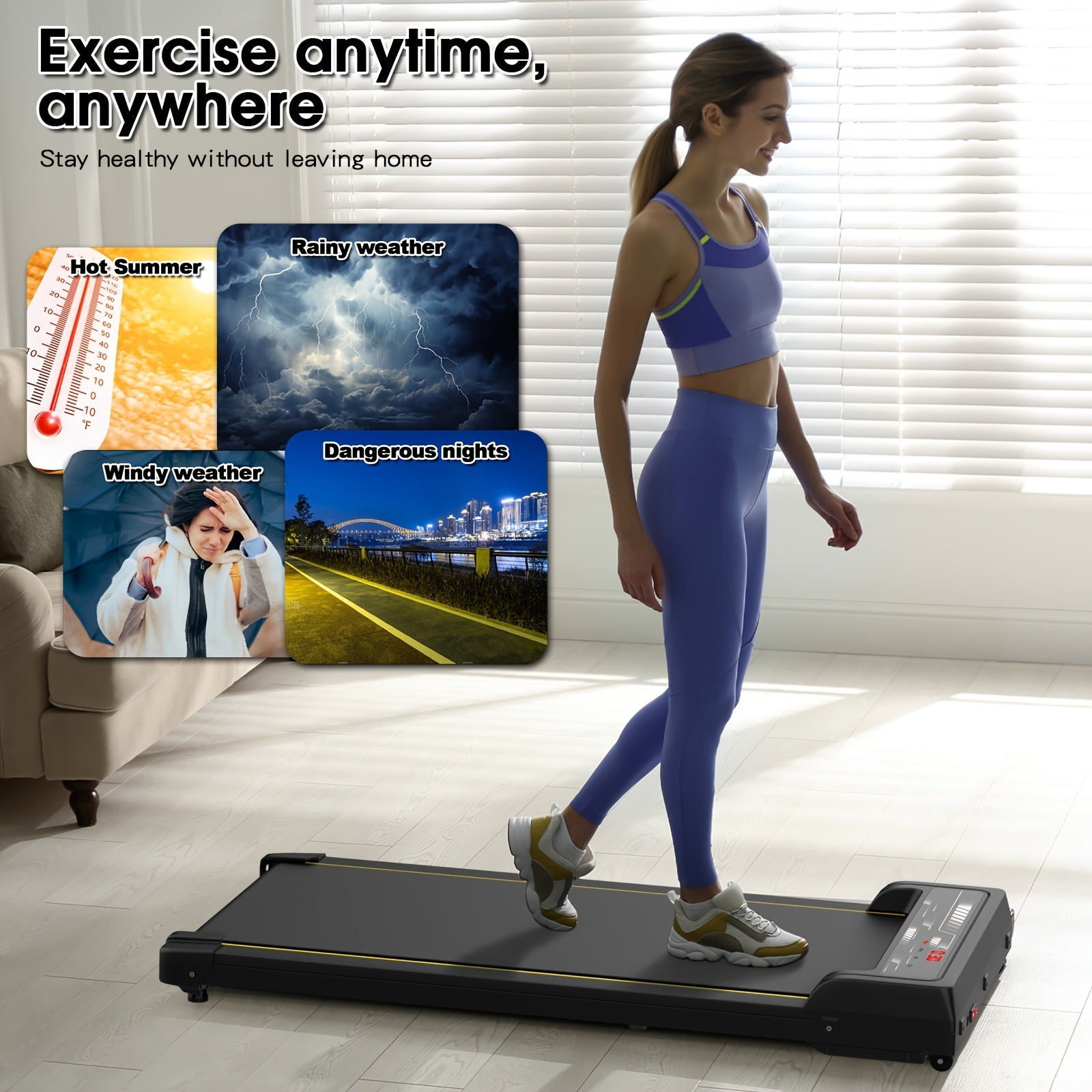
| 2.25HP Under Desk Treadmill, Black | $101.10 | 0.6-4 mph | None listed | Not listed | Budget home office |
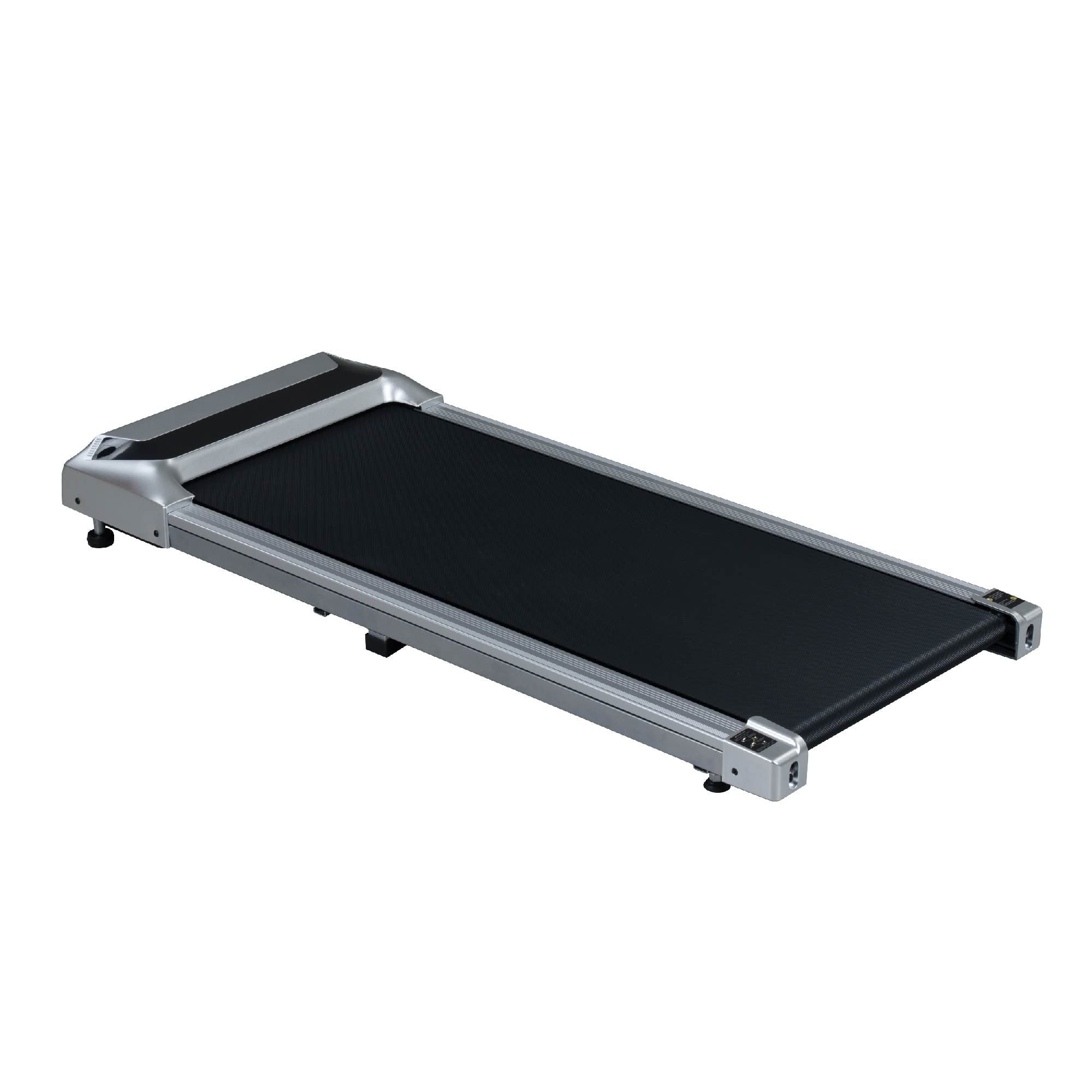
| 2.5HP Under Desk Treadmill, Silver | $101.10 | 0.6-4 mph | None listed | Not listed | Quiet shared spaces |
| Under Desk Walking Pad, Black | $458.69 | 1-8 km/h | None listed | 120 kg | Higher-capacity use |
| 7° Incline Walking Pad | $117.41 | Not listed | 7° fixed | 220 lb | Incline walking |
| Walking Pad with 8° Incline | $105.53 | 1.0-6.0 km/h | 8° | 220 lb | Incline with remote |
Starting Price
Prices are the figures listed in our catalog, quoted in USD.
Quiet Under Desk Treadmill for Home Office Calls
If you take video calls while you walk, noise is the first thing to check, and most buying guides handle it with a single adjective. A treadmill's sound profile changes with speed, belt tension, deck cushioning, and the surface it sits on, so "quiet" is not a fixed property. The practical question is narrower: will your microphone pick it up, and will the person on the other end hear it?
What actually makes an under desk treadmill loud
Four sources dominate, and each responds to a different fix:
- Motor and drive noise. Our 2.5HP silver model is described as whisper-quiet with a brushless drive. Motor noise rises with speed and load.
- Belt and roller noise. Belt seams, roller bearings, and belt tension produce a rhythmic hum or slap, the noise most likely to survive noise suppression because it is steady and tonal.
- Footfall impact. Usually the loudest element at walking speeds, it travels through the floor as structure-borne vibration, and it is what a desk mat and a cushioning deck reduce most.
How to test noise for calls before you commit
You do not need a lab. You need a phone and five minutes:
- Place the treadmill where it will actually live and put a mat under it if you plan to use one.
- Open a voice-recording app on a second device, or start a test call with a colleague, and stand at your normal desk position.
- Record 30 seconds at each speed you expect to use: typically 1.5 mph for typing, 2.0-2.5 mph for calls, and 3.0 mph or above for walking breaks.
- Play it back on headphones. If you hear a steady hum or a rhythmic thump under your voice, the microphone is picking it up.
- Repeat with your microphone's noise suppression on and off.
Reading manufacturer decibel claims
The 7° Incline Walking Pad listing claims a quiet motor under 55 dB. Treat that as a manufacturer claim measured under unspecified conditions. A motor rating says little about footfall, which is often the louder source at walking speeds. Confirm with your own recording before you rely on it for back-to-back calls.
Matching speed to the call
Noise rises with speed faster than most people expect, and the jump from 2 mph to 3 mph is more noticeable on a call than the jump from 1 mph to 2 mph. A practical approach:
- Typing and focused work: 1.0-1.5 mph. Quiet enough that most microphones will not pick up the belt, and slow enough to keep your hands steady.
- Audio-only calls: 1.5-2.0 mph. Comfortable for most walkers and usually masked by noise suppression.
- Video calls where you are mostly listening: 1.5-2.0 mph, with the mat in place and the camera framed above the belt.
Watch out: shared walls and floors transmit footfall more than motor noise, so a machine that sounds quiet in your room can still be audible to a neighbor below, test from the adjacent room, not just from your desk chair.
The quietest setup is a system, not a model
If calls are the priority, budget for the mat at the same time you budget for the treadmill.
Under Desk Treadmill Weight Capacity and Build Quality
Weight capacity determines who can use a model comfortably. The Under Desk Walking Pad in black, which supports up to 120 kg lists the highest stated capacity in our range, while the 7° Incline and 8° Incline models are rated for 220 lb.
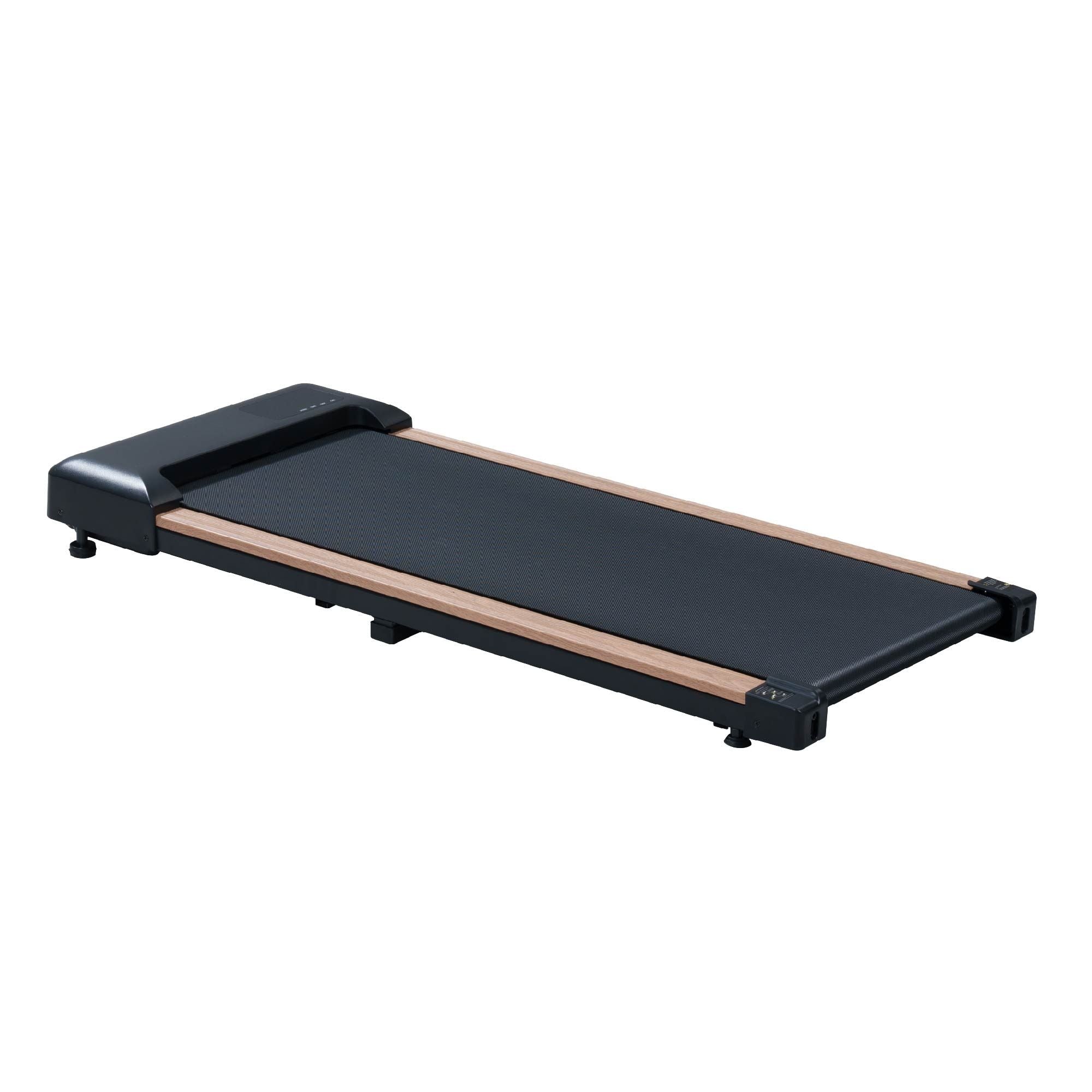
Build details vary. The black 2.25HP model is described with a wood-grain edge and a scratch-resistant finish, and the 7° Incline model offers a 15 by 39 inch running surface with no side rails in the way.
Under Desk Treadmill with Remote Control and Display Features
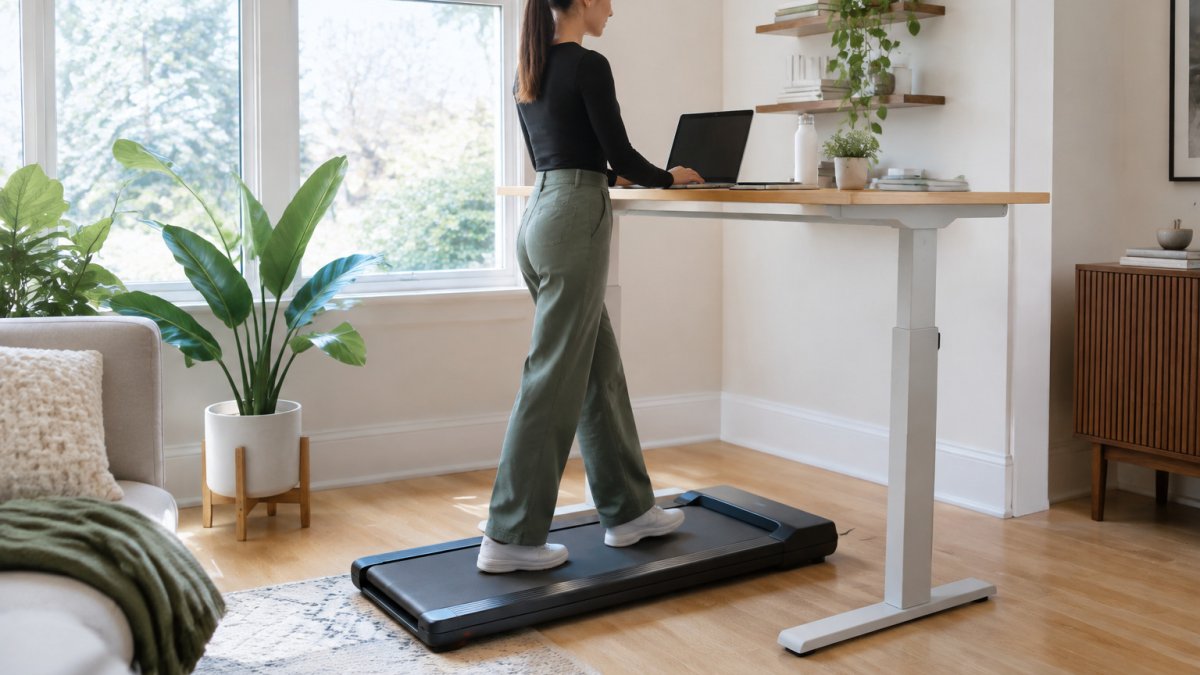
Being able to change speed without leaning forward keeps you walking during a call. The 2.5HP and 2.25HP models include remote control, and the 8° Incline model includes an LED display.
The 7° Incline model also includes an LED display.
Walking Pad for Standing Desk Setups and Small Spaces
A walking pad that fits under a standing desk has to clear three separate constraints: the height under the desk frame, the width between the desk's legs or crossbars, and the depth of the belt relative to your stride. Most listings publish only some of these, and almost none publish the one that matters most, the height of the deck at its highest point, including any incline mechanism.
The measurements that decide whether it fits
Take these four numbers before you order:
- Under-desk clearance. Measure from the floor to the lowest point of your desk frame, not the desktop. Many standing desks have a crossbar or motor housing that hangs below the surface and reduces usable clearance by several inches. You need the deck height plus your shoe plus a small margin.
- Deck height. The 7° Incline model's fixed incline raises the front of the deck, so its effective height at the front is greater than a flat pad's. If clearance is tight, a flat walking pad is safer than an incline model.
- Width between the legs. A pad wider than the gap between your desk's legs will not slide in from the front. Measure the narrowest point, including any caster wheels or feet.
- Belt length versus stride. The 7° Incline model lists a 15 by 39 inch running surface. A 39-inch belt is workable for walking but short for anyone with a long stride at higher speeds; if you are tall or plan to walk fast, prioritize belt length over deck width.
Desk height and the ergonomics of walking while working
A standing desk set for standing is usually too low for walking. When you step onto a pad, your body rises by the deck height plus your shoe, typically 4-6 inches on a flat pad.
A practical sequence: set the desk to its standing height, step onto the pad, and raise the desk until your elbows are near 90 degrees and the top of your monitor is at or slightly below eye level.
Cable routing and the moving-desk problem
A standing desk that goes up and down drags every cable with it. Adding a treadmill adds a power cord that must reach the floor and stay out of the belt path. Two habits prevent most problems:
- Route the treadmill's cord down the back leg of the desk with a velcro strap or a cable spine, leaving enough slack for the desk's full height range.
- Keep the treadmill's control console or remote on the desktop, not on the floor, so you are not bending down mid-walk to change speed. The 2.5HP and 2.25HP models include a remote for exactly this reason, and the 8° Incline model adds an LED display that tracks time, speed, and distance in real time.
Small-space trade-offs
Compact does not mean interchangeable. The 2.25HP and 2.5HP models are described as compact and portable with two front wheels. The 7° Incline model stands upright for storage and rolls away in seconds, the better choice if floor space is the binding constraint.
For a small office, the realistic workflow is: walk, stop, roll the pad against the wall, and drop the desk back to seated height. A pad that takes more than about 30 seconds to stow will stop getting used.
What the listings do not tell you
Most listings do not give exact deck dimensions or under-desk clearance, so a tape measure will save you a return. Measure your desk's lowest crossbar, the gap between its legs, and the height of your monitor's lowest comfortable position, then compare those against the deck height and belt length of the model you are considering. If a listing omits a dimension you need, assume the worst case rather than the best.
Choosing Your Under Desk Treadmill and Starting Your Walking Routine
Start with the features you will actually use. If you mostly want a quiet budget option, the 2.5HP silver model at $101.10 is a practical first pick.
Begin with short sessions at a slow pace, then build up over several weeks. Sore calves and shins are common in the first days of a new walking routine.
For a full range of walking pads and related gear, browse our under desk treadmills collection, and when you are ready to compare the incline models side by side, see the walking pad with incline options.
Frequently Asked Questions
Which under desk treadmill is the best quality?
Quality depends on the build, motor and weight capacity you need. The Body Hack 7° Incline Walking Pad Treadmill is listed at $117.41 with a 220 lb capacity and a 2.55HP quiet motor, while the 2.5HP Under Desk Treadmill in Silver is listed at $101.10. Check the warranty, belt size and motor specs against your daily walking time before deciding, since a heavier-duty frame usually costs more but lasts longer under regular use.
Are treadmills under a desk worth it?
For many home office workers, yes, because they let you add walking time without changing your schedule. Walking at low speeds while answering email or taking calls can add up over a week. Under-desk models generally have fewer features than full treadmills, with limited displays and no railings, so they suit steady, low-speed walking rather than running or steep training.
How quiet are under desk treadmills?
Noise varies by motor and model. The 2.5HP Under Desk Treadmill is marketed as ultra-quiet with a brushless motor, and the 7° Incline Walking Pad is listed as under 55 dB. Listing figures are manufacturer claims, so test a model during a real call before relying on it, and keep speed moderate, since higher speeds generally produce more sound and vibration.
What should I look for in an under desk treadmill?
Start with weight capacity, belt size, speed range and noise level. The listed capacities range from 120 kg (about 265 lb) to 220 lb across the Body Hack lineup, and speeds from 0.6 to 4 mph to 1 to 8 km/h. Also confirm the power supply, whether a remote control and LED display are included, and whether the unit folds or rolls for storage in a small room.
