

Table of Contents
- Why Your Home Gym Needs a Recovery Setup
- Quick Comparison: Best Home Gym Recovery Tools
- Percussion Massage Gun Benefits for Sore Muscles
- Foam Rolling Techniques for Beginners
- Cold Therapy vs Heat Therapy for Muscle Recovery
- Targeted Tools for Knots, Feet, and Hard-to-Reach Spots
- How to Build a Recovery Routine That Sticks
- Frequently Asked Questions
Last Updated: September 26, 2026
Why Your Home Gym Needs a Recovery Setup
Training breaks your muscles down; recovery builds them back stronger. Most home gym owners spend their whole budget on racks, bars, and dumbbells, then wonder why they feel beat up by week three. The missing piece is a recovery setup.
Recovery is not a luxury, it is the other half of the training equation. Delayed onset muscle soreness, or DOMS, is the ache a day or two after a hard session that signals micro-damage to muscle fibers. Without a way to manage it, your next workout suffers.
The good news: a home recovery station costs far less than most people expect. You do not need a full spa setup, a few targeted tools used consistently make a measurable difference.
This guide covers home gym recovery tools, from percussion massagers to foam rollers, and shows you how to build a routine that actually sticks.
Quick Comparison: Best Home Gym Recovery Tools
Here is a side-by-side look at the top recovery tools for a home gym, matched to the job each one does best.
| Tool | Price | Best For | Standout Feature |
|---|---|---|---|
| NNEDSZ Green Massage Gun | $74.82 | Deep tissue knots | 6 speeds, 4 heads |
| Foam Roller for Body Relief | $80.06 | Full-body myofascial release | 33 cm high-density foam |
| Electric Foam Roller (Blue Wave) | $290.80 | Hands-free vibration | Multi-level motor |
| Vibration Massage Ball | $49.14 | Feet, neck, trigger points | 5 intensities, 180-min battery |
| Travel Muscle Recovery Bundle | $85.41 | Portability and value | 5-piece kit |
The right pick depends on your training style and budget. A lifter with chronic back tightness gets more from a massage gun; a runner with plantar fasciitis needs the massage ball and foot tools. Most people benefit from combining two or three.

Percussion Massage Gun Benefits for Sore Muscles
A percussion massage gun delivers rapid, targeted pulses into muscle tissue, increasing blood flow and easing muscle tension faster than static stretching alone.
For post-workout soreness, a massage gun is hard to beat, it reaches deep tissue your hands cannot.
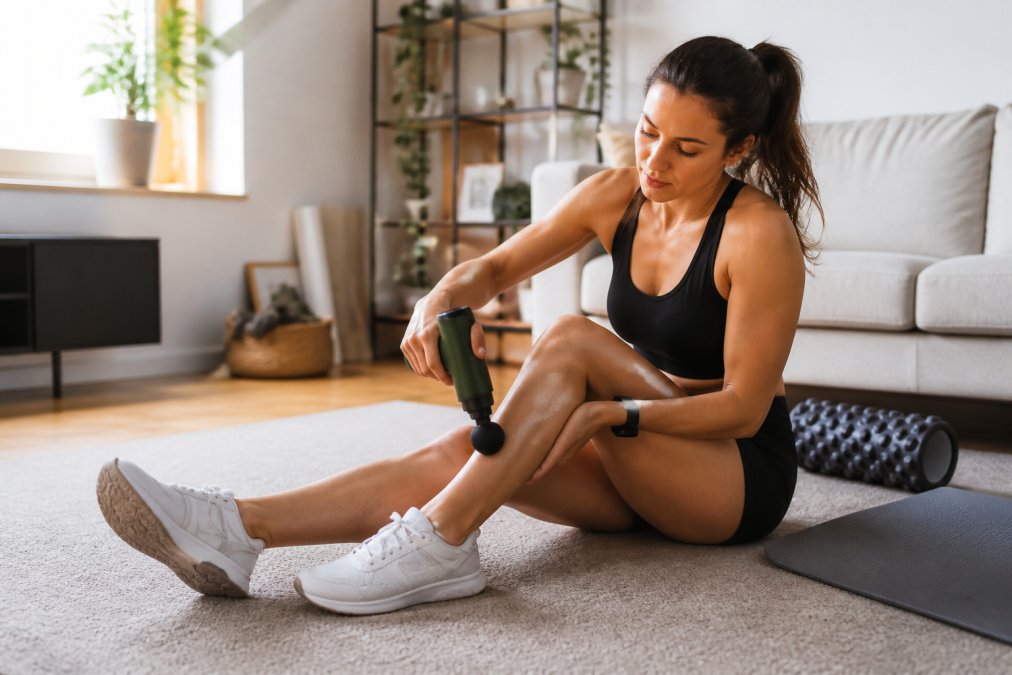
The NNEDSZ Green Massage Gun is our top pick for most home gyms. Six adjustable speeds let you start light on tender areas and ramp up for stubborn knots, while four professional heads cover everything from large muscles to trigger points. The large-capacity battery handles extended sessions without a mid-massage charge.
What most people get wrong: pressing too hard and moving too fast. Let the tool do the work, glide it slowly at a moderate speed for 30 to 60 seconds per area.
Foam Rolling Techniques for Beginners
Foam rolling is self-myofascial release using your body weight over a dense cylinder, targeting large muscle groups like quads, hamstrings, and the back.
Beginners make one mistake: rolling too fast. Slow, deliberate passes work best, 30 to 60 seconds per area.
The Foam Roller for Body Relief is a solid starting point. At 33 cm, it fits small spaces yet works the back, and the high-density foam holds its shape over time.

Cold Therapy vs Heat Therapy for Muscle Recovery
Cold and heat do opposite things to blood vessels, which is why you pick one over the other. Cold causes vasoconstriction, vessels narrow, blood flow drops, nerve conduction slows, blunting acute pain and limiting swelling. Heat causes vasodilation, vessels widen, blood flow rises, tissue extensibility improves, loosening stiffness and improving range of motion.
Cold therapy: what actually works at home
Cold water immersion is a form of cold therapy for post-exercise recovery. A common home protocol is 10 to 15 minutes in water between 50°F and 59°F. A cold shower is a substitute without a tub or plunge.
Heat therapy: the pre-workout and evening tool
Moist heat, a warm shower, heated pad, or warm towel, can be used for stiffness. For stiffness, 15 to 20 minutes at a comfortable temperature is standard.
Contrast therapy and the timing question
Neither end of the spectrum requires expensive equipment. A tub of ice water and a quality heating pad cover both jobs.
Targeted Tools for Knots, Feet, and Hard-to-Reach Spots
Some areas resist every general tool. Feet, neck, and deep glute knots need something more precise. This is where small, targeted recovery tools earn their place.
How to Build a Recovery Routine That Sticks
Most recovery guides hand you a product list and stop. What actually changes how you feel is the schedule, which tool, at which point in the day, for how long. Here is a framework you can adapt to your training.
The three recovery windows
Think of recovery as three windows, each with a different goal.
Adapt the protocol to your training
Different training styles create different recovery demands. A generic routine ignores that.
- Powerlifters and strength athletes: prioritize heat before lifting to prepare heavy joints, then foam rolling plus targeted massage gun work on the lower back, hips, and shoulders after. Save cold immersion for rest days so it does not blunt training adaptation.
- Endurance runners: the calves, feet, and IT band take the most load. A vibration massage ball for the feet and a dense foam roller for the calves belong in Window 1, with compression or elevation in Window 2 if you have swelling.
- HIIT and CrossFit-style athletes: systemic fatigue is the issue, not one muscle group. Prioritize sleep, contrast therapy, and full-body foam rolling over spot treatment.
A sample week
You do not need the full protocol every day. A workable pattern for someone training four times a week:
- Training days: Window 1 foam roll (5 min) + Window 2 massage gun or ball on problem areas (5 min) + Window 3 heat and stretch (10 min).
- Rest days: one longer session, 15 to 20 minutes of full-body rolling, mobility, and either a cold plunge or a hot soak depending on how you feel.
- Hard weeks: add a second Window 3 session and protect sleep above all else.
Make it stick
The routine that survives has the fewest decisions. Pick one tool per window, put the recovery block on your calendar next to your workouts, and pair it with something you already do, a show, a podcast, winding down for bed. Track soreness and energy for two to three weeks.
Frequently Asked Questions
What is the best at-home recovery equipment for muscle soreness?
For most people, a percussion massage gun and a foam roller cover the widest range of soreness. The NNEDSZ Green Massage Gun ($74.82) offers six speeds and four heads for targeting specific muscle groups, while a high-density foam roller like the NNEOBA 33 cm roller ($80.06) handles broader areas like quads and back. Pairing both lets you address trigger points and general muscle tension in one session.
How do percussion massage guns compare to foam rollers for recovery?
Percussion massage guns deliver rapid, targeted pulses that reach deep tissue and trigger points, which makes them useful for knots in the calves, shoulders, and glutes. Foam rollers apply broader, slower pressure across larger muscle groups and help with range of motion and flexibility. Many people use a foam roller first to warm up tissue, then follow with a massage gun on specific tight spots.
Is it worth investing in compression therapy for home use?
For home use, the value of compression therapy depends on how often you train hard. If you exercise four or more times a week and deal with lingering soreness, a compression tool can be beneficial. If you train casually, a massage gun or foam roller covers most recovery needs at a lower cost.
How often should you use recovery tools after a workout?
Most people get good results using recovery tools for 10 to 15 minutes after training, once per day. Percussion massage guns can be used in shorter sessions of 2 to 3 minutes per muscle group. Foam rolling works best when done consistently, even on rest days, to maintain flexibility and reduce muscle tension. Overuse can cause irritation, so keep sessions brief and listen to your body.
What are the essential recovery tools for a small home gym space?
Start with a massage gun and a compact foam roller. The NNETM Portable Mini Massage Gun ($97.27) is pocket-sized and USB-C rechargeable, making it easy to store. The Travel Muscle Recovery Bundle ($85.41) includes a trigger point ball, roller stick, and mini foam roller, all small enough for a shelf or gym bag. Together these cover percussion therapy, myofascial release, and trigger point work without taking up floor space.
Building a home gym is only half the job. Without a recovery setup, your training plateaus and your motivation fades. Bodyhackfitnesss offers a curated range of recovery equipment, including massage guns, foam rollers, and vibration tools, so you can train harder and recover faster in one complete home environment. Shop now and build the recovery station your training deserves.