


Last Updated: November 1, 2026
Quick Summary
A dumbbell workout routine for total body strength uses seven compound moves done as a three-round circuit, three sessions a week, with 40 seconds of work and 20 seconds of transition per move. One pair of dumbbells and 30 minutes is enough to start.
- The seven moves are goblet squat, deadlift, chest press, row, overhead press, reverse fly, and renegade row or plank.
- Beginners should start with two sets of eight to 10 reps and add a set after two weeks.
- Use the two-rep reserve rule: pick a weight leaving about two reps in the tank.
- Rest 45 to 60 seconds between sets of the same move in strength-focused training.
- Deload every six to eight weeks with half the sets and a weight about 20 percent lighter.
Table of Contents
- Dumbbell Workout Routine for Total Body Strength: The 7-Move Plan
- What You'll Need Before You Start
- Full-Body Dumbbell Workout for Beginners: Master These 7 Moves First
- 30-Minute Full-Body Dumbbell Workout You Can Do at Home
- Full-Body Dumbbell Workout Sets and Reps for Strength
- How Often to Do Full-Body Dumbbell Workouts
- Progressive Overload: How to Make the Routine Harder
- Exercise Substitutions for Limited Equipment or Mobility
- Build Your Home Dumbbell Setup and Start Training
- Frequently Asked Questions
Dumbbell Workout Routine for Total Body Strength: The 7-Move Plan
A dumbbell workout routine for total body strength works best when it stays simple: seven compound moves, three sessions a week, and a weight you can control. This plan is built around exercises that give you the most return for the least time. You do not need a rack of weights. One pair of dumbbells and 30 minutes is enough to start.
Here is the part most guides skip: the routine itself is the easy bit. Choosing your weights and adding load over time is what actually builds strength. Below, we show you exactly how to run the seven moves, how to pick a starting weight, and how to make the plan harder without adding days.
What You'll Need Before You Start
You need three things: a pair of dumbbells, a clear space about the size of a yoga mat, and a chair or bench. That is it. No cable machine, no barbell, no gym membership.
A single dumbbell is enough for several of these moves, including goblet squats and rows. If you are starting from nothing, a premium 20LB rubber coated cast iron dumbbell is one option to cover most of the plan while you learn the movements.

Two practical notes before your first session:
- Clear the floor around you, especially for rows and deadlifts.
- Keep water within reach. Grip fatigue shows up fast in dumbbell training.
Full-Body Dumbbell Workout for Beginners: Master These 7 Moves First
A beginner full-body dumbbell workout should focus on seven compound movements that train every major muscle group. These are the moves that build total-body strength fastest, and they are the ones we would teach anyone first.
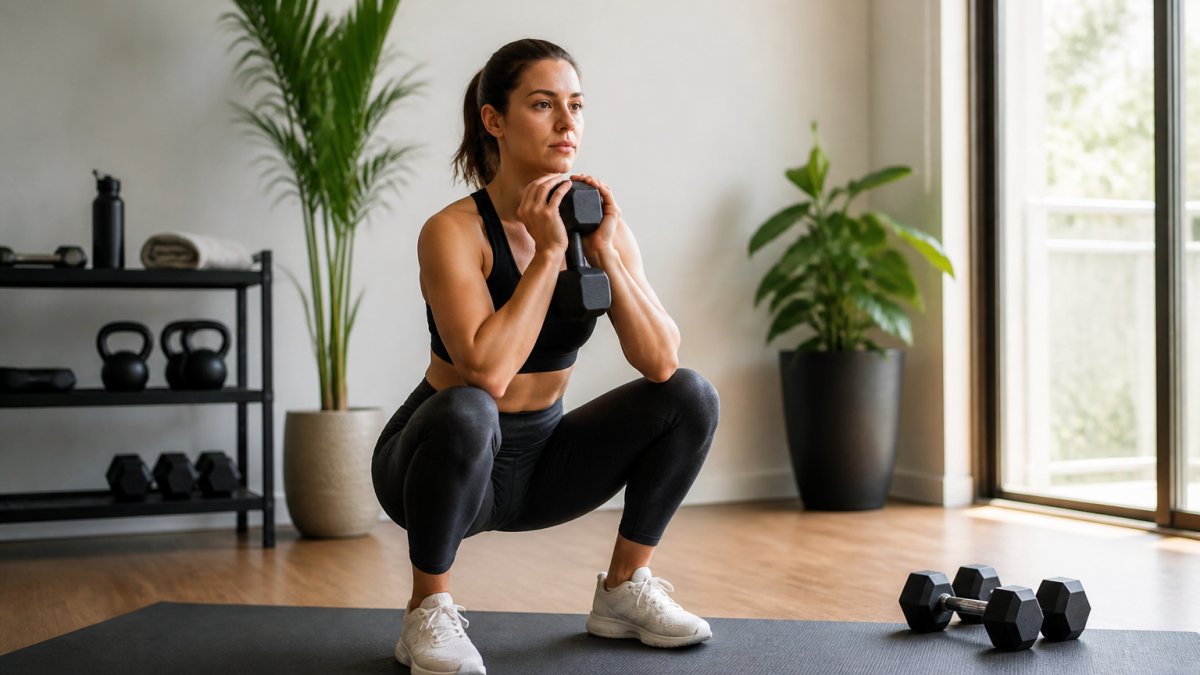
- Goblet squat - lower body. Hold one dumbbell at your chest, squat down, stand up.
- Dumbbell deadlift - lower body and back. Hinge at the hips, keep the weights close to your legs.
- Chest press - upper body. Press from your chest, not your shoulders.
- Dumbbell row - back. Pull the weight to your hip, not your armpit.
- Overhead press - shoulders. Press straight up, ribs down.
- Reverse fly - upper back. Light weight, slow tempo.
- Renegade row or plank - core. Keep your hips level the whole time.
Form Cues and Common Mistakes
The biggest mistake beginners make is going too heavy too soon. Form breaks before the muscles do, and that is where tweaks happen.
Watch out: letting your lower back round on deadlifts. Keep your chest up and push your hips back, not down.
A few cues that fix most problems:
- Squat: knees track over your toes, chest stays tall.
- Row: no twisting. Pull with your elbow, not your hand.
- Overhead press: squeeze your glutes so your lower back does not arch.
30-Minute Full-Body Dumbbell Workout You Can Do at Home
A 30-minute full-body dumbbell workout works best as a circuit you repeat for three rounds, not as seven separate exercises with long breaks. The circuit format keeps your heart rate up, fits the time limit, and still loads every major muscle group. Here is the exact session.
| Block | Moves | Time |
|---|---|---|
| Warm-up | Marching in place, arm circles, bodyweight squats, hip hinges | 5 min |
| Circuit round 1 | Goblet squat, chest press, dumbbell row, reverse fly, deadlift, overhead press, plank | 6 min |
| Rest | Walk around, shake out arms | 60 sec |
| Circuit round 2 | Same seven moves | 6 min |
| Rest | Walk around, shake out arms | 60 sec |
| Circuit round 3 | Same seven moves | 6 min |
| Cooldown | Stretching and slow breathing | 5 min |
Inside each 6-minute round, you do each move for 40 seconds of work and 20 seconds of transition to the next station. That gives you roughly 8 to 12 reps per move depending on tempo.
Warm-Up and Cooldown
Skip the warm-up and your first set feels heavy. Five minutes of easy movement raises your body temperature and primes your joints. The warm-up above hits the hips, shoulders, and knees, which are the joints that take the most load in this plan.
For the cooldown, hold each stretch for 20 to 30 seconds. Focus on hips, hamstrings, chest, and shoulders.
Rest Intervals Between Sets
Rest is where most home lifters go wrong. Too short and your next set falls apart. Too long and the workout stretches past 30 minutes.
If you switch to straight sets instead of a circuit, rest 60 to 90 seconds after lower-body moves like goblet squats and deadlifts, and 45 to 60 seconds after upper-body moves like presses and rows.
20-Minute Version
Short on time? Run two rounds instead of three and cut the cooldown to three minutes. That lands near 20 minutes. Keep the warm-up at five minutes even in the short version, because cold joints are where tweaks happen. Two rounds still hit every muscle group; you just accumulate less volume, so plan to train three days that week rather than two.
Full-Body Dumbbell Workout Sets and Reps for Strength
For strength, use three to four sets of six to 12 reps per move. Pick a weight where the last two reps feel hard but your form holds. That range builds strength and muscle at the same time. Beginners should start with two sets of eight to 10 reps and add a set after two weeks.
The unique part most guides skip: you need a repeatable way to choose your starting weight and a clear rule for when to add load. Without both, you either stay too light for months or jump too heavy and stall.
Premium 20LB Rubber Coated Cast Iron Dumbbell with Ergonomic Chrome Handle →
How to Choose Dumbbell Weights
Use the two-rep reserve rule. Choose a weight you can lift for the target reps with about two reps left in the tank. If you can do 15 easy reps, it is too light.
A practical starting point for most beginners:
- Goblet squat and deadlift: the heaviest dumbbell you can control for 10 clean reps
- Chest press and row: a medium dumbbell that leaves two reps in reserve at 10 reps
- Overhead press and reverse fly: the lightest dumbbell that still feels challenging at 10 to 12 reps
Lighter options like an 8LB rubber coated dumbbell suit the pressing and fly movements. For a mid-range pair that covers more of the plan, a rubber hex dumbbell set of 15-pound pair gives you room to grow.

A Simple Progression Method
Add one variable at a time, and only when you hit the top of the rep range with two reps still in reserve on every set. Here is the order:
- Weeks 1-2: learn the moves, two sets of 8 to 10 reps each.
- Weeks 3-4: add a third set at the same weight and reps.
- Weeks 5-6: add reps within the 8-to-12 range until you reach 12 reps on all sets.
- Week 7 and beyond: move up to the next dumbbell weight and drop back to 8 reps.
If you cannot complete the target reps with good form, stay at the current weight for another week. That is not a setback. That is the plan working.
When to Deload
Every six to eight weeks, take one lighter week. Cut your sets in half and use a weight about 20 percent lighter than your working weight. This is a deload, and it lets your joints and nervous system catch up. If you feel beat up, sore for more than two days after a session, or your reps are dropping session to session, deload early rather than pushing through.
How Often to Do Full-Body Dumbbell Workouts
Train three days a week with a rest day between sessions. A common approach is Monday, Wednesday, and Friday. That gives each muscle group time to recover before you load it again.
Two sessions a week still builds strength if you are new. More than four sessions rarely helps a beginner, because recovery becomes the limit.
Progressive Overload: How to Make the Routine Harder
Add weight, reps, or sets over time, but only one at a time. This is progressive overload, and it is the reason a routine keeps working after week four.
A simple progression:
- Week 1-2: learn the moves, two sets each
- Week 3-4: add a third set
- Week 5-6: add reps within the range
If you cannot complete the target reps with good form, stay at the current weight for another week. That is not a setback. That is the plan working.
Exercise Substitutions for Limited Equipment or Mobility
Swap moves when equipment or joints limit you, but keep the movement pattern. A reader with limited equipment can use an adjustable dumbbell and barbell set to cover substitutions. A squat becomes a box squat. A row becomes a single-arm row on a bench.
Common swaps:
- Shoulder pain on overhead press: use a neutral grip or press one arm at a time.
- No bench: press from the floor.
- Knee discomfort on squats: squat to a chair and stand back up.
Build Your Home Dumbbell Setup and Start Training
Start with one pair of dumbbells, a mat, and a plan you can repeat. That setup is enough for months of progress. Our guide on how to build a home gym walks through the full setup step by step.
Then run the seven moves three times a week. Track your weights and reps. Add load when the last set feels easy.
Frequently Asked Questions
What is a good full-body dumbbell workout routine?
A good dumbbell workout routine hits every major muscle group with compound movements first, then isolation work. Start with a goblet squat, dumbbell deadlift, chest press, and dumbbell row, then add a shoulder press, reverse fly, and a core exercise. Do 3 sets of 8 to 12 reps per move, resting 60 to 90 seconds between sets. This structure covers your chest, back, shoulders, legs, and core in one session and fits a 30-minute window.
How many sets and reps should I do for a full-body dumbbell workout?
For strength, use 3 to 5 sets of 5 to 8 reps with a weight that feels challenging by the last rep. For muscle growth, do 3 to 4 sets of 8 to 12 reps. For endurance, do 2 to 3 sets of 12 to 20 reps. Beginners should start with 2 to 3 sets of 8 to 12 reps and focus on form before adding weight. Rest 60 to 90 seconds between sets for strength work and 30 to 60 seconds for endurance work.
How often should I do a full-body dumbbell workout?
Two to three full-body dumbbell workouts per week is enough for most people. Leave at least one rest day between sessions so your muscles recover. If you train three times a week, try Monday, Wednesday, and Friday. Beginners can start with two sessions and add a third after two to three weeks.
Can beginners do a full-body dumbbell workout at home?
Yes. A full-body dumbbell workout for beginners needs only a pair of dumbbells and a few feet of floor space. Start with light weights, such as 8LB Rubber Coated Dumbbells, and learn the seven core moves: goblet squat, deadlift, chest press, row, overhead press, reverse fly, and a core exercise. Do 2 to 3 sets of 8 to 12 reps, keep rest periods at 60 to 90 seconds, and add weight only when the last rep feels easy with good form.
Building total-body strength does not require a full gym. It requires a routine you repeat and weights you can adjust as you get stronger. Bodyhackfitness stocks rubber-coated cast iron dumbbells with knurled chrome handles for a secure grip, plus digital programs and recovery gear to keep you training. Get started with Bodyhackfitness and build the home setup that keeps you consistent.
