


Last Updated: November 6, 2026
Quick Summary
Keep fitness habits while traveling by setting a minimum effective dose before you leave: two 10-20 minute sessions per week, one long walk per day, or ten minutes of stretching before bed. A short workout you actually finish beats a perfect plan you skip, so set the bar low and clear it every day.
- Run three rounds of 40 seconds on, 20 seconds off for a no-equipment bodyweight circuit.
- On business trips, aim for 7,000-8,000 steps on meeting days and block two 15-minute windows.
- Aim for a protein source at every meal and pair it with two short strength sessions a week.
- Get outside in daylight within an hour of arriving to help reset your body clock.
- Pack a mini massage gun, foam roller or roller stick, trigger point ball, resistance band, and jump rope.
Table of Contents
- Step 1: Set a Minimum Effective Dose Before You Leave
- Step 2: Build a Travel Workout No Equipment Can Match
- Step 3: Learn How to Stay Fit While Traveling for Work
- Step 4: How to Maintain Muscle While Traveling With Protein and Strength Work
- Step 5: Find a Gym While Traveling Without Wasting a Day
- Step 6: Plan for Jet Lag, Sleep, and Recovery
- Step 7: Pack Your Portable Recovery Kit
- Shop the Travel Kit That Keeps Your Routine Intact
- Frequently Asked Questions
Step 1: Set a Minimum Effective Dose Before You Leave
The best strategies for maintaining fitness habits while traveling start before you zip the suitcase. Pick a minimum effective dose: the smallest workout you can repeat on your worst day and still call it done.
At Bodyhackfitness, we suggest writing it down before you book the flight.
- Two 10-20 minute sessions per week
- One long walk per day
- Ten minutes of stretching before bed
That's it. A short workout you actually finish beats a perfect plan you skip. Research published through the National Institutes of Health's PubMed Central notes that people who keep results tend to stick to consistent routines rather than heroic efforts.
Set the bar low. Then clear it every day.
Step 2: Build a Travel Workout No Equipment Can Match
A travel workout no equipment can match is a short bodyweight circuit you can do anywhere: squats, push-ups, lunges, planks, and hip hinges. No gym, no gear, no excuses.
Run three rounds of 40 seconds on, 20 seconds off. Ten to twenty minutes is enough to keep the habit alive.
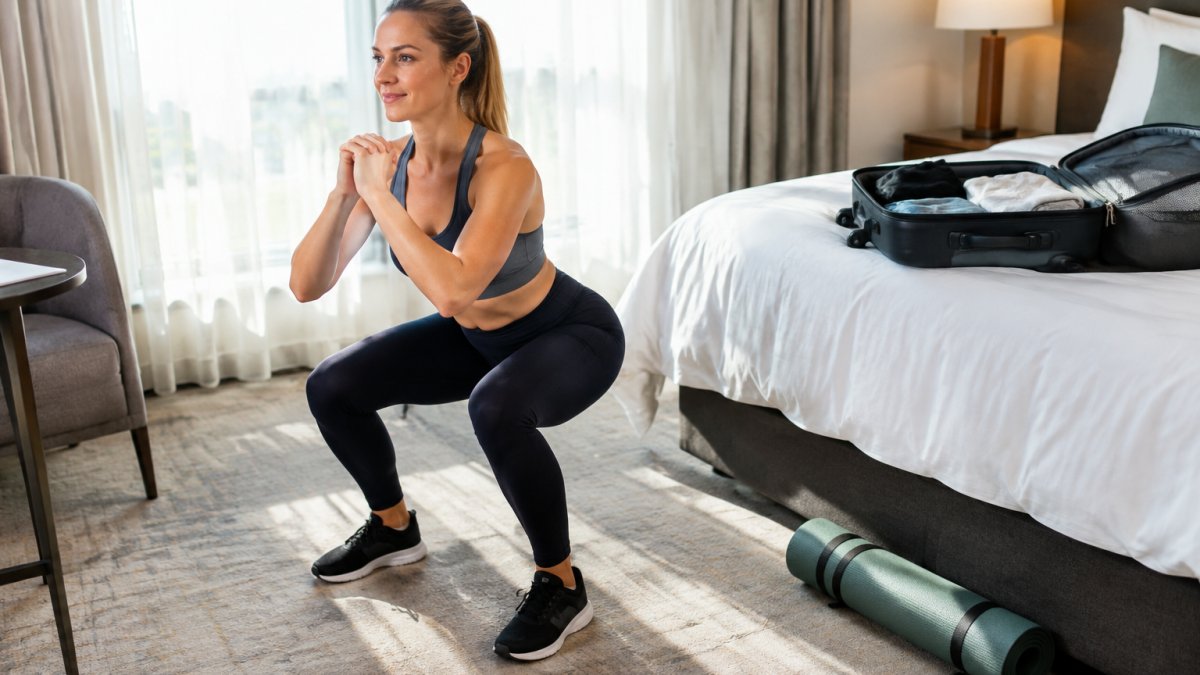
We like the Morrissey Trekk Travel Yoga Mat for this. It weighs 2.5 lb and measures 24"x72"x5mm, and its textured bottom is designed to grip.

Short sessions add up. Consistency is the whole game.
Step 3: Learn How to Stay Fit While Traveling for Work
Business trips reward planning, not willpower. Learn how to stay fit while traveling for work by anchoring movement to things you already do: the commute, the coffee break, the walk between meetings. But the same principle scales to every trip type, and most travel-fitness advice stops at business travel. Here are sample routines for the four trips people actually take.
Business trip (3-4 days, packed calendar). Treat movement as a meeting with yourself. Book a hotel with a fitness center or near a walking path, then block two 15-minute windows: one before your first call and one after your last. Walk the terminal instead of sitting at the gate, take stairs over elevators, and do a 10-minute hotel-room circuit (squats, push-ups, planks) before you shower. Aim for 7,000-8,000 steps on meeting days and one 20-minute strength session if the schedule allows. Pack workout clothes you can wear twice so fewer decisions mean fewer skipped workouts.
Family vacation (5-7 days, shared schedule). Fitness has to fit between naps, meals, and everyone else's plans. Front-load movement: a 20-minute bodyweight circuit before the family wakes up, then count the day's walking as your cardio. Swap one sedentary activity for an active one (a walking tour instead of a bus tour, stairs at the museum, a swim instead of a movie). Keep the minimum effective dose at two short strength sessions and a daily walk; that is enough to hold the habit without stealing vacation time.
Backpacking or camping (variable days, limited gear). Your pack is the gym. Do a 10-minute circuit at each rest stop using a bench, a tree branch for rows, and your own body weight. Keep a resistance band in an outside pocket for pull-aparts and rows. Walking with a loaded pack counts as strength and cardio, so on hiking days skip formal workouts and protect sleep and hydration instead.
Cruise (5-10 days, food everywhere). Structure beats willpower at sea. Use the ship's gym or walking track in the morning before breakfast, take the stairs instead of the elevator, and pick one active excursion per port. At meals, anchor each plate with a protein source and a vegetable before adding anything else. Two 15-minute strength sessions and a daily walk keep the routine intact even with the buffet.
Limited time or mobility. If you have 10 minutes, do one round of the no-equipment circuit from Step 2. If mobility is limited, use a chair for sit-to-stands, wall push-ups, and seated band rows, and count walking or wheeling through the airport as your movement. The habit is the target, not the workout.
Watch out: don't build a plan that requires a gym you haven't confirmed is open or a schedule you haven't checked against the itinerary; a fallback that fits the trip beats an ambitious plan that doesn't.
Here are the sample routines the article lays out for the four trips people actually take.
| Trip type | Trip length | Sample routine |
|---|---|---|
| Business trip | 3-4 days, packed calendar | Two 15-minute windows; 7,000-8,000 steps on meeting days |
| Family vacation | 5-7 days, shared schedule | 20-minute bodyweight circuit before family wakes; count walking as cardio |
| Backpacking or camping | Variable days, limited gear | 10-minute circuit at each rest stop; resistance band in outside pocket |
| Cruise | 5-10 days, food everywhere | Ship's gym or walking track before breakfast; take stairs; one active excursion per port |
| Limited time or mobility | Not stated | One round of the no-equipment circuit; chair for sit-to-stands and wall push-ups |
Step 4: How to Maintain Muscle While Traveling With Protein and Strength Work
Muscle loss on a trip comes down to two levers: enough protein and enough resistance. How to maintain muscle while traveling is simpler than most people think.
Aim for a protein source at every meal. Greek yogurt, eggs, jerky, canned tuna, and grilled chicken all travel well. Pair that with two short strength sessions a week and you give your body a reason to hold onto muscle.
Keep the strength work basic:
- Push-ups for chest and triceps
- Squats for legs
- Rows with a resistance band for back
- Planks for core
Soreness after travel days is normal. For natural options, see our guide to natural alternatives to ibuprofen for muscle pain so you can manage aches without packing medication.
Step 5: Find a Gym While Traveling Without Wasting a Day
Finding a gym while traveling takes about five minutes if you know where to look. Start with your hotel, then widen the search.
Check these in order:
- Hotel gym or fitness center
- Hotel swimming pool for laps
- Local gym with a day pass
- Public park with outdoor equipment
Call ahead and ask about day-pass pricing and hours before you go.
A quick swim or a 20-minute session on a hotel treadmill keeps your routine intact. If nothing is close, fall back to the no-equipment workout from Step 2. You lose nothing.
Step 6: Plan for Jet Lag, Sleep, and Recovery
Jet lag wrecks routines faster than a busy schedule. Plan recovery the same way you plan workouts, because the first 48 hours in a new time zone decide whether your habit survives the trip.
Timing. Get outside in daylight within an hour of arriving, even if you feel tired; morning light is the strongest signal for resetting your body clock. Keep a consistent bedtime in the local time zone, and avoid long naps after 3 p.m. so you can sleep at night. If you land in the evening, go to bed close to your normal local bedtime rather than pushing through to midnight.
Hydration. Drink water through the flight and on arrival day, and pair each coffee or alcoholic drink with a glass of water. Dehydration mimics fatigue and makes a short workout feel like a long one. A refillable bottle in your carry-on is the simplest tool you have.
Training decisions. On the first two days, keep sessions short: a 10-minute walk or one round of the bodyweight circuit is enough to keep the habit alive. If you slept poorly or feel dizzy, skip the workout and take a walk instead; rest is part of the plan, not a failure of it. Once you have slept a full night in the local time zone, return to your normal minimum effective dose.
Recovery. Active recovery helps sore muscles after long travel days. Our article on active recovery exercises for sore muscles walks through gentle options that fit a hotel room. Keep the first session after a long flight to stretching, walking, and easy mobility rather than intense intervals.
Sleep is training. Skip it and your workout plan falls apart. Treat a consistent bedtime, daylight exposure, and hydration as the foundation the rest of this guide sits on.
Watch out: don't chase a hard workout on day one of a big time-zone change; a short walk and an early night often do more for the habit than a session you'll pay for with fatigue.
Step 7: Pack Your Portable Recovery Kit
A portable recovery kit turns a hotel room into a recovery station. Pack light, but pack on purpose.
Here's what we'd put in the bag:
- A mini massage gun for tight muscles
- A foam roller or roller stick
- A trigger point ball
- A resistance band
- A jump rope for quick cardio
The Travel Muscle Recovery Bundle includes a silicone trigger point ball, a deep tissue roller stick, and a foam roller designed to be compact. Add the portable mini massage gun for deep tissue relief; it charges over USB-C and comes with four massage heads.


Small tools, big payoff. Recovery is how you keep showing up.
Shop the Travel Kit That Keeps Your Routine Intact
The hardest part of travel fitness isn't the workout. It's the gap between the plan and the packed bag.
Packable gear that fits a carry-on can help close that gap. Our travel yoga mat is lightweight and easy to carry, and our recovery bundle is a compact option for sore muscles.
Get started with Bodyhackfitness and keep your fitness habits working wherever you land.
Your routine doesn't need to survive the trip perfectly. It just needs to survive. Pick your minimum dose, pack one piece of gear, and move for ten minutes. That's a win.
Frequently Asked Questions
How often should you work out while traveling?
Two to three short sessions a week is enough to protect your fitness habits on most trips. Aim for 10 to 20 minutes of strength or cardio work on those days, and treat walking as your daily baseline. A 20-minute bodyweight circuit in your hotel room plus 8,000 steps of sightseeing covers more than most travelers manage.
What are effective no-equipment workouts for travel?
A travel workout no equipment requires nothing more than floor space and 15 minutes. Try three rounds of 12 squats, 10 push-ups (knees or full), 12 reverse lunges, 30 seconds of planks, and 20 glute bridges. Rest 45 seconds between rounds. For cardio, do 30 seconds of high knees, 30 seconds of mountain climbers, and 30 seconds of squat jumps, repeated five times. A cordless jump rope packs flat in a carry-on and adds a cardio option that works in any hallway or hotel gym.
How can you avoid losing muscle on vacation?
Keep two things steady: protein and tension. Eat protein at every meal, roughly a palm-sized portion, and hit each major muscle group twice a week with bodyweight or band work. Short sets of push-ups, rows, squats, and hip hinges signal your body to hold onto muscle even when total volume drops. Sleep matters too, since recovery happens overnight. A mini massage gun or a silicone trigger point ball can be useful to pack for working on tight spots.
How can you find a gym when traveling?
Check your hotel's fitness page before booking, since many properties list equipment and hours online. Ask the front desk about day passes at nearby gyms. If nothing is close, a hotel-room workout with a resistance band and a travel yoga mat covers strength and mobility without leaving the building.
