


Table of Contents
- Smart Fitness Mirror Pros and Cons: What You Gain and Give Up
- Smart Mirror Workout Subscription Cost and Long-Term Ownership
- Smart Mirror vs Workout App: Which Fits Your Training Style?
- Home Workout Mirror Space Requirements and Setup
- Privacy, Data, and Product Longevity: What Buyers Overlook
- Buy or Skip: A Decision Framework for Home Training
- Frequently Asked Questions
Last Updated: October 14, 2026
Smart Fitness Mirror Pros and Cons: What You Gain and Give Up
A smart fitness mirror is a wall-mounted or freestanding display that streams instructor-led classes while you watch your own reflection, and it can track your movement through built-in cameras and sensors. Buyers often ask the same question before every purchase: does the mirror replace a gym membership, or does it become an expensive wall ornament? The honest answer depends on how you train, not how the marketing photos look.
Where a mirror genuinely wins is accountability. A fixed screen in your home removes the two biggest excuses for skipping a session: travel time and crowded equipment. Instructor-led classes run on a schedule you control, and the display keeps your form visible in real time.
Where Smart Mirrors Win
Convenience is the strongest argument. A workout mirror turns a corner of a bedroom or garage into a training space without a rack of machines. On-demand workouts cover strength training, cardio, yoga, Pilates, boxing, and bodyweight exercises, so one device serves several training styles.
Motion tracking adds something a phone screen cannot. Real-time feedback on repetitions, sets, and heart rate gives you numbers to chase, and progress tracking keeps a record you can review. For beginners, seeing a certified personal trainer demonstrate each movement reduces the guesswork that makes home training feel aimless.
Where They Fall Short
The mirror cannot correct a movement the way a trainer standing beside you can. Camera-based form checking flags obvious deviations, but independent evidence that it prevents injury is thin, and we would not treat a screen as a substitute for coaching when you are recovering from an injury.
Floor space and installation add friction. A wall-mounted unit needs a stud, a level line, and enough clearance to step back. Freestanding models need a dedicated footprint you will not move daily.
Above all, the mirror is a subscription product. Skip the membership fee and you own a reflective panel.
Smart Mirror Workout Subscription Cost and Long-Term Ownership
Most buyers fixate on the sticker price and miss the line item that actually decides whether a smart fitness mirror is worth it: the recurring membership. Budget for two numbers, not one, and treat the hardware as the smaller figure over any horizon longer than about eighteen months.
The hardware line. Smart fitness mirrors generally fall into three price bands. Entry-level units with a smaller display and a lighter class library, mid-tier units with a larger display, better audio, and a fuller library, and premium units with the largest displays, bundled accessories, and the deepest content libraries are available. Freestanding models usually cost more than wall-mounted equivalents because of the stand and enclosure.
The subscription line. Nearly every brand gates its class library behind a monthly or annual membership. Monthly plans and annual plans are common, with annual plans often offering a discount for a longer commitment. Some brands bundle the first year into the purchase price; others bill separately from day one. A few limit core features, progress tracking, multi-profile support, or the full class catalog, if the membership lapses.
The accessory line. A mat, a set of adjustable dumbbells, resistance bands, and a heart-rate strap are the usual add-ons. None are mandatory, but most guided strength and cardio programs assume at least some of them, so fold a realistic accessory budget into year one rather than discovering it in month two.
Financing. Some brands offer installment plans through third-party lenders, which spreads the hardware cost but does not reduce it. Read the terms: promotional zero-interest windows often convert to a standard rate if the balance is not cleared in time, and the total paid can exceed the sticker price.
Do the math over realistic horizons:
- Year one: hardware plus twelve months of membership plus starter accessories
- Year three: hardware plus thirty-six months of membership, the subscription total frequently overtakes the original hardware price
- Year five: the point where a gym membership you actually use can come out cheaper, especially if you would otherwise pay month-to-month
The fair comparison is not sticker price versus monthly dues. It is total cost of ownership over the years you expect to keep training, divided by the number of sessions you will realistically complete. A mirror used three times a week for three years looks very different from one used twice a month.
Smart Mirror vs Workout App: Which Fits Your Training Style?
A workout app is the better choice for most people starting out. Apps cost far less, run on hardware you already own, and travel with you. A smart fitness mirror earns its place when three conditions line up: you train at home consistently, you want form guidance on screen, and you will use the class library several times a week.
| Factor | Smart Fitness Mirror | Workout App |
|---|---|---|
| Upfront cost | High (hardware) | Low or free |
| Ongoing cost | Monthly membership | Often free or cheap |
| Form guidance | Camera-based, on screen | Video only |
| Portability | Fixed in one room | Anywhere |
| Best for | Dedicated home gym users | Beginners, travelers |
The dividing line is commitment, not budget. Someone who trains three times a week at home will get more from a mirror than someone who trains twice a month and travels often.
Home Workout Mirror Space Requirements and Setup
Plan for roughly the footprint of a yoga mat plus a step-back zone. You need enough clear floor space to extend your arms and legs fully without striking furniture, and for wall-mounted units, a section of wall with a stud behind it. Measure before you buy; a mirror that forces you to train sideways defeats the purpose.
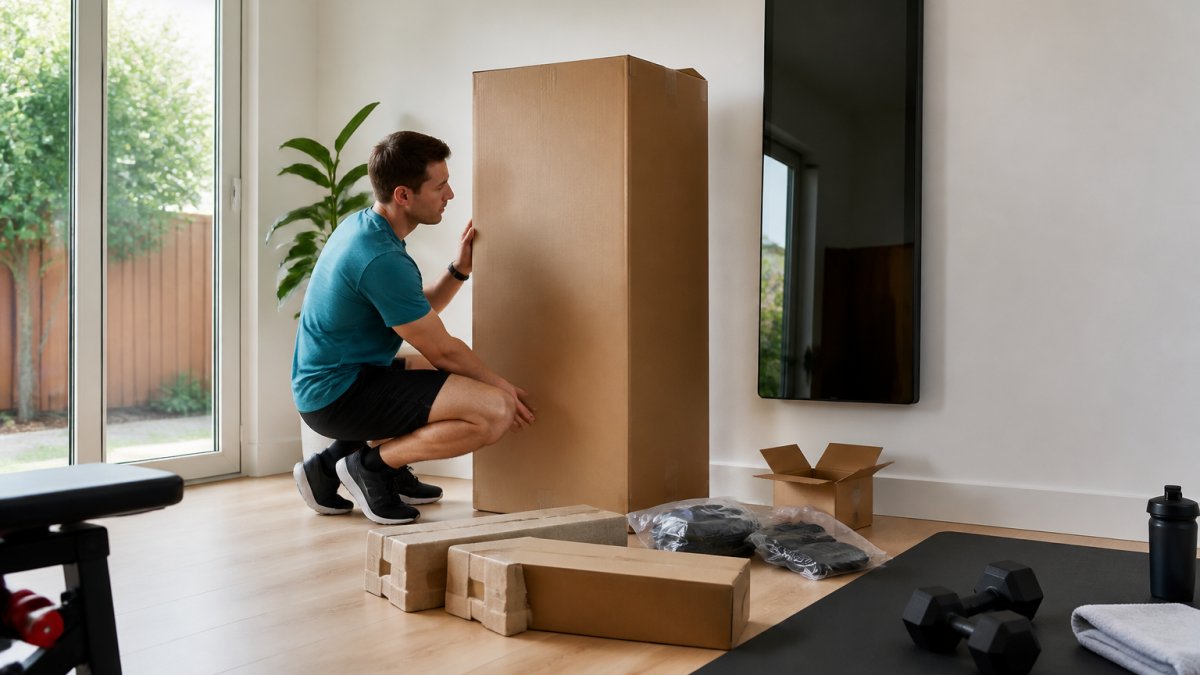
Setup involves mounting the unit level, connecting it to Wi-Fi, and pairing the app. Expect to spend an afternoon on installation and account setup. Accessories such as a mat, a set of dumbbells, and resistance bands round out the space and are worth budgeting alongside the mirror.
Privacy, Data, and Product Longevity: What Buyers Overlook
A camera and microphone in your bedroom deserve a second look, and this is the area most buying guides skip entirely. Smart fitness mirrors typically use a combination of an RGB camera, a depth sensor, and sometimes a microphone array to track movement, count repetitions, and accept voice commands. Understanding what each sensor does, and what it sends off the device, is the difference between a tool you trust and one you resent.
What may be collected. Common categories include workout history (classes completed, duration, estimated calories), motion data used for rep counting and form feedback, account and profile details, and, on units with voice control, short audio clips or transcripts. Some brands process motion data on-device and transmit only summary metrics; others send richer data to cloud servers for analysis. The distinction matters because it determines what a breach or a policy change could expose.
Settings to check before you buy. Look for a physical camera shutter or a software toggle that fully disables the camera, a microphone mute that is hardware-level rather than app-level, the ability to delete your account and associated data, a clear retention window, and whether the brand sells or shares data with advertisers. If the spec sheet does not answer these, the support documentation usually will.
Software support and longevity. A mirror is only as good as the app behind it. Ask how long the brand has supported older models, how frequently firmware and app updates ship, and what the published end-of-support policy looks like. Connectivity is the other half: the mirror depends on Wi-Fi and on the servers behind the workout library, so a discontinued product or a shuttered service can turn the hardware into a reflective panel. Check the warranty length and what it covers, display, sensors, and mounting hardware are often treated differently.
Household suitability. If two or more people share the mirror, confirm the subscription supports multiple profiles and that the display and camera adjust for different heights. For households with children, check whether profiles can be locked or restricted and whether the camera can be disabled during non-workout hours. For renters, confirm the mounting method will not forfeit a security deposit, freestanding models avoid the issue but consume floor space.
Accessibility. Consider reach and mobility: a wall-mounted unit at standing eye level may not suit a seated or wheelchair-based workout, and voice control may be the only practical input for some users. Check whether the class library includes seated, low-impact, or adaptive programming before assuming the mirror fits every body in the house.
Buy or Skip: A Decision Framework for Home Training
Use this framework to decide in five minutes:
- Do you train at home at least three times a week?
- Do you have clear floor space and a wall you can mount to?
- Will you use instructor-led classes rather than training solo?
- Can you absorb the membership fee for at least two years?
- Have you checked the camera and data controls?
Four or more checks: a mirror is worth buying. Two or fewer: start with a workout app and revisit in six months.
Frequently Asked Questions
Is a smart fitness mirror worth buying for home workouts?
It depends on how you train. A smart fitness mirror makes sense if you want instructor-led classes, form guidance, and a compact setup that fits a small room. It makes less sense if you already follow a workout app consistently, prefer lifting heavy with your own program, or want to avoid a recurring membership fee. Match the mirror to your habits, not the other way around.
Do smart fitness mirrors require a monthly subscription?
Most do. The hardware alone usually gives you limited or no classes, so the workout library, live classes, and progress tracking sit behind a subscription. Budget the membership fee alongside the upfront cost before you buy, because a mirror without an active subscription often becomes an expensive wall mirror.
How much space do you need for a workout mirror?
Plan for the mirror plus enough floor space to move. You need roughly 6 to 8 feet of clearance in front of the mirror for strength training, yoga, or boxing, and wall-mounted units need a stud or proper anchor. Measure your room before buying: a mirror that fits the wall but leaves no room to move defeats the purpose.
Can a smart fitness mirror replace a personal trainer?
For general fitness, guided classes, and form reminders, a smart mirror covers a lot of ground at a fraction of the cost of one-on-one sessions. It cannot replicate a trainer who adjusts your program week to week, spots you under heavy load, or catches subtle movement faults. Treat it as a strong supplement, not a full replacement, especially if you have injury history.
The real challenge with home training is not the equipment, it is staying consistent long enough to see results. At Bodyhackfitness, we help you build a complete training environment with carefully curated gym products and digital fitness programs, including recovery tools that support you between sessions and a customer-focused shopping experience for both training and recovery gear. Shop now with Bodyhackfitness and build the home setup that keeps you training.