


Last Updated: November 4, 2026
Quick Summary
To track progressive overload dumbbells, log six fields for every set: exercise name, weight per dumbbell, reps, sets, rest time, and an effort rating from 1 to 10. Then use double progression: add reps until you hit the top of your rep range, then add weight and reset to the bottom.
- Record six fields per set: exercise, weight per dumbbell, reps, sets, rest, and effort from 1 to 10.
- Add weight only after two consecutive sessions at the top of your rep range with effort of 8 or lower.
- When the next dumbbell is too big a jump, extend the rep range, add a set, or slow the tempo.
- Take a deload week cutting volume by roughly 40 to 50 percent when a lift stalls three or more sessions.
- Judge progress on a rolling average of session volume across three to four weeks, not one workout.
Table of Contents
- What to Record in Every Dumbbell Session
- Progressive Overload Examples for Home Workouts
- How to Increase Intensity With Fixed Dumbbells
- Rules for When to Add Weight or Reps
- Best Apps for Tracking Strength Training
- Building a Progressive Overload Tracker in Excel
- Telling Real Progress Apart From a Bad Day
- Stock Your Home Rack and Start Logging
- Frequently Asked Questions
What to Record in Every Dumbbell Session
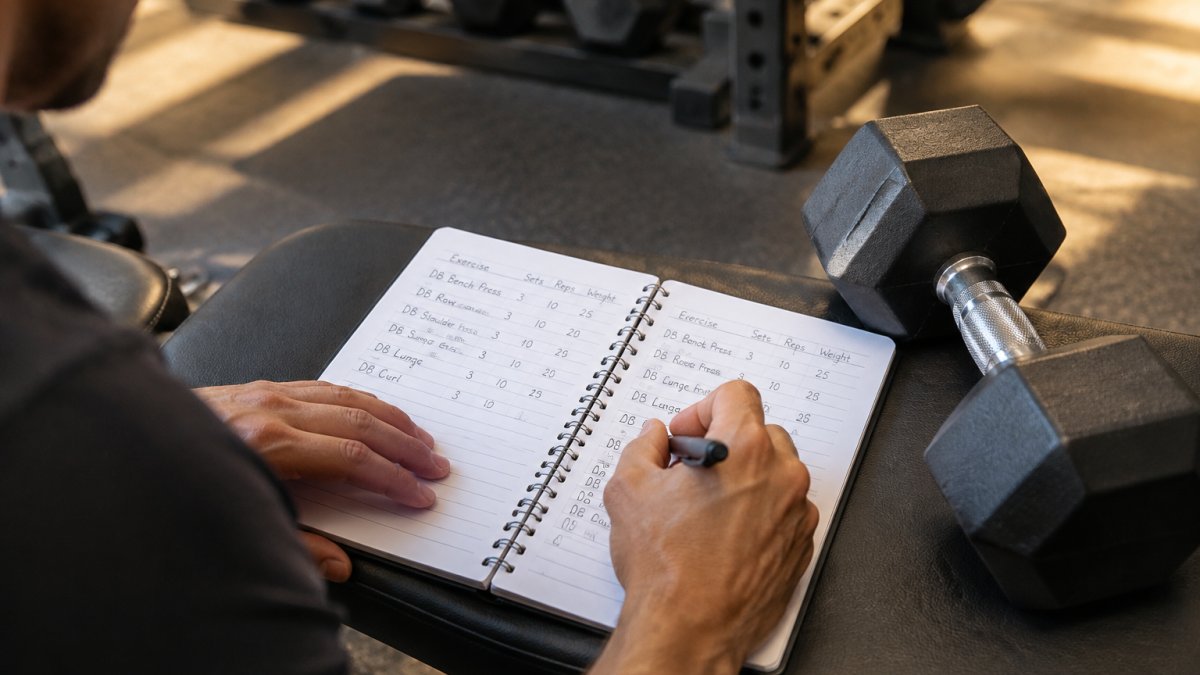
Learning how to track progressive overload dumbbells starts with one habit: writing down what you actually lifted. Progressive overload is the practice of gradually asking your muscles to do more work over time, and you cannot manage what you never measure.
The National Center for Biotechnology Information review on resistance training principles confirms that overload is a core driver of strength gains, and it can come from load or from other volume-based variables.
The Six Columns That Matter
Record these six fields for every set. Nothing else is required.
- Exercise name (be specific: "incline dumbbell press," not "chest")
- Weight per dumbbell in pounds
- Reps completed on each set
- Sets completed
- Rest time between sets
- Effort rating from 1 to 10
Progressive Overload Examples for Home Workouts
A real progression beats a vague plan. The table below shows a double-progression cycle for a dumbbell bench press using a rep range of 8 to 12, then the same logic applied to three other common home movements so you can see how the rule flexes by exercise.
| Week | Weight per dumbbell | Sets x Reps | What Changes |
|---|---|---|---|
| 1 | 20 lb | 3 x 8 | Baseline week, log everything |
| 2 | 20 lb | 3 x 9 | Add one rep per set |
| 3 | 20 lb | 3 x 10 | Add one rep per set |
| 4 | 20 lb | 3 x 12 | Top of rep range reached |
| 5 | 25 lb | 3 x 8 | Add weight, drop back to 8 reps |
That is double progression, the simplest form of progressive overload dumbbells allow: earn reps first, then add load. Dupont Fitness guidance on tracking progressive overload recommends exactly this approach for dumbbells, because it keeps progress measurable when weight jumps are large.
Exercise-Specific Progression Examples
The same rule does not produce the same week-by-week numbers on every lift. Small muscles and single-joint movements usually need smaller jumps and longer rep ranges; big compound lifts tolerate larger jumps and shorter ranges.
One-arm dumbbell row (rep range 8-12, per side)
| Week | Weight | Sets x Reps per side | What Changes |
|---|---|---|---|
| 1 | 30 lb | 3 x 8 | Baseline |
| 2 | 30 lb | 3 x 10 | Add two reps per set |
| 3 | 30 lb | 3 x 12 | Top of range |
| 4 | 35 lb | 3 x 8 | Add weight, reset reps |
Goblet squat (rep range 10-15)
| Week | Weight | Sets x Reps | What Changes |
|---|---|---|---|
| 1 | 35 lb | 3 x 10 | Baseline |
| 2 | 35 lb | 3 x 12 | Add two reps per set |
| 3 | 35 lb | 3 x 15 | Top of range |
| 4 | 40 lb | 3 x 10 | Add weight, reset reps |
Dumbbell lateral raise (rep range 12-20)
| Week | Weight | Sets x Reps | What Changes |
|---|---|---|---|
| 1 | 8 lb | 3 x 12 | Baseline |
| 2 | 8 lb | 3 x 15 | Add three reps per set |
| 3 | 8 lb | 3 x 18 | Add three reps per set |
| 4 | 8 lb | 3 x 20 | Top of range |
| 5 | 10 lb | 3 x 12 | Add weight, reset reps |
Notice the pattern: the smaller the muscle and the lighter the load, the wider the rep range and the more reps you bank before adding weight.
When the Next Dumbbell Is Too Big a Jump
Home racks often skip from 20 lb to 25 lb, or from 25 lb to 30 lb, which is a 20-25% load increase, far more than most lifters can absorb in one step. When that happens, do not force the jump. Use one of these options instead, in this order of preference:
- Extend the rep range. Instead of 8-12, work 8-15 on that exercise before adding weight. More reps at the same load is still overload.
- Add a set. Going from 3 x 12 to 4 x 12 raises weekly volume without touching the weight.
- Slow the tempo. A 3-second lowering phase on every rep makes the same dumbbell meaningfully harder.
- Add a pause. Two seconds at the bottom of a press or the top of a row removes the stretch reflex and increases difficulty.
- Switch to a unilateral version. Two-arm pressing 20 lb per hand becomes one-arm pressing 20 lb with one hand, the same load on half the working muscle.
- Microload with add-on weights. If your dumbbells accept magnetic or strap-on plates, a 1.25 lb or 2.5 lb increment closes the gap between fixed pairs.
A common pattern among home lifters is to spend two to four weeks on options 1-3 before the next dumbbell feels manageable. That is not a stall; it is the progression working as intended.
If you want a full weekly structure to hang this on, see our guide to structuring a full body strength workout.
How to Increase Intensity With Fixed Dumbbells
Fixed dumbbells stop at the weight you own, but intensity has more than one dial.
- Slow the tempo. A 3-second lowering phase adds time under tension without adding pounds.
- Add a pause. Two seconds at the bottom of a press makes the same weight harder.
- Add a set. One extra set per exercise raises weekly volume.
GymAware's 2026 guidance on training load cautions against blindly following a fixed percentage rule, since bodies respond differently week to week.
Watch out: adding tempo work and extra sets in the same week often leaves you too sore to train again on schedule. Change one variable at a time.
Rules for When to Add Weight or Reps
Use a simple decision rule so you never guess. The rule below assumes you have picked a target rep range for each exercise (for example, 8-12 for presses and rows, 10-15 for squats and lunges, 12-20 for lateral raises and curls) and that you are rating effort on a 1-10 scale where 10 means you could not complete another rep with good form.
The Four Decisions
Add reps when you complete every set at the top of your rep range with an effort rating of 8 or lower on the last set. Add one rep per set next session.
Add weight when you complete every set at the top of your rep range for two consecutive sessions with an effort rating of 8 or lower on the last set. Increase load by the smallest available increment and drop back to the bottom of the rep range.
Hold steady when your effort rating reaches 9 or 10 before your final set, or when form starts to break down on the last rep. Repeat the same weight and reps next session before deciding anything.
Drop back when you miss reps on two sessions in a row at the same load, or when form breaks down before you hit the bottom of your rep range. Reduce load by one increment and rebuild.
Premium 20LB Rubber Coated Cast Iron Dumbbell with Ergonomic Chrome Handle →
Why Two Sessions, Not One
A single good session can be a fluke, extra sleep, a good meal, cooler room, better music. Requiring two consecutive sessions at the top of the range filters out one-off performance spikes and prevents you from adding weight on a day that flattered you. It also gives you a built-in buffer: if the first session at the top of the range felt like an 8, the second one tells you whether that was real or a good day.
The 10% Guideline Is a Ceiling, Not a Target
Treat a small percentage increase as a ceiling, not a target. A 5 lb jump on a 20 lb dumbbell press is 25%, too much for most lifters in one step, which is why the rep-range buffer and the microloading options above matter. On a 50 lb row, a 5 lb jump is 10% and usually fine. The smaller the muscle and the lighter the load, the smaller the jump should be.
Telling Real Progress From a Bad Day
One rough session is noise, not a trend. Real progress shows up as a pattern across three to four weeks: more reps at the same weight, cleaner form, or shorter rest for the same output. Judge progress on a rolling average of your session volume (weight x total reps), not on a single workout. Sleep, stress, food, and rest periods move daily performance more than most lifters expect, so before you change a program, check whether the last two sessions were outliers.
Plateaus, Deloads, and Recovery
When a lift stalls for three or more sessions despite good sleep and food, do not keep grinding at the same load.
Watch out: adding reps, adding sets, and adding weight in the same week usually leaves you too sore to train again on schedule, which breaks the log and the progression. Change one variable at a time and give it at least two sessions before judging it.
Best Apps for Tracking Strength Training
An app helps only if you actually open it mid-set. The best options are fast to log and show last session's numbers at a glance.
Alpha Progression's 2026 review of progressive overload apps notes that specialized apps rank well for overload tracking, but any standard workout tracker can apply the principle manually by logging load, sets, and reps.
What matters most:
- One-tap logging of weight and reps
- Last-session history shown per exercise
- Simple charts of volume over time
A notes app on your phone does the same job for free. The tool is not the system; the habit is.
Building a Progressive Overload Tracker in Excel
A spreadsheet gives you full control and costs almost nothing. You can build your own tracker in a few minutes.
Set up these columns across the top row:
- Date
- Exercise
- Weight
- Set 1 reps
- Set 2 reps
- Set 3 reps
- Effort (1-10)
- Notes
Then add two formulas: one that multiplies weight by total reps for session volume, and one that pulls the previous entry for the same exercise so you see what to beat. Sort by exercise, and your history stacks up automatically.
Telling Real Progress Apart From a Bad Day
One rough session is noise, not a trend.
Judge progress on a rolling average, not a single workout. If your volume trend line rises over a month, you are progressing even when one session feels heavy.
Review your log periodically to spot plateaus before they stall you for months. When a lift stalls, check recovery first, then change one variable.
Stock Your Home Rack and Start Logging
The system only works if your rack supports steady jumps. Fill them with pairs that match your plan: our 8 lb rubber coated dumbbells cover warm-ups and small increments, and the 20 lb rubber coated cast iron dumbbell handles your main pressing work with a secure, non-slip chrome handle.


Once the weights pile up, a commercial-grade steel dumbbell rack keeps them organized and off the floor. And if you are still working with fixed pairs that have hit a ceiling, an adjustable set with a secure double-locking weight system lets you keep adding load in smaller steps.
Frequently Asked Questions
How do I do progressive overload with dumbbells?
Pick one variable to push each session and log it. Most lifters use double progression: choose a rep range such as 8 to 12, add reps at the same dumbbell weight until you hit the top of the range on every set, then move up in weight and drop back to the bottom. Write down the load, reps, and sets for every exercise so the next session has a target. A 2022 NCBI review confirms load is only one route; adding sets, slowing tempo, or extending range of motion also counts.
What is the best way to track progressive overload?
The best method is the one you will actually fill in after every set. A paper training log, a notes app, a dedicated workout app, or a spreadsheet all work. Record the exercise, dumbbell weight, reps per set, and a short note on how it felt. Review the log periodically to spot plateaus. Consistency of recording matters more than which tool you choose.
How do I apply progressive overload when I only have a fixed set of dumbbells?
Change the other variables. Add a rep per set, add a set, slow the lowering phase to three or four seconds, add a two-second pause at the bottom, switch to a unilateral version, or extend range of motion with a deficit. Any of these raises the demand without a heavier dumbbell. Log the change so you can repeat it and confirm the overload is real rather than accidental.
How many reps should I add before increasing dumbbell weight?
Work within a set rep range, typically 8 to 12 for most dumbbell movements. When you can complete the top of the range on all planned sets with clean form, increase the weight and reset to the bottom of the range. Keep weekly load increases modest, which matters when dumbbell jumps are large. If the next dumbbell is too big a step, stay at the current weight and add reps or sets instead.
Your first log entry is the hardest one. Write down today's weights, reps, and effort, then beat one number next week. Shop the Bodyhackfitnesss dumbbell range and build the rack that keeps your progression moving.
