


Quick Summary
A sustainable home exercise schedule starts with an honest look at your current fitness level, then sets small, specific goals you can hit even on busy weeks. Begin with 2 to 3 sessions of 20 minutes each and add one variable at a time, such as frequency or duration.
- Public health guidance commonly recommends 150 minutes of moderate-intensity activity per week for adults.
- Set goals with three parts: the activity, how often, and how long per session.
- Progress by changing only one variable per week: add a session, add five minutes, or add resistance.
- Stop a set when form breaks, not when the rep count is reached.
- Every beginner movement has an equipment-free version, so missing gear is never a reason to skip.
Table of Contents
- Assess Your Current Fitness Level Before You Plan
- Set Realistic Goals for Your Home Exercise Schedule
- Weekly Workout Schedule for Beginners: Start Slowly and Progress
- Home Workout Schedule Template You Can Copy
- Short Home Workouts That Fit a Busy Day
- How to Stay Consistent With Exercise Using Habit Stacking
- Your First Week: Booking Your Home Workout Sessions
- Frequently Asked Questions
Assess Your Current Fitness Level Before You Plan
Last Updated: November 9, 2026
A sustainable home exercise schedule starts with an honest look at where you are right now. Public health guidance commonly recommends 150 minutes of moderate-intensity physical activity per week for adults (the CDC). That is the target, but it is not where most people start.
Before you pick a number of sessions, check a few basics:
- How many days a week did you move last month?
- Can you climb two flights of stairs without stopping?
- Which movements feel easy, and which feel hard?
- Do you have any injuries or joint pain to work around?
If any of those answers surprise you, that is useful. Your starting point decides how hard your first weeks should be.
Watch out: If you have a medical condition, recent injury or have been inactive for a long time, talk with a doctor before you start a new routine.
Set Realistic Goals for Your Home Exercise Schedule
Goals keep a schedule alive. Vague goals like "get fit" fade fast. Specific goals stick.
A good home exercise goal has three parts:
- What: the activity (strength, walking, mobility)
- How often: days per week
- How long: minutes per session
A first goal might look like this: "Work out 3 times a week for the next 4 weeks."
Keep the first goal small enough that you can hit it even on a busy week.
Weekly Workout Schedule for Beginners: Start Slowly and Progress
Beginners do best with a simple plan that adds effort slowly. Trying too much in week one is the most common reason people quit. The 150-minutes-per-week target is a destination, not a starting line.
Here is a sample starting pattern that adds one variable at a time, first frequency, then duration:
- Week 1-2: 2-3 sessions of 20 minutes each
- Week 3-4: 3 sessions of 25-30 minutes each
- Week 5-6: 4 sessions of 30 minutes each
Progress by changing only one variable per week: add a session, add five minutes, or add a small amount of resistance. Changing all three at once is what causes the soreness-and-skip cycle that ends most home routines.
Each session can include a full-body strength circuit. The dumbbell exercises for a full-body routine cover squats, rows, presses and carries, which work most major muscle groups in one session.
Form and Technique Basics for Home Workouts
Without a trainer watching, form is the variable most likely to cause joint pain and derail a schedule. Three cues cover most home strength movements:
- Squat: feet about shoulder-width, knees track over the toes, chest up. Sit back as if reaching for a chair behind you.
- Push-up: hands slightly wider than shoulders, body in one line from head to heels. Drop to your knees before your hips sag.
- Row: pull with your elbows, not your hands, and squeeze your shoulder blades together at the top.
Stop a set when form breaks, not when the rep count is reached. Two clean sets beat three sloppy ones, and clean reps are what keep you injury-free enough to stay consistent.
Choosing Enjoyable Activities and a Balanced Routine
You are more likely to keep going if you enjoy the work. Mix strength training with something you like, such as walking, dancing or cycling. A mini pedal stepper can add a low-impact cardio option to your week.
Aim for a balance:
- 2 days of strength training
- 1-2 days of cardio
- 1 day of mobility or stretching
Adjust the mix to fit your goals and how your body feels.
Equipment-Free Modifications for a Sustainable Home Routine
A schedule that depends on gear you do not own is not sustainable. Every movement in the beginner plan has a no-gear version, so a missed delivery or a small apartment never becomes a reason to skip:
- Squat: bodyweight squat, or sit-to-stand from a chair for a gentler range.
- Row: towel row around a door handle, or a bent-over row with a filled water jug.
- Press: wall push-up or incline push-up on a counter.
- Carry: walk a loaded laundry basket from room to room.
- Cardio: march in place, walk stairs, or do step-ups on a bottom stair.
Keep a resistance band set by the couch so you can add a few band rows or presses when you have a few extra minutes. The Thick Folding Fitness Yoga Mat also works well as a dedicated floor space for short sessions.

Home Workout Schedule Template You Can Copy
Copy this simple weekly template and fill in your own times:
| Day | Session | Duration | Focus |
|---|---|---|---|
| Monday | Strength | 30 min | Full body |
| Tuesday | Cardio | 25 min | Walking or stepper |
| Wednesday | Rest | - | Recovery |
| Thursday | Strength | 30 min | Full body |
| Friday | Mobility | 20 min | Stretching |
| Saturday | Cardio | 30 min | Your choice |
| Sunday | Rest | - | Recovery |
Duration
Write the schedule where you will see it every day, such as on the fridge or in your phone's calendar. Tick each session off when it is done.
Short Home Workouts That Fit a Busy Day
Some days you only have 15 minutes. A short workout still counts.
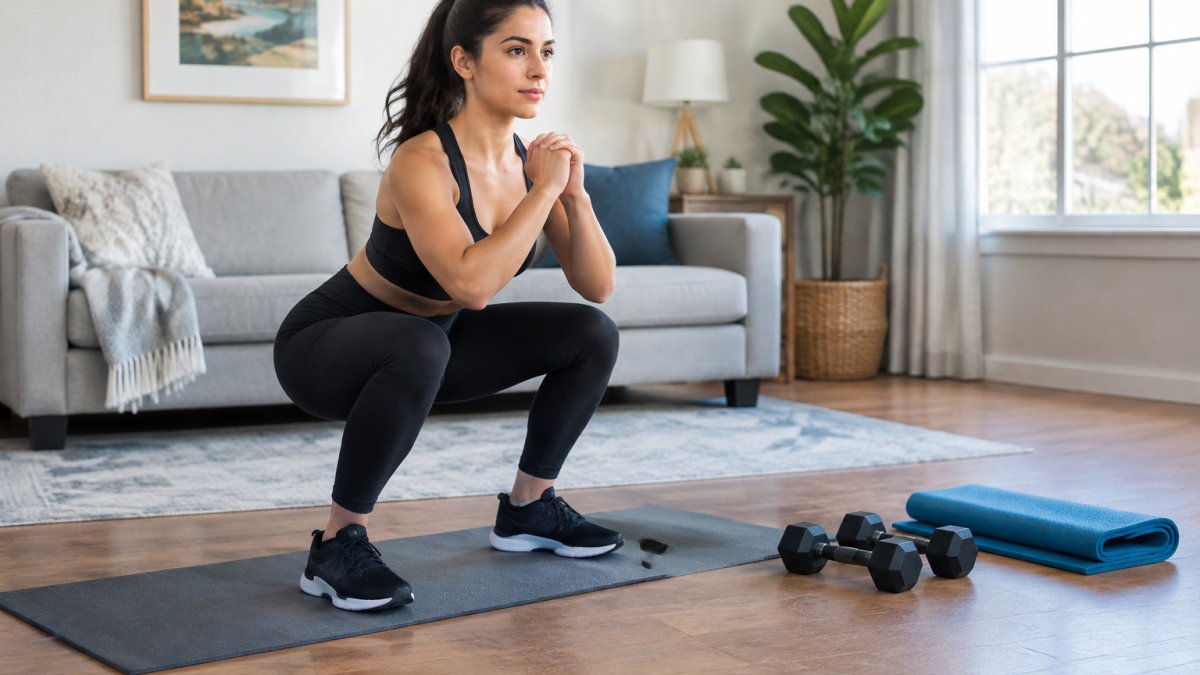
An adult doing bodyweight squats on a yoga mat in a bright living room, with a folded blue mat and rubber-coated dumbbells nearby. The man is American.
Try this quick routine:
- 10 bodyweight squats
- 10 push-ups (on knees if needed)
- 30 seconds of marching in place
- Repeat 3 times
Keep a resistance band set by the couch so you can add a few band rows or presses when you have a few extra minutes. The Thick Folding Fitness Yoga Mat also works well as a dedicated floor space for short sessions.
How to Stay Consistent With Exercise Using Habit Stacking
Habit stacking works because it borrows the trigger from a behavior you already do without thinking. The habit loop is a useful model here: a cue fires, you perform a routine, and a reward reinforces the loop. Most home exercise plans fail at the cue stage, not the motivation stage.
A stackable cue has three traits: it happens at the same time most days, it takes less than a minute, and it ends in a clear physical spot. Good cues include starting the coffee maker, brushing your teeth, letting the dog out, or closing your laptop at the end of the workday. Weak cues include "when I feel motivated" or "after lunch," which drift by 30 to 90 minutes depending on the day.
Build the stack in four steps:
- Pick one anchor habit that already happens daily at a stable time.
- Attach a tiny version of the workout immediately after it, two minutes, not twenty. The first goal is repetition, not intensity.
- Make the reward immediate and small. A tally mark on a wall calendar, a check in your phone notes, or a single song you only play during the session. Delayed rewards like "better health in six months" do not reinforce a loop.
- Keep the cue visible. Lay your mat and resistance band where the anchor habit happens, so the environment does the reminding.
A common pattern is that the stack holds for two to three weeks and then breaks during a schedule disruption, a work trip, a sick child, a holiday week. Plan for the break before it happens. Choose a "minimum viable" version of the session (five minutes of mobility or a short walk) that still counts, so the loop survives the disruption instead of resetting.
Watch out: If you stack the workout onto a cue that already has a competing routine, scrolling your phone with coffee, for example, the stronger habit usually wins.
Managing Exercise Burnout and Mental Fatigue
Sustainability is as much mental as physical. The most common burnout pattern in home routines is not overtraining; it is monotony plus pressure. Doing the same circuit four days a week with a strict streak rule creates a fragile plan that collapses the first time life gets busy.
Three adjustments keep the mental load low:
- Cap the decision count. Decide your week's sessions once, on Sunday, rather than each morning. Fewer daily decisions means less fatigue.
- Rotate the format, not the goal. Keep the same weekly target but swap the activity, strength circuit one day, walk or mini pedal stepper the next, mobility the third. Novelty reduces boredom without changing the plan.
- Use a "never miss twice" rule instead of a streak. One missed session is data; two in a row is a pattern. The rule gives you permission to miss once without abandoning the schedule.
If you notice dread before sessions for more than a week, cut the session length in half for two weeks rather than quitting.
Scheduling Rest Days and Recovering From Missed Workouts
Rest days are part of the plan. Muscles adapt between sessions, so schedule at least two off days per week, and avoid stacking two hard strength days back to back when you are new.
Missed a workout? Do not try to make it up with a double session. Return to your normal schedule the next day. One missed session is not a failure; missing several in a row is the real risk, so get back on track quickly. If you travel often, these tips for keeping fitness habits while traveling can help you plan around disruptions.
Your First Week: Booking Your Home Workout Sessions
Start your first week with a calendar check. Block out your sessions just as you would a work meeting.
- Pick your three or four workout days.
- Set a fixed start time for each one.
- Add a reminder 10 minutes before each session.
- Lay out your gear the night before.
- Log each session after you finish.
By the end of week one, you will have a working routine. Adjust it as you learn what fits your life.
If you want help choosing equipment for your plan, the Bodyhackfitness shop carries rubber-coated dumbbells and a 5-piece latex resistance band set at $49.50 and $73.99. Shop now and build the home setup that fits your schedule.

Frequently Asked Questions
How do I create a sustainable home exercise schedule?
Start with two or three sessions a week, not six. Pick fixed days and times, keep each workout under 30 minutes at first, and log what you finish. Public health guidance commonly recommends 150 minutes of moderate activity per week for adults, so build toward that total gradually. Add a session only after the current one feels routine for at least three weeks. Equipment such as a folding yoga mat or a set of resistance bands is enough to start.
How many days a week should I work out at home?
Most adults do well with three to five days of exercise per week. Public health guidance commonly calls for 150 minutes of moderate-intensity activity each week, and you can spread that across the week in any combination. Beginners should begin with three shorter sessions and leave at least one full rest day between harder workouts. Adding a day only once the current routine feels easy keeps the schedule sustainable.
How long should a home workout be for beginners?
A beginner home workout of 20 to 30 minutes is usually enough to build the habit without causing burnout. Include a five-minute warm-up, two or three strength exercises such as squats, push-ups and band rows, and a short cooldown. As the sessions get easier, add repetitions or a few minutes at a time. Short, consistent workouts tend to outlast long, occasional ones.
How do I stay consistent with exercise at home?
Tie your workout to a habit you already do, such as making coffee or finishing your first work email, so the cue is automatic. Put the session on your calendar, keep your mat or dumbbells visible, and track each completed workout. If you miss a day, resume at the next scheduled session instead of trying to make up the lost time. Consistency comes from a routine you can repeat, not from motivation alone.
