

Table of Contents
- Peloton vs Tonal for Home: Key Differences at a Glance
- Peloton Guide vs Tonal: Which Coaching Style Fits You?
- Home Strength Training Equipment Cost: Breaking Down the Real Numbers
- Space-Saving Home Gym Solutions: Footprint and Installation
- Programming and Class Variety: Cardio vs. Strength
- Durability, Maintenance, and Resale Value
- Wearable Integration and Injury Prevention
- Conclusion
- Frequently Asked Questions
Last Updated: September 27, 2026
Peloton vs Tonal for Home: Key Differences at a Glance
The Peloton vs Tonal decision comes down to one question: do you want cardio or strength? Peloton builds its ecosystem around indoor cycling and running, while Tonal is a wall-mounted digital resistance trainer built for strength training. This guide from Bodyhackfitnesss breaks down cost, footprint, programming, and long-term ownership so you can match the machine to your actual fitness goals.
Here's the short version. If you already ride or run and want instructor-led classes that keep you consistent, Peloton wins. If you want muscle hypertrophy and progressive overload without a rack of dumbbells, Tonal is the stronger pick. Both carry a subscription model, and both take up real space in a home gym setup.
American Council on Exercise guidance on home fitness equipment
Quick Comparison Table
| Factor | Peloton | Tonal |
|---|---|---|
| Primary focus | Cardiovascular endurance | Strength training |
| Form factor | Freestanding bike or treadmill | Wall-mounted unit |
| Training style | Instructor-led live and on-demand | Digital resistance with AI coaching |
| Subscription | Required monthly fee | Required monthly fee |
| Best for | Riders and runners | Lifters with limited space |
Peloton Guide vs Tonal: Which Coaching Style Fits You?
Peloton Guide vs Tonal is really a contrast between two coaching philosophies. The Peloton Guide is a camera-based strength accessory that watches your form and tracks reps while you work with your own weights. Tonal replaces the weights entirely with digital resistance and adjusts load for you between sets.
The Peloton Guide suits people who already own dumbbells and want feedback on form correction. Tonal suits people who want the machine to set the resistance so they can focus on output. One teaches you to lift; the other lifts with you.
What most guides miss is that neither replaces a human eye. If you're new to lifting and worried about injury, start with lighter loads and prioritize form over volume.
Home Strength Training Equipment Cost: Breaking Down the Real Numbers
Home strength training equipment cost is where the Peloton vs Tonal comparison gets uncomfortable. Both systems pair hardware with a required subscription, and the subscription is the part buyers underestimate. You are not buying a machine. You are buying a monthly membership that happens to include a machine.
Upfront Hardware and Subscription Fees
The hardware price is the visible cost. The subscription is the recurring one, and it never stops while you own the system. Budget for both before you commit.
- Hardware: a one-time payment that varies by model and bundle. Expect the wall-mounted digital resistance trainer to sit at the top of the range because it replaces an entire rack of weights, while the freestanding bike sits lower because it replaces one cardio machine.
- Subscription: billed monthly, required for classes and programming. Neither brand sells a fully functional machine without it, the hardware is a delivery vehicle for the membership.
- Accessories: mats, weights, heart rate straps, and shoes add up fast. A chest strap, a lifting mat, and a set of adjustable dumbbells for the camera-based strength accessory can quietly add several hundred dollars.
- Delivery and setup: some units need professional installation, especially wall-mounted ones. Freestanding bikes usually ship in one box and assemble in about an hour with basic tools.
Total Cost of Ownership Over Three Years
Total cost of ownership means hardware plus three years of subscription plus accessories and any repairs. Run that math before you buy, because the monthly fee often exceeds the hardware price over a full ownership cycle.
Here is the mechanism most buyers miss: the subscription is priced per month, but the commitment is effectively per ownership year. Three years of membership on either platform typically lands in the same ballpark as the hardware itself. Add accessories and a single out-of-warranty repair, and the true three-year figure can approach double the sticker price you saw at checkout.
A practical way to model it:
- Write down the hardware price for the exact bundle you want.
- Multiply the monthly subscription by 36.
- Add accessories you do not already own.
- Add a repair buffer for one service call or replacement part.
- Compare that total against what you would spend on a gym membership over the same period.
If the number still works, the machine is a good fit.
The Resale Offset Nobody Prices In
Most cost breakdowns stop at the three-year total and ignore what the equipment is worth when you sell it. That is the gap worth claiming here. A freestanding bike holds resale value better than a wall-mounted trainer for one structural reason: it can be unplugged, rolled out, and hauled away by a single buyer with a car. A wall-mounted unit has to be uninstalled, patched, and re-anchored at the next location, which shrinks the pool of willing buyers and pushes the resale price down.
A No-Subscription Baseline for Comparison
For a budget-friendly alternative, Bodyhackfitnesss carries a Spinning Home Exercise Fitness Equipment at $675.58 with adjustable resistance, an ergonomic seat, and multi-position handlebars. Pair it with a Cycling Desk at $89.18 and you have a connected fitness setup with no monthly fee at all. Run the same three-year math on that pairing and the subscription line item drops to zero, which is the single biggest lever in the entire cost comparison.
Spinning Home Exercise Fitness Equipment →


Space-Saving Home Gym Solutions: Footprint and Installation
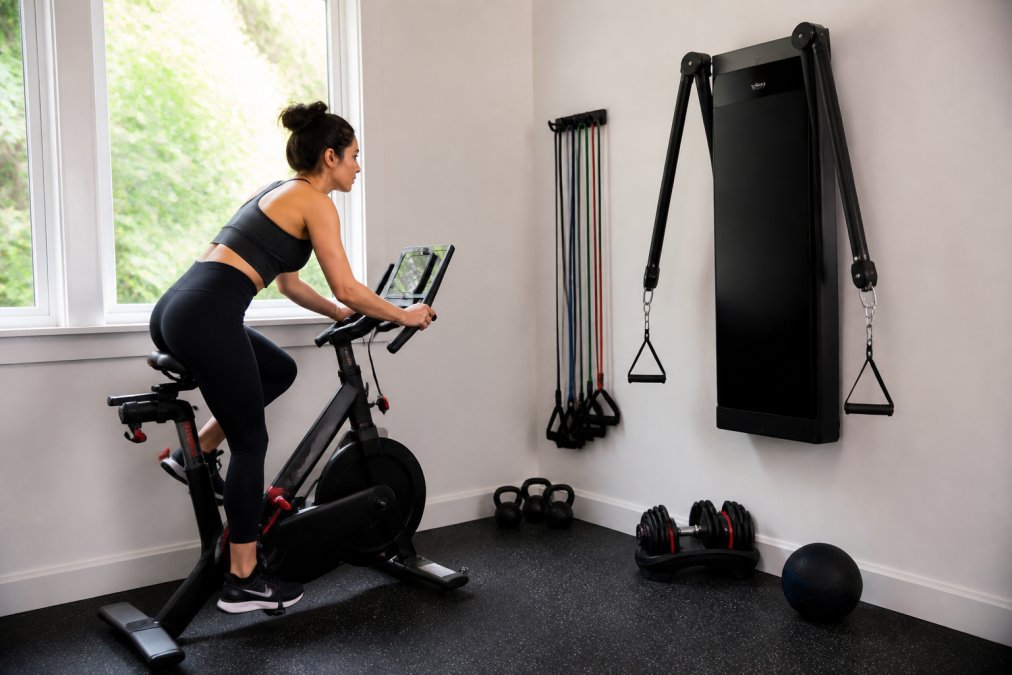
Space-saving home gym solutions matter more than spec sheets suggest. Tonal mounts to a wall and needs structural anchoring plus clearance to extend its arms, so it demands a dedicated wall and roughly the floor space of a small closet. Peloton's bike takes a modest floor footprint but stands free, so you can move it.
Programming and Class Variety: Cardio vs. Strength
Programming splits cleanly along the cardio-versus-strength line. Peloton's library leans on live and on-demand cycling, running, and HIIT classes led by instructors who pace you through the session. Tonal's library is built around strength blocks, progressive overload, and AI-adjusted resistance.
Durability, Maintenance, and Resale Value
Durability and resale value are the two factors competitors gloss over. Steel frames and magnetic resistance systems generally hold up well with basic care, while wall-mounted units with moving arms have more parts that can wear. The difference is not build quality, it is the number of proprietary components and how hard they are to replace.
Maintenance and Repair Logistics
Maintenance and repair logistics differ sharply, and this is where the ownership experience diverges most.
Secondary Market and Resale Value
Secondary market demand favors equipment that is easy to move and does not require uninstalling from a wall. Freestanding bikes and folding models resell more readily because a buyer can haul them away in a car.
What This Means for Your Decision
If you want maximum longevity with minimum dependence on a manufacturer, freestanding equipment wins on both maintenance and resale. If you want the training capability that only a wall-mounted digital resistance system provides, accept that you are also buying into its service network and its depreciation curve. Neither is wrong, but only one of them lets you walk away cleanly if your goals change.
Wearable Integration and Injury Prevention
Wearable integration is where the ecosystem play shows up. Both systems connect to heart rate monitors and fitness trackers so workout metrics flow into one dashboard, and both use biometric tracking to shape recommendations. Real-time feedback on heart rate helps you stay in the right zone.
Conclusion
Choosing between these two systems is really about which habit you will keep. If you want a no-subscription cardio setup you can move, fold, or store, Bodyhackfitnesss stocks compact bikes and cycling desks built for small home gyms.
Frequently Asked Questions
Why are people getting rid of their Peloton bikes?
Some users sell their Peloton bikes because they want a full-body strength workout that a stationary bike cannot provide. The Peloton vs Tonal debate often comes down to whether you want cardio or resistance training. If your fitness goals shift toward muscle hypertrophy, a cardio-only machine may sit unused. Resale value for Peloton bikes remains decent, so upgrading to a strength-focused system is often a practical option rather than a total loss.
Is Tonal better than Peloton for building muscle?
For muscle hypertrophy, Tonal offers digital resistance up to 200 lbs, which supports progressive overload without a rack of dumbbells. Peloton focuses on cardiovascular endurance through cycling and some strength classes, but it does not provide the same mechanical resistance. If building muscle is your priority, Tonal is the stronger choice. If you want heart-pumping cardio, Peloton wins.
What is the total cost of ownership for Peloton vs. Tonal?
You can reduce home strength training equipment cost by adding a budget-friendly spinning bike from Bodyhackfitness for under $700 and pairing it with a cycling desk.
How much space do I need for a Tonal versus a Peloton bike?
Tonal requires 7 feet of wall space and about 7 feet of clearance in front, plus 16-inch stud spacing for mounting. Peloton Bike needs a floor footprint of roughly 4 feet by 2 feet. For space-saving home gym solutions, a folding exercise bike or a wall-mounted system works well. If you rent or have limited wall access, a freestanding bike is the better fit.
Can you get a full-body workout with just a Peloton?
Peloton offers cycling, running, yoga, and strength classes through its app, but the bike itself only trains legs and cardiovascular endurance. For a true full-body workout, you need additional equipment like dumbbells or resistance bands. Many users pair a Peloton-style bike with a cycling desk for upper-body training while pedaling. This combination delivers a more complete fitness ecosystem at home.