


Last Updated: October 31, 2026
Quick Summary
Build strength with yoga and dumbbells by pairing yoga's mobility and core control with dumbbell loading in three weekly sessions: one full dumbbell yoga workout, one yoga-only mobility flow, and one dumbbell strength circuit. Start with 5 to 10 pound dumbbells, rest 45 to 60 seconds between sets, and add weight only when the last rep feels easy with clean form.
- A beginner dumbbell yoga workout blends five yoga poses with light dumbbells and takes about 25 minutes.
- Beginners should pick a weight that tires the muscles after 10 to 15 reps.
- Run the routine three days a week, alternating yoga-focused and dumbbell-focused sessions.
- Track one number per session, such as heaviest weight with clean form or total reps.
- Progress without heavier weights by slowing tempo, adding reps, or using resistance bands.
Table of Contents
- Why Yoga and Dumbbells Cover Each Other's Gaps
- Yoga for Strength Training: What It Actually Builds
- Your First Beginner Dumbbell Yoga Workout
- A Weekly Yoga and Strength Training Routine You Can Repeat
- How to Run a Yoga Workout With Dumbbells at Home
- Form Mistakes That Stall Progress and How to Fix Them
- How to Add Resistance Without Adding Weight
- Building Your Home Setup: Mat and Dumbbells to Start With
- Frequently Asked Questions
Why Yoga and Dumbbells Cover Each Other's Gaps
Building strength with yoga and dumbbells works because each method fixes what the other leaves out. This pairing is one of the most practical home plans for people who want to get stronger without a gym membership.
The research backs the low time cost. A study from the Harvard T.H. Chan School of Public Health found that just 30 to 60 minutes of strength training per week may be enough to see meaningful change.
Where Yoga Stops Short on Strength
Yoga builds real strength, but it plateaus. Once you can hold Chaturanga with control, holding it again and again stops challenging your muscles the same way. Without adding load, strength gains tend to stall.
Where Dumbbells Alone Leave You Stiff
Dumbbells build muscle and bone density fast. They also shorten your range of motion if that's all you do. Lifters who skip mobility work often lose hip and shoulder range over time. Yoga restores that range while keeping joints healthy. That's the gap dumbbells leave open.
Yoga for Strength Training: What It Actually Builds
Yoga for strength training builds muscle endurance, core stability, and joint control rather than maximum force. A well-structured practice loads your shoulders, hips, and trunk through bodyweight holds. That translates to better balance and everyday movement.
Here's what a consistent practice develops:
- Core strength through plank and boat holds
- Shoulder stability in weight-bearing poses
- Hip mobility for deeper squatting and lunging
What yoga won't do is add serious muscle mass on its own. For that, you need external resistance. That's where dumbbells come in.
Your First Beginner Dumbbell Yoga Workout
A beginner dumbbell yoga workout blends five yoga poses with light dumbbells for a full-body session you can finish in about 25 minutes. Start with 5 to 10 pound dumbbells. Keep the weight light enough to hold clean form through every rep, if you have to rush the last two reps, the weight is too heavy.
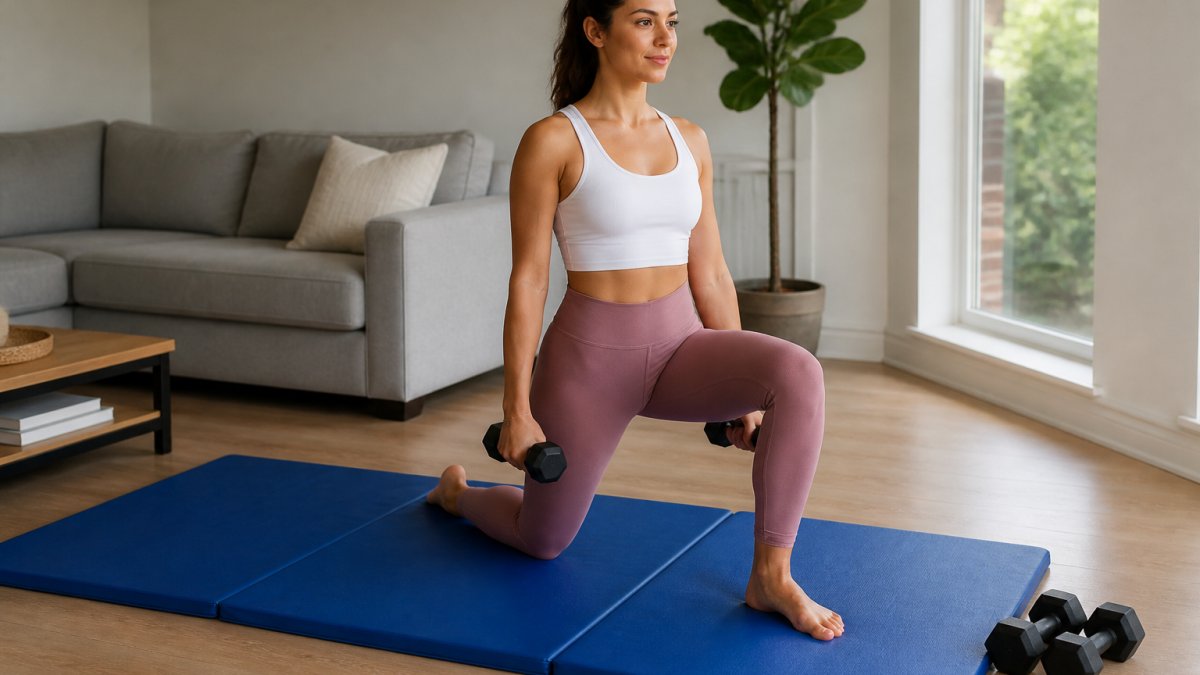
The Warm-Up, Five Poses, and Cooldown
Start with five minutes of dynamic movement: arm circles, cat-cow, and hip circles. For a fuller routine, see our dynamic warm up for hip flexors.
Then run these five poses in order. Move slowly, about two seconds down and two seconds up on every rep, and breathe out on the effort.
- Goddess squat with dumbbells, 3 sets of 10 reps. Stand with feet wide, toes turned out about 45 degrees, one dumbbell in each hand at your sides. Sit your hips down between your heels, keep your chest tall, and push your knees out over your toes. Pause for one second at the bottom.
- Warrior II to reverse warrior, hold 30 seconds per side, dumbbell in the top hand. Front knee tracks over the ankle; back leg stays straight. On the reverse, lean back gently and reach the top arm overhead, stop before your ribs flare.
- Chair pose with dumbbells at chest, 3 sets of 8 reps. Hold both dumbbells against your chest, sit back as if lowering into a chair, and keep your weight in your heels. Squeeze your glutes at the top of each rep.
- Dumbbell rows in a lunge, 3 sets of 10 per side. Step into a split stance, hinge slightly forward, and row one dumbbell toward your hip. Keep your back flat and your shoulder blade pulled down, don't shrug.
- Bridge pose with a dumbbell on hips, 3 sets of 12 reps. Lie on your back, knees bent, and rest a dumbbell across your hip crease while holding it steady with both hands. Press through your heels and lift your hips until your body forms a straight line from knees to shoulders.
Finish with a two-minute cooldown: child's pose, seated forward fold, and a supine twist. Hold each for about 30 seconds and breathe slowly.
Weights, Sets, Reps, and Rest
Beginners should pick a weight that tires the muscles after 10 to 15 reps. The Mayo Clinic strength training guidance recommends choosing resistance heavy enough to tire muscles in about 12 to 15 repetitions.
Use this simple framework:
| Goal | Weight | Sets | Reps | Rest |
|---|---|---|---|---|
| Learn form | 5 lb | 2 | 8-10 | 60 sec |
| Build strength | 8-10 lb | 3 | 10-12 | 45-60 sec |
| Build endurance | 5-8 lb | 3 | 15 | 30 sec |
Rest 45 to 60 seconds between sets. Add weight only when the last rep feels easy with clean form.
Scaling the Session for Your Level
If you're brand new to weights, run two sets instead of three for the first two weeks and keep every dumbbell at 5 pounds. If you already lift, start at 10 pounds and add a pause at the hardest point of each rep, the bottom of the goddess squat, the top of the row, before you add weight. Anyone with wrist sensitivity should use a thicker mat or a folded towel under the hands for the weight-bearing poses.
A Weekly Yoga and Strength Training Routine You Can Repeat
A repeatable yoga and strength training routine runs three days a week, alternating yoga-focused and dumbbell-focused sessions. This gives muscles time to recover while keeping mobility work frequent.
Here's a schedule that works for most beginners:
- Monday: Full dumbbell yoga workout (25 min)
- Wednesday: Yoga-only flow for mobility (20 min)
- Friday: Dumbbell strength circuit (20 min)
What Each Session Actually Contains
Monday, full dumbbell yoga workout. Run the five-pose session above exactly as written: warm-up, three sets of each pose, cooldown. This is your heaviest day of the week.
Wednesday, yoga-only mobility flow. No dumbbells. Move through cat-cow, downward dog, low lunge with a twist, warrior II, triangle, and a seated forward fold. Hold each pose for five slow breaths.
Premium Adjustable Dumbbell Set - 44lbs Cast Iron Barbell Kit for Home Gym →
Friday, dumbbell strength circuit. Three rounds of: 10 goblet squats, 10 dumbbell rows per side, 10 Romanian deadlifts, and a 30-second plank. Rest 60 seconds between rounds. This is the day that drives the strength adaptation.
A Four-Week Progression You Can Follow
Most people keep the same weights for months and wonder why nothing changes. Here is a simple week-by-week plan that adds load or volume without adding equipment.
| Week | Monday | Wednesday | Friday |
|---|---|---|---|
| 1 | 5 lb, 2 sets per pose | Mobility flow, 5 breaths per pose | 3 rounds, 5 lb |
| 2 | 5 lb, 3 sets per pose | Mobility flow, 6 breaths per pose | 3 rounds, 5 lb |
| 3 | 8 lb, 3 sets per pose | Mobility flow, 6 breaths per pose | 3 rounds, 8 lb |
| 4 | 8 lb, 3 sets, 2-sec pause at hardest point | Mobility flow, 8 breaths per pose | 4 rounds, 8 lb |
At the end of week four, repeat the cycle starting at week three's weights. That is progressive overload in practice: you add reps, sets, tempo, or weight, one variable at a time, and only when the current week feels controlled.
How to Measure Progress
Track one number per session in a notebook or phone note: the heaviest weight you used with clean form, or the total reps you completed at a given weight. If either number goes up over four weeks, the plan is working. If it stalls for two cycles, add a set before you add weight.
How to Run a Yoga Workout With Dumbbells at Home
Running a yoga workout with dumbbells at home needs only a mat, a pair of light dumbbells, and about two square meters of floor. Clear the space, set your weights within reach, and follow a set sequence.
Follow these steps:
- Clear your space - remove trip hazards and give yourself room to extend arms
- Set your weights - place dumbbells at the top of your mat
- Warm up for five minutes - dynamic movement only
- Move through your five poses - control each rep, breathe steadily
- Cool down and stretch - never skip this
- Log the session - note weight, reps, and how it felt
Track one thing each week: either reps at the same weight or weight at the same reps. When one goes up, you're progressing.
Form Mistakes That Stall Progress and How to Fix Them
The most common form mistake is rushing reps with weights that are too heavy. Bad form builds nothing and raises injury risk. Slow down and drop the weight.
Watch for these:
- Rounding the back in rows or bridges - brace your core and keep a neutral spine
- Holding your breath - exhale on the effort
- Letting knees cave in squats - push them out over your toes
Watch out: jumping straight to heavier dumbbells before your form is clean is the fastest way to a strain. Spend two weeks at light weight first.
How to Add Resistance Without Adding Weight
You can progress without buying heavier dumbbells by slowing your tempo, adding reps, or using resistance bands. Tempo work is the cheapest option: lower for three seconds instead of one.
Other ways to add resistance:
- Increase reps per set
- Add a pause at the hardest point of a rep
- Use a resistance band for extra tension
For band options, see our guide to the best resistance bands for home training.
Building Your Home Setup: Mat and Dumbbells to Start With
A home setup for yoga and dumbbells starts with two pieces: a mat thick enough for joint support and an adjustable dumbbell set that grows with you. That's it. Everything else is optional.
For the mat, thickness matters. Too thin and your knees and wrists take the load. Our guide on how thick a yoga mat should be breaks down the right range for home workouts.
For weights, an adjustable set saves space and money. The Premium Adjustable Dumbbell Set - 44lbs Cast Iron Barbell Kit converts from dumbbells to a barbell in seconds, so you can progress from light holds to loaded lifts without buying new pairs.

Weighing dumbbells against kettlebells? Our kettlebell vs dumbbell comparison covers which suits home strength work better.
Frequently Asked Questions
Can yoga and dumbbells be combined in the same workout?
Yes, and the pairing works well because each fills a gap the other leaves. Yoga builds body awareness, balance, and range of motion; dumbbells supply the progressive resistance needed for muscle strength. A practical format is 5 minutes of mobility, 20 to 25 minutes of dumbbell work at 2 to 3 sets of 8 to 12 reps, then 10 minutes of yoga poses for the muscles you just trained. Keep the yoga portion after the weights so fatigue does not compromise your form on loaded lifts.
What dumbbell weight should a beginner use for yoga workouts?
Start lighter than you think. For most beginners, 5 to 10 pounds per hand is enough for the first two weeks, and a 20-pound dumbbell or a 44-pound adjustable set covers the moves you will add later. A simple test: if you can complete 12 controlled reps with two reps still in reserve, the weight is right. If your form breaks down before rep 8, drop down. A common guideline is to choose resistance heavy enough to tire the muscle after roughly 12 to 15 repetitions.
How often should you do yoga and dumbbell workouts to build strength?
Two to three full-body dumbbell sessions per week gives most people steady strength gains, with at least one rest day between loaded sessions. Add short yoga sessions on the days between, since gentle movement supports recovery and joint health without adding fatigue. Research on strength training suggests 30 to 60 minutes per week may be enough to see benefits, so a 30-minute session twice a week is a reasonable starting point rather than a compromise.
Should you do yoga before or after lifting dumbbells?
Do dynamic yoga first as a warm-up and save longer holds for after. Five to eight minutes of cat-cow, downward dog, and low lunge raises tissue temperature and opens the hips and shoulders before you load them. Deep stretching before heavy sets can temporarily reduce force output, so keep pre-lift poses moving rather than static. After your last set, 10 minutes of pigeon, child's pose, and supine twist helps you cool down and keeps your range of motion improving alongside your strength.
Building strength at home takes a plan you can repeat, not a pile of equipment. Bodyhackfitness stocks the adjustable dumbbells, mats, and bands that make a yoga and dumbbell routine work in a small space. Our digital programs pair with that gear so you always know your next session. Get started with Bodyhackfitness and build a home setup that keeps you training week after week.
