

Table of Contents
- Why Dynamic Warm Up for Hip Flexors Matters Before Leg Day
- Dynamic vs Static Stretching for Hips: What the Evidence Shows
- Hip Flexor Mobility Exercises: The Complete Movement Library
- Hip Flexor Warm-Up Routine Duration and Frequency
- Common Mistakes That Reduce Warm-Up Effectiveness
- When to Modify or Skip: Contraindications and Injury Considerations
- Frequently Asked Questions
Last Updated: September 20, 2026
Why Dynamic Warm Up for Hip Flexors Matters Before Leg Day
A tight iliopsoas compromises glute activation, increases lower back compensation, and reduces lift quality.
A dynamic warm up for hip flexors increases blood flow, activates stabilizer muscles, and improves pelvic alignment, unlike static stretching, which weakens muscles before they're ready to work.
Proper warm-up protocols improve knee tracking, depth, and strength immediately in your first set.
Your hip flexor complex needs neuromuscular activation. A dynamic warm up for hip flexors preps these muscles for work while maintaining core stability.
Dynamic vs Static Stretching for Hips: What the Evidence Shows
Dynamic stretching improves range of motion without reducing strength output; static stretching before workouts temporarily weakens muscles and should wait until after training.
A dynamic warm up for hip flexors takes joints through active ranges under control, building neuromuscular awareness. Static stretching holds positions passively, valuable for recovery, not preparation.
Athletes using dynamic movements report better form and consistent strength; those using static stretching report feeling loose but sometimes weaker in opening lifts.
Dynamic work is superior for warm-up: it provides active range of motion, engages stabilizers and prime movers, primes your nervous system to movement patterns, and lubricates joints without stress.
Static stretching still has a place, use it after your workout when muscles are warm and pliable. A dynamic warm up for hip flexors is what gets you ready to lift.
Hip Flexor Mobility Exercises: The Complete Movement Library
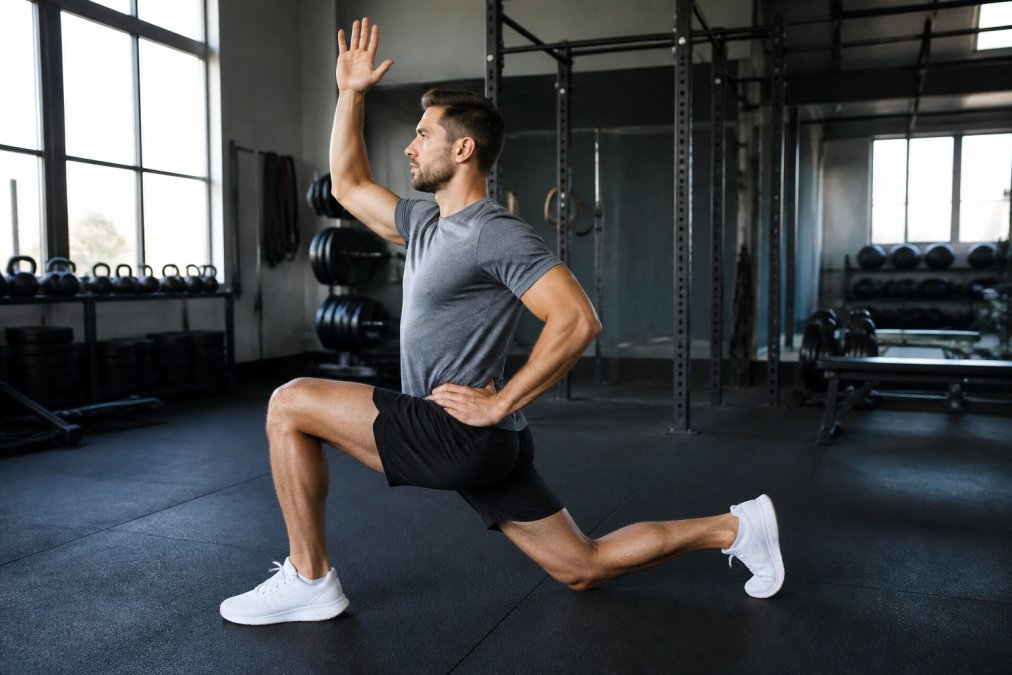
The most effective dynamic warm up for hip flexors combines leg swings, controlled kicks, and lunge variations to target different aspects of hip mobility.
Leg Swings and Controlled Kicks
Forward and Backward Swings: Stand facing a wall and swing one leg forward and back in controlled rhythm, gradually increasing range over 10-12 swings. Keep torso stable; let the hip joint do the work.
Side-to-Side Swings: Stand sideways to a wall and swing your leg across your body and out to the side, controlling both directions. Perform 10-12 swings per side.
High Knees March: Walk forward driving knees toward chest in controlled manner. March 15-20 steps.
Walking Leg Kicks: Take slow walking steps while kicking your leg straight up. Perform 10 kicks per leg.
Half-Kneeling Hip Flexor Stretches with Movement
Half-Kneeling Hip Flexor Stretch with Reach: Kneel on one knee with the other foot forward. Shift weight forward until you feel a stretch in the back of your hip. Reach your arm overhead on the same side as your back leg. Hold for a breath, then return. Perform 8-10 reps per side.
Half-Kneeling with Pelvic Tilt: From half-kneeling, tilt your pelvis under (posterior tilt) to deepen the stretch. This teaches pelvic alignment under load, critical for squats and deadlifts.
Half-Kneeling Rotation: From half-kneeling, rotate your torso toward your front leg while keeping hips square. Perform 8-10 controlled rotations per side.
Lunge Variations for Active Hip Extension
Walking Lunges: Step forward and lower until both knees bend to roughly 90 degrees. Drive through your front heel to stand. Perform 12-15 steps.
Reverse Lunges: Step backward instead of forward. Perform 10-12 per leg.
Stationary Lunges with Overhead Reach: Hold a lunge position and reach both arms overhead. Hold for 2-3 seconds, return to standing, and switch legs. Perform 8-10 per side.
Curtsy Lunges: Step one leg diagonally behind and across your body. Perform 8-10 per side.
Hip Flexor Warm-Up Routine Duration and Frequency
A complete dynamic warm up for hip flexors takes 8-12 minutes for most athletes. The ideal duration and frequency depend on your training context, job, and mobility baseline.
Standard Training Schedule (Gym Athletes)
Perform the full warm-up before every leg day: leg swings and kicks (3-4 min), half-kneeling stretches (2-3 min), lunge variations (3-4 min).
1pc Multifunctional Adjustable Yoga →
If you train legs twice per week, do the complete routine both times. On upper body days, use a shorter 3-5 minute version targeting just leg swings and half-kneeling stretches to maintain hip mobility without fatiguing your system.
Desk-Worker Modification (Sedentary Job)
If you sit 6+ hours daily, sitting chronically shortens the iliopsoas and rectus femoris, requiring additional mobility work beyond a standard warm-up.
Morning Activation (5-7 minutes, before work): Perform leg swings (15 reps per direction), half-kneeling stretches with pelvic tilt (10 reps per side), and walking lunges (12 reps per leg).
Midday Reset (3-5 minutes, lunch or afternoon break): Walk 2-3 minutes, perform leg swings (10 reps per direction), and half-kneeling stretches (5 reps per side).
Pre-Workout Preparation (10-15 minutes, before training): After a full day of sitting, extend the half-kneeling stretches to 4-5 minutes and add 2-3 minutes of walking lunges with longer holds at the bottom position to address accumulated tightness.
Evening Mobility (10-15 minutes, after work or post-workout): Spend 10-15 minutes on static stretching and foam rolling. Hold half-kneeling stretches for 60-90 seconds per side and use a foam roller on your quadriceps and hip flexors for 60-90 seconds per leg. This evening session lengthens muscles shortened all day.
Sport-Specific Frequency Adjustments
Runners: Perform the full dynamic warm-up 4-5 times per week before every run. Runners experience repetitive hip flexor shortening from the running stride, so daily mobility work prevents cumulative tightness. On rest days, perform 5-10 minutes of static stretching.
Weightlifters and Powerlifters: Perform the full routine before every lower body session (typically 2-3 times per week). On upper body days, use the 3-5 minute shortened version. Weightlifters benefit from longer holds in the half-kneeling position (3-5 seconds per rep) to build stability under load.
Martial Artists and Combat Athletes: Perform the full routine before every training session, plus an additional 5-10 minute session on non-training days. Combat sports demand extreme hip mobility and rapid hip flexor engagement. Add rotational movements 4-5 times per week.
Sedentary Athletes (Desk Job + Training): Combine the desk-worker protocol with your sport-specific frequency: morning activation (5-7 min) + midday reset (3-5 min) + pre-workout full routine (10-15 min) + evening mobility (10-15 min) on training days.
Common Mistakes That Reduce Warm-Up Effectiveness
Rushing Through Movements: Performing leg swings or lunges quickly defeats the purpose. Your nervous system needs time to recognize the movement pattern and activate stabilizers. Control each repetition.
When to Modify or Skip: Contraindications and Injury Considerations
A dynamic warm up for hip flexors is safe for most people, but certain conditions require modification, progression, or temporary avoidance.
Hip Labral Tears
Weeks 1-2 (acute phase): Avoid all dynamic hip flexor warm-ups. Perform gentle isometric glute activation: lie on your back, squeeze your glutes for 5 seconds, rest 5 seconds, repeat 10 times.
Groin Strain (Adductor Strain)
Weeks 1-2 (acute phase): Avoid all dynamic movements. Rest and ice. Perform gentle glute activation.
Lower Back Pain (Non-Acute)
Acute phase (pain 7-10/10): Avoid all dynamic hip flexor work. Perform glute activation only. Consult a healthcare provider.
Knee Pain (Patellofemoral Pain, Meniscal Issues)
Acute phase: Avoid all lunge variations. Perform leg swings and half-kneeling stretches only at 50% range of motion.
SI Joint Dysfunction
Acute phase: Avoid all rotational movements (half-kneeling rotations, curtsy lunges). Perform forward/backward leg swings and symmetrical lunges only. Keep your pelvis level and stable.
Recent Surgery (Hip, Knee, or Lower Back)
Weeks 1-4 post-op: No dynamic warm-ups. Follow your surgeon's or physical therapist's protocol only.
General Progression Framework for Returning from Injury
When returning to dynamic warm-ups after any injury, follow this progression:
- Pain-free glute activation only (2-3 days)
- Add leg swings at 50% range (3-5 days)
- Increase leg swings to 75% range (3-5 days)
- Add half-kneeling stretches without movement (3-5 days)
- Add half-kneeling stretches with movement (3-5 days)
- Add walking lunges at 50% depth (3-5 days)
- Increase lunges to 75% depth (3-5 days)
- Return to full standard routine (ongoing)
Frequently Asked Questions
How long should a dynamic warm-up for hip flexors last?
A complete dynamic warm-up for hip flexors typically takes 5 to 10 minutes. Start with 2 to 3 minutes of light cardio to elevate your heart rate, then spend 3 to 5 minutes performing 8 to 12 controlled repetitions of each movement. If you're doing a full-body warm-up, allocate this time as part of your overall pre-workout routine. Quality matters more than duration, focus on controlled, deliberate movements rather than rushing through repetitions.
Why is dynamic stretching better than static stretching before a workout?
Dynamic stretching activates your muscles and increases neuromuscular activation, preparing your body for movement and improving range of motion during exercise. Static stretching, by contrast, temporarily reduces muscle stiffness but can decrease force production if done before heavy lifting. Research shows dynamic warm-ups enhance hip mobility, improve postural alignment, and reduce injury risk during leg day. Save static stretching for after your workout during the cool-down phase.
Can dynamic warm-ups help prevent hip injuries during leg day?
Yes. Dynamic warm-ups increase joint lubrication, improve pelvic alignment, and activate the glute muscles that stabilize the hip joint. By taking your hip flexors through their full range of motion with control, you prepare the iliopsoas and rectus femoris for loaded movement patterns. This reduces compensatory movement and muscle imbalances that lead to injury. Consistent hip flexor warm-up routines also address tightness caused by prolonged sitting, a major injury risk factor.
How often should I perform hip flexor mobility work?
Perform dynamic hip flexor warm-ups before every leg day or lower-body session. If you sit for 8+ hours daily, add 5 minutes of hip flexor mobility work during your lunch break or evening routine to counteract stiffness. Active recovery days can include lighter, longer-duration stretching. Aim for at least 3 to 4 sessions per week of dedicated hip mobility work if you have significant tightness or desk-based work.