

Table of Contents
- Why Runners Get Tight Hip Flexors
- Dynamic vs. Static Stretching: What Runners Should Do First
- Best Hip Flexor Stretches for Runners
- PNF Stretching for Runners: The Contract-Relax Method
- How Long to Hold Hip Flexor Stretches
- Hip Flexor Strengthening Exercises for Runners
- Best Recovery Tools for Tight Hips
- Common Mistakes When Stretching Hips
- Frequently Asked Questions
Last Updated: September 22, 2026
Why Runners Get Tight Hip Flexors
Tight hip flexors in runners are rarely a stretching problem, they are usually a strength and positioning problem. And "tight hip flexors" is not one condition but at least two, each responding to different protocols. Most guides collapse them into a single list of stretches. That is the first thing to fix.
Every stride shortens the hip flexors under load. Distance running keeps the hip in a narrow range of motion for thousands of repetitions, so the iliopsoas and rectus femoris adapt to that shortened position. Add hours of sitting, and the tissue never gets a reason to lengthen. This guide covers the best hip flexor stretches for runners, plus the strengthening work that makes them hold.
The American Council on Exercise notes that prolonged sitting shortens the hip flexors and contributes to anterior pelvic tilt, which alters stride mechanics over time American Council on Exercise on hip flexor tightness.
Sitting-Induced vs. Overuse-Induced Tightness
These two patterns feel similar in the front of the hip but come from opposite directions and need different protocols.
Sitting-induced tightness develops from hours in a flexed-hip position. The tissue is not damaged; it is adapted to a shortened resting length. The hip flexors are often weak in end-range and the glutes are inhibited. The tell: tightness is worst in the morning or after long desk blocks, and eases once you warm up. The protocol is lengthening plus activation, half-kneeling holds paired with glute bridges and dead bugs.
Overuse-induced tightness develops from training load. The hip flexors work hard every stride, and the tissue is genuinely guarded and fatigued rather than just short. The tell: tightness builds through a run, is worse on the side you favor, and comes with a heavy or "locked" feeling at push-off. The protocol is release first, then length, self-myofascial work to reduce resting tone, followed by gentler stretching and a hard look at training volume.
Many runners are both: desk-bound on weekdays and logging high mileage on weekends. They need release work and activation work, in that order, not just more stretching.
The Psoas, Iliopsoas, and Anterior Pelvic Tilt Connection
The iliopsoas is the combined psoas major and iliacus muscle group, the primary hip flexor connecting the lumbar spine to the femur. Because the psoas attaches to the lower spine, its tension directly influences pelvic position.
When the psoas stays short, it pulls the pelvis into anterior pelvic tilt, the forward rotation that arches the lower back. That tilt changes hip extension at push-off and loads the posterior chain unevenly, creating overactive hip flexors on one side and underactive glutes on the other. Hip mobility work for runners must address pelvic alignment, not just the front of the hip.
The practical test: stand relaxed in front of a mirror and check your belt line. If the front dips noticeably below the back, you carry anterior tilt, and every hip flexor stretch needs a deliberate posterior pelvic tilt to be effective.
Dynamic vs. Static Stretching: What Runners Should Do First
Dynamic stretching belongs before a run; static stretching belongs after. Reversing that order is the most common mistake runners make with hip flexor stretches.
Dynamic drills move the joint through full range of motion and raise tissue temperature. Leg swings, walking lunges, and hip circles prepare the hip for running. Static holds work better on warm tissue after your cool-down, when the goal shifts to restoring length.
| Timing | Type | Goal | Example |
|---|---|---|---|
| Before run | Dynamic | Warm up, activate | Leg swings, walking lunges |
| After run | Static | Restore length | Half-kneeling hold |
| Rest day | PNF | Reset tension | Contract-relax |
Best Hip Flexor Stretches for Runners
The best hip flexor stretches for runners combine a half-kneeling position with a posterior pelvic tilt, because that tilt lengthens the psoas rather than just the front of the thigh.
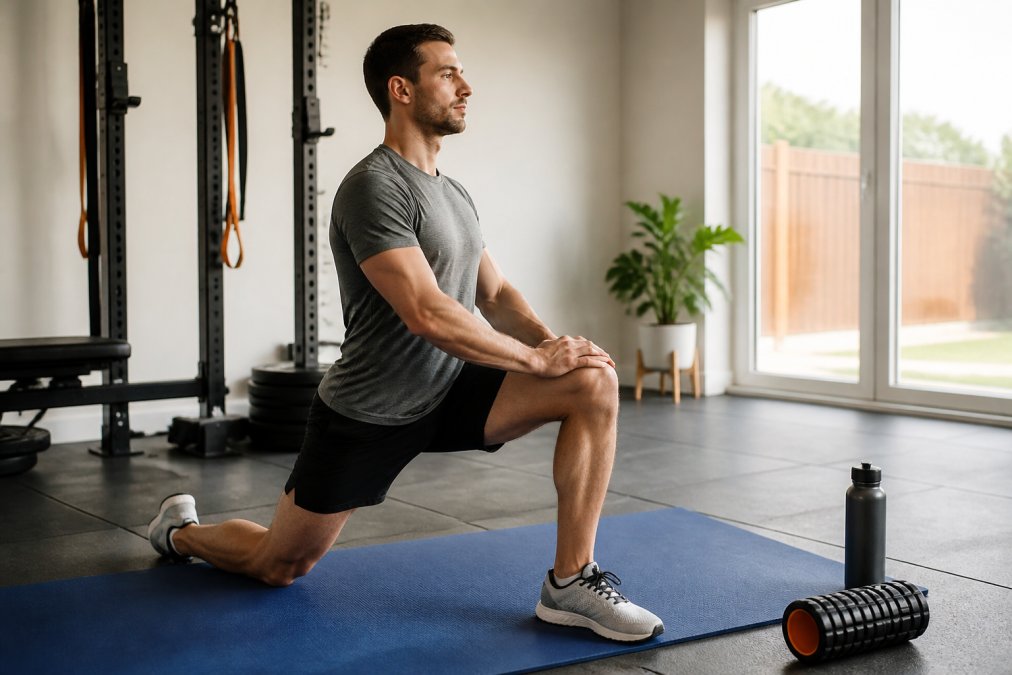
Half-Kneeling Hip Flexor Stretch
The half-kneeling hip flexor stretch is the most reliable position for targeting the iliopsoas. Kneel on one knee, plant the opposite foot forward, then tuck your tailbone under to flatten the lower back. Without that tuck, you arch the spine and bypass the stretch.
Lunge Stretch and Couch Stretch
The lunge stretch is the half-kneeling position with a forward shift, adding a hip extension component that mimics your stride. The couch stretch elevates the back foot against a wall or couch, increasing the stretch on the rectus femoris and joint capsule.
Foam roller Roller For body Relief →
PNF Stretching for Runners: The Contract-Relax Method
Proprioceptive Neuromuscular Facilitation (PNF) uses a contract-relax cycle to reset muscle tension faster than passive holding. It is the single biggest upgrade you can make to a hip flexor routine.
Here is the protocol:
- Set up in the half-kneeling hip flexor stretch.
- Press the down knee gently into the floor and squeeze the glute, contracting the hip flexor against resistance for 5 seconds.
- Relax fully and sink slightly deeper into the stretch.
- Repeat 3 times, then switch sides.
How Long to Hold Hip Flexor Stretches
Hold static hip flexor stretches for 30 to 45 seconds per side, and PNF contractions for 5 seconds each. Longer is not automatically better; consistency beats one long session.
Hip Flexor Strengthening Exercises for Runners
Hip flexor strengthening exercises for runners are the missing half of the equation. A muscle that is only ever stretched never learns to control its new range, so tightness returns within days.
The exercises that matter most:
- Glute bridges: activate the posterior chain and counter anterior pelvic tilt.
- Dead bugs: build core control while keeping the pelvis neutral.
- Standing hip flexion with a resistance band: train the hip flexor through range instead of just lengthening it.
- Split squats: load hip extension and improve functional movement patterns.
Best Recovery Tools for Tight Hips
The best recovery tools for tight hips are ones you will actually use between runs, the tool matters less than the technique. Self-myofascial release before stretching reduces resting tension and makes the stretch more productive, but only if you target the right tissue in the right order. This is the step most runners skip, and it is the difference between a stretch that holds and one that fades by the next run.

The Release-Before-Stretch Protocol
Work in this order: release, then lengthen, then strengthen. Releasing first lowers resting tone so the stretch reaches the psoas instead of stalling at the surface of the quad.
3. Stretch (see the half-kneeling and lunge sections above).
| Tool | Best For | Where to Use It | Price |
|---|---|---|---|
| Foam roller | Body relaxation | Quads, TFL, IT band | $81.06 |
| Foam massage roller | Muscle recovery | Glutes, hamstrings | $81.07 |
| Massage gun | Deep tissue relaxation and recovery | Quads, glutes, calves | $75.76 |
| Massage ball | Psoas region | Front of hip, inner hip bone | , |
| Yoga knee pad | Protecting the down knee | Half-kneeling and lunge positions | $9.70 |
Common Mistakes When Stretching Hips
The most common mistake when stretching hips is chasing the stretch in the lower back instead of the front of the hip. If you feel it in your spine, you have lost the pelvic tuck and the psoas is not lengthening.
Other mistakes worth fixing:
- Holding your breath, which increases tension instead of releasing it.
- Stretching cold before a run instead of after.
- Skipping the strengthening work, so the tightness returns.
- Bouncing in and out of the stretch rather than holding steady.
- Ignoring one side; most runners have a dominant side that needs more attention.
Frequently Asked Questions
Is it okay to run with tight hip flexors?
You can often run with mild tightness, but sharp pain, a pinching sensation in the front of the hip, or a shortened stride means you should back off. Tight hip flexors change your pelvic tilt and stride mechanics, which can load the lower back and knees. Try a dynamic warm-up before the run and a short static or PNF session after. If pain persists past a few days, see a physical therapist before adding mileage.
What is the fastest way to loosen tight hip flexors?
Start with a half-kneeling hip flexor stretch held for 30-60 seconds per side, then follow with a couch stretch or lunge stretch. Pair that with body relaxation using a foam roller on the quads and hip area, which may improve range of motion before you stretch. A massage gun for deep tissue relaxation and recovery on the quad and upper thigh can also help. Consistency matters more than any single session.
How often should runners stretch their hip flexors?
Most runners do well with hip flexor stretches four to six days a week, holding each position 30-60 seconds per side. Static and PNF work fits best after a run or as a separate session. Dynamic hip mobility belongs in your warm-up. If you sit at a desk all day, add a short midday stretch break to counter prolonged hip flexion.
What are the signs of weak hip flexors?
Common signs include difficulty lifting your knee above hip height, a lagging drive phase on hills, and lower back or hip discomfort after runs. Weak hip flexors often pair with an overactive psoas and poor glute activation, creating a muscle imbalance. Hip flexor strengthening exercises for runners, like banded marches and standing knee drives, help restore balance alongside your stretching routine.