


Last Updated: October 25, 2026
Quick Summary
To stay motivated with home workouts, build a system that makes starting easy and stopping hard instead of relying on willpower. Set a specific, achievable goal you can hit in 4-6 weeks, keep sessions to 20-45 minutes, and add accountability so someone notices when you skip. Never miss twice, and restart after a missed week with a 10-minute session rather than guilt.
- Set a goal with a number, a deadline, and a personal reason, and pick one you can reach in 4-6 weeks.
- Start with three days a week, keeping each session short, repeatable, and hard to skip.
- Keep home workouts to 20-45 minutes and match session length to your worst weekday, not your best.
- Use the two-minute rule and never miss twice to stay consistent when nobody is watching.
- Cap accountability at three layers, such as a scheduled event, a visible record, and a weekly review.
Table of Contents
- Why Home Workouts Lose Momentum (And What Actually Fixes It)
- Step 1: Set Exercise Goals You Can Actually Hit
- Step 2: Build a Home Workout Routine for Beginners
- Step 3: How Long Should a Home Workout Be?
- Step 4: How to Stay Consistent With Working Out at Home
- Step 5: Workout Accountability Ideas That Don't Require a Gym
- Step 6: Track Progress Beyond Weight and Appearance
- Step 7: Restart After a Missed Week Without Guilt
- Frequently Asked Questions
Why Home Workouts Lose Momentum (And What Actually Fixes It)
Home workouts fail for a boring reason: the friction is invisible until it wins. There's no commute to a gym, no class start time, no trainer waiting.
The fix isn't more willpower. It's building a system that makes starting easy and stopping hard.
This guide walks you through seven steps. Each one targets a specific leak in the motivation bucket. Below, we'll show you exactly how to stay motivated with home workouts when nobody is watching.
Step 1: Set Exercise Goals You Can Actually Hit
Most people quit because their goal was never realistic. "Get in shape" is a wish, not a target. A goal you can hit has three parts: a number, a deadline, and a reason that matters to you personally.
Try this filter before you commit:
- Specific: "Do 10 push-ups without stopping" beats "get stronger"
- Achievable: Pick something you can reach in 4-6 weeks, not 6 months
- Personal: Tie it to something you care about, like keeping up with your kids
Write your goal down and put it where you train. A goal on paper gets done more often than a goal in your head.
Find the Personal Reason Behind the Goal
Competitors tell you to "find your why" and stop there. That's not actionable. A personal reason only works when it's specific enough to answer one question on a bad day: What will I lose if I skip this?
Run your goal through this three-question test:
- Who else is affected? "I want to keep up with my grandkids at the park" is stronger than "I want to be healthier" because skipping has a visible cost.
- What does the reason connect to? A reason tied to a real event (a trip, a birthday, a doctor's appointment) creates a deadline your brain respects.
- Would you say it out loud? If the reason feels embarrassing or vague when spoken, it won't survive week three.
A common pattern among people who stick with home training: their goal is tied to a role they play for someone else, not a number on a scale.
Set a Process Goal and an Outcome Goal
Outcome goals (a number on the scale, a clothing size) are outside your direct control. Process goals (sessions completed, minutes trained) are entirely inside it. Set one of each, and make the process goal the one you check daily.
| Goal Type | Example | When You Check It |
|---|---|---|
| Outcome | Do 10 push-ups without stopping by week 6 | Every 2 weeks |
| Process | Train 3 times this week | Every Sunday |
| Identity | "I'm someone who trains at home" | Reframe after each session |
The 4-6 Week Rule
Pick a goal you can reach in 4-6 weeks. Longer horizons invite drift, and drift is what kills home routines. When you hit the 6-week mark, set a new goal from where you actually are, not from where you hoped to be. This keeps the target close enough to feel real and far enough to require effort.
Write your goal down and put it where you train. A goal on paper gets done more often than a goal in your head, and a goal with a name attached to it gets done even more.
Step 2: Build a Home Workout Routine for Beginners
A beginner routine should be short, repeatable, and hard to skip. That's it. Complexity kills consistency.
Start with three days a week. Each session needs a warm-up, two or three strength movements, and a short cool-down. Bodyweight exercises cover the basics: squats, push-ups, lunges, planks, and glute bridges. Add light dumbbells when bodyweight gets easy.
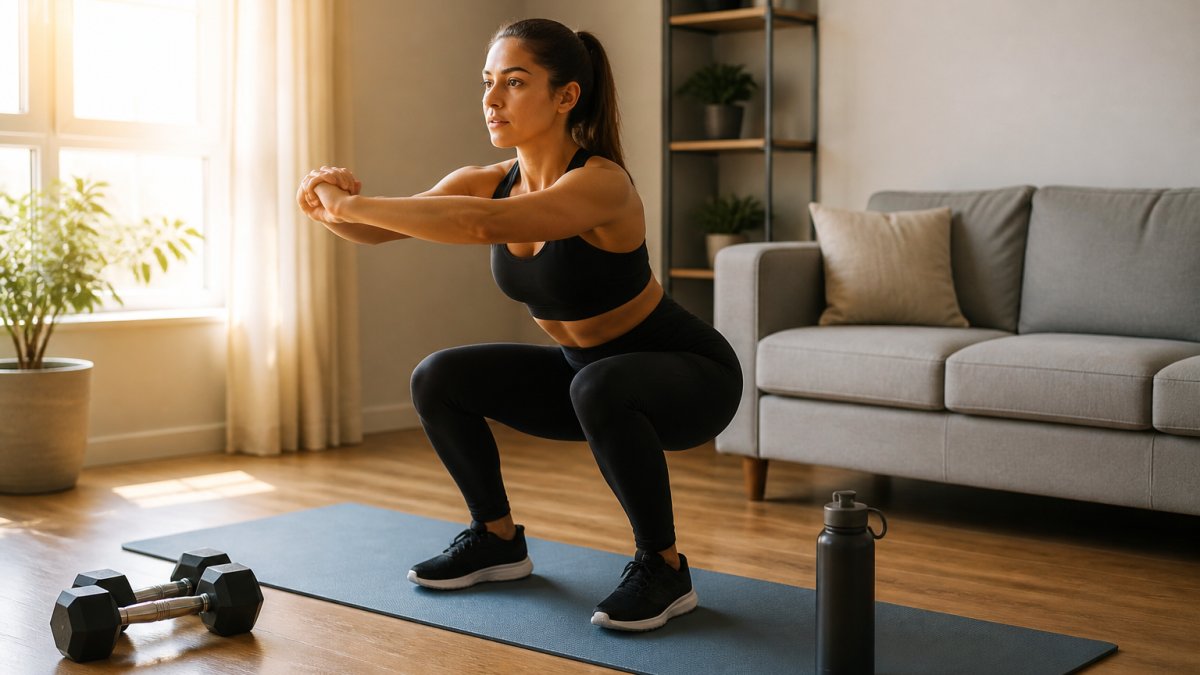
If you're unsure where to start, our guide to digital fitness programs for beginners covers how to pick a program that matches your level. And before you buy any weights, read up on how to choose the right dumbbell weight so you don't overshoot on day one.
A Simple 3-Day Starter Split
- Day 1: Squats, push-ups, plank (3 rounds)
- Day 2: Rest or a 20-minute walk
- Day 3: Lunges, rows, glute bridges (3 rounds)
Want more detail on building that middle session? Here's how to structure a full-body strength workout without overcomplicating it.
Step 3: How Long Should a Home Workout Be?
A home workout should run 20-45 minutes for most people. Shorter sessions beat skipped sessions every time. Twenty focused minutes done four times a week outperforms one 90-minute session you dread.
The real question isn't optimal length. It's what you'll actually do on a bad day.
Matching Session Length to Your Real Schedule
| Time Available | Session Type | What to Do |
|---|---|---|
| 10 minutes | Micro-session | One circuit, 2 rounds |
| 20-25 minutes | Standard | Warm-up, 3 exercises, cool-down |
| 35-45 minutes | Full session | Warm-up, 4-5 exercises, finisher |
| 60+ minutes | Optional | Add mobility or a longer walk |
Pick the length that fits your worst weekday, not your best one.
Step 4: How to Stay Consistent With Working Out at Home
Consistency comes from lowering the bar, not raising your effort. The people who stay consistent with working out at home make starting ridiculously easy. Shoes by the mat. Clothes laid out. A playlist queued.
Here's what actually moves the needle:
- Same time, same place. A fixed slot removes the daily decision
- Two-minute rule. Commit to two minutes. You'll usually keep going
- Stack the habit. Work out right after coffee or right before your shower
Watch out: chasing perfect weeks is the fastest way to quit. A messy 15-minute session still counts.
Step 5: Workout Accountability Ideas That Don't Require a Gym
Accountability works best when someone expects you to show up. It doesn't need a gym or a paid trainer. It needs a person, a plan, or a deadline.
Try one of these workout accountability ideas:
- A workout buddy who texts you before and after
- A shared calendar with a friend doing the same program
- A weekly check-in with a partner or roommate
The common thread: someone notices when you skip. That's enough.
Why Accountability Actually Works
Accountability isn't magic. It works through two mechanisms: anticipated social cost (you don't want to explain a skip to someone who asked) and external structure (a scheduled event removes the daily decision).
That's why a standing 7 a.m. video call with a friend beats a vague "text me when you work out" agreement. The call happens whether you feel like it or not; the text depends on you remembering to send it.
Match the Accountability Type to Your Barrier
One-size-fits-all accountability advice fails because people skip for different reasons. Pick the setup that targets your actual barrier:
| Your Barrier | Best Accountability Setup | Why It Works |
|---|---|---|
| Low energy | A scheduled live class or video session | The start time carries you past the energy dip |
| Boredom | A buddy doing the same program | Shared progress gives you something to talk about |
| Limited space | A partner who trains in the same room | Two people in a small space forces a short, focused session |
| Caregiving demands | A 15-minute check-in with another caregiver | The window is short, so it fits around duties |
| Preference for solitude | A private log shared with one person | You get the social cost without the crowd |
Build a Home Accountability Stack
The most reliable setup combines three layers, each cheap to maintain:
- A scheduled event. A recurring video workout, a live class, or a walk with a neighbor at a fixed time.
- A visible record. A paper calendar on the fridge or a shared spreadsheet. Visible streaks create their own pressure.
- A weekly review. Five minutes on Sunday: what got done, what got skipped, what changes next week.
Low-Cost and No-Cost Options
You don't need to pay for accountability. A neighbor who walks at the same time each morning, a sibling on a video call, or a group chat with a shared weekly goal all work. If you do pay, the value is in the schedule, not the price, a $0 standing appointment beats a $50 program you never open.
Step 6: Track Progress Beyond Weight and Appearance
The scale lies on a weekly basis. It moves for water, salt, sleep, and stress. If weight is your only scoreboard, you'll quit during a perfectly good training block.
Track these instead:
- Reps and load. More push-ups or heavier dumbbells is progress
- Energy levels during and after sessions
- Sleep quality and resting heart rate
A fitness tracker makes this easy. The MOLED Fitness Tracker Black logs heart rate, SpO₂, sleep, and activity through the Mi Fitness app, which gives you a progress picture beyond the scale. The MOLED Fitness Tracker Black logs heart rate, SpO₂, sleep, and activity through the Mi Fitness app, which gives you a progress picture beyond the scale. If you notice one side lagging, our guide on fixing uneven muscle growth from home workouts explains what to adjust.

Step 7: Restart After a Missed Week Without Guilt
Everyone misses a week. The people who succeed restart fast and skip the punishment. Guilt adds friction, and friction is what killed the habit in the first place.
Use this restart script:
- Pick today, not Monday
- Do a 10-minute session, nothing more
- Return to your normal schedule the next session
- Don't "make up" missed workouts by doubling up
- Review what caused the gap and remove one obstacle
A missed week is data, not a verdict. Restart small and keep the streak alive.
Frequently Asked Questions
Why is it so hard to stay motivated to work out at home?
Home workouts compete with everything else in your house: the couch, the TV, laundry, and family members. There is no commute to a gym and no trainer waiting for you, so the decision to start falls entirely on you. That friction is the real problem, not willpower. The fix is to lower the barrier: set out your gear the night before, pick a fixed time, and keep sessions short enough that starting feels easy. Once the first five minutes pass, momentum usually takes over.
How long should a home workout be for a beginner?
Twenty to thirty minutes is enough for a beginner, three to four days a week. That window covers a warm-up, two or three sets of bodyweight exercises, and a cooldown without wiping you out. Longer sessions are not automatically better; a 20-minute routine you complete four times a week beats a 60-minute plan you abandon after five days. As your fitness level rises, add five to ten minutes or an extra set rather than jumping straight to an hour.
What are some workout accountability ideas that work at home?
Try a weekly check-in text with a workout buddy, a shared calendar where you log completed sessions, or a paid class series with a set start time so skipping feels like wasting money. You can also schedule sessions with a family member who trains at the same time in another room. Public commitment helps too: post your weekly plan where friends can see it. The common thread is that someone else notices whether you showed up.
How do I restart home workouts after falling off for a few weeks?
Cut your old routine in half for the first week. If you were doing 40-minute sessions, start with 15 to 20 minutes at a lighter effort, and aim for two sessions before adding a third. Skip the guilt and skip the urge to overcompensate with a punishing week. Rebuild the habit first, then rebuild the volume. Most people who restart successfully treat the first week as a re-entry, not a test of how much fitness they lost.
Staying motivated with home workouts comes down to one thing: making the next session easier to start than to skip. That's where Bodyhackfitness fits in. We stock training and recovery gear plus digital fitness programs built to keep you moving, from trackers that show real progress to equipment that fits your space. Shop now and build the home setup that makes showing up the easy choice.
